Printed circuit board

dl324

Joined Mar 30, 2015
18,337
0.035" is right for many small components. It is the size I specify most often. 0.042" is the next larger size that I use quite often.
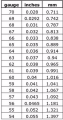
I use 0.0292" for most components to leave more copper for the pad. 0.035" for TO-220 leads and 0.025" square header pins; 0.041 for pots (Beckman 8339M style with tapered leads).

upload_2018-2-20_8-48-45.png
 

ebp

Joined Feb 8, 2018
2,332
My boards are almost all double sided with plated through holes, sometimes on thick (3/32") laminate, sometimes with 4 ounce finished copper. Holes smaller than 0.035" for things like resistors and small capacitors make it much harder to remove parts quickly and efficiently. If a square pin actually firmly contacts the barrel of the plated through hole, there is high probability of damage to the barrel in trying to remove the pin. Plated through holes make a small annulus less of concern. I typically use 0.060" round pads for small parts. Small holes also make both manual and machine insertion of parts more difficult. Often it is necessary to use "oversize" holes because of broad tolerance of pin position. Things you can get away with on hobby boards are often unacceptable on production boards.

I once replaced a large number of electrolytic capacitors on a compaq motherboard. I have multiple soldering irons with all manner of tips, hot air toois and power vacuum desoldering equipment. The cap leads connected to inner layers of copper on the PCB, the holes were not much bigger than the leads and the pads were small. It was unbelievably difficult to get the caps out. Larger holes would have helped because there would be more copper to get heat to the inner layers.
 

Thread Starter

Arjune

Joined Jan 6, 2018
354
after drilling the board and soldering the parts the 4511 display drivers and displays worked. I used wire wrap IC sockets that spread with lead spread apart for more space. there was minimal soldering area on the pads with the 1/16 in bit and I don't have a smaller one but the holes were a good size for the wire wrap sockets. the etchant solution is brown so it must be ferric chloride. I have to proceed to the counters for the clock now. I did not use a Sharpie industrial but I think that would be better.
IMG_20180221_210453.jpg
 

Janis59

Joined Aug 21, 2017
1,894
RE:""dl324 AAC Fanatic! Mar 30, 2015""
Your picture shows absolutely too large drilling places and absolutely too small a copper patches around them. At soldering process they will like to deglue.

Try to apply the 0,6 mm instead of 0,8 mm drill, and patch ought to be at least 3 or better 4 mm long.
 

dl324

Joined Mar 30, 2015
18,337
Your picture shows absolutely too large drilling places and absolutely too small a copper patches around them. At soldering process they will like to deglue.
The board turned out fine. I use toner transfer and I apply heat/pressure until the holes are almost closed. I've never had problems with traces becoming unglued.

EDIT: Well, I did once. I was solder plating some SMT pads before installing components and sucked up one while removing the excess solder. Fortunately, it was an unused pad for a diode in a SOT-23 package. I was more careful after that.
 
Last edited:

Thread Starter

Arjune

Joined Jan 6, 2018
354
RE:""dl324 AAC Fanatic! Mar 30, 2015""
Your picture shows absolutely too large drilling places and absolutely too small a copper patches around them. At soldering process they will like to deglue.

Try to apply the 0,6 mm instead of 0,8 mm drill, and patch ought to be at least 3 or better 4 mm long.
Are you trying to change the physical structure because I have a problem believing you.
 
Top