Power switching loss how can a switch behave like this?

Thread Starter

Samantha Groves

Joined Nov 25, 2023
152
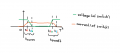
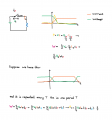
I am studying power switching losses and before I even began reading , I had conceptually visualised how the switch would behave.Suppose you have a circuit with a voltage source,a switch and a load,well it takes time for the voltage over the switch to change and so does the current , but as the voltage over the switch rises the current through the switch drops.

So I came up with this analysis:
null (15).png

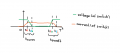
However some controlled switches(MOSFETs) behave like this diagram:
1720361036688.png
How can any switch behave like this under pulsation control voltage/current?I am utterly confused.
 

Papabravo

Joined Feb 24, 2006
22,058
I am studying power switching losses and before I even began reading , I had conceptually visualised how the switch would behave.Suppose you have a circuit with a voltage source,a switch and a load,well it takes time for the voltage over the switch to change and so does the current , but as the voltage over the switch rises the current through the switch drops.

So I came up with this analysis:

View attachment 326362

However some controlled switches(MOSFETs) behave like this diagram:

View attachment 326363
How can any switch behave like this under pulsation control voltage/current?I am utterly confused.
How would you like it to behave?
 

ronsimpson

Joined Oct 7, 2019
4,647
Assuming a simple circuit like in post #1 with a battery, switch, and resistor.
Assuming there must be voltage across a resistor before current can flow.
In this picture you show current climbing when there is no voltage across the resistor. This cannot happen.
Also, it appears there is current flowing when the voltage across the resistor is near zero. No.
1720365576833.png
My view is that a MOSFET is like a voltage variable resistor. The MOSFET has 0.01 ohms closed and 10 mega ohms when open.
It takes time for the switch to open or close.
Assume the load resistor is 10 ohms.
As the MOSFET moves from 0.01 ohms to 10 mega ohms there is a point in time where the MOSFET=10 ohms. At that time 1/2 the voltage is across the switch and 1/2 is across the resistor so the current is 1/2 of the battery.

This is for resistive loads. Inductive and capacitive loads change things. We can talk about that later.
 

crutschow

Joined Mar 14, 2008
38,321
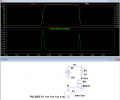
Below is the LTspice sim of a simple MOSFET switch:
The green trace shows the instantaneous dissipation in the switch as it transitions between the off and on conditions, where it is acting as a fast changing, variable resistor, going from near infinite impedance to near zero impedance.
Note that, as expected, the peak power occurs at the half-way point for the current and voltage where the MOSFET resistance equals the load resistance.

1720368704802.png
 
Last edited:

ronsimpson

Joined Oct 7, 2019
4,647
I have been working with inductive loads. (transformers or inductors) A charged up inductor is like a constant current source. The current flow continues all through the voltage transitions.

When I study MOSFETs I want to see how they switch with resistive loads and inductive loads.
 

Thread Starter

Samantha Groves

Joined Nov 25, 2023
152
Assuming a simple circuit like in post #1 with a battery, switch, and resistor.
Assuming there must be voltage across a resistor before current can flow.
In this picture you show current climbing when there is no voltage across the resistor. This cannot happen.
Also, it appears there is current flowing when the voltage across the resistor is near zero. No.
View attachment 326367
My view is that a MOSFET is like a voltage variable resistor. The MOSFET has 0.01 ohms closed and 10 mega ohms when open.
It takes time for the switch to open or close.
Assume the load resistor is 10 ohms.
As the MOSFET moves from 0.01 ohms to 10 mega ohms there is a point in time where the MOSFET=10 ohms. At that time 1/2 the voltage is across the switch and 1/2 is across the resistor so the current is 1/2 of the battery.

This is for resistive loads. Inductive and capacitive loads change things. We can talk about that later.
Yes!The MOSFET has some parasitic capacitance between Drain and Source due to the built in diode for reverse polarities.
 

crutschow

Joined Mar 14, 2008
38,321
Yes!The MOSFET has some parasitic capacitance between Drain and Source due to the built in diode for reverse polarities.
That diode is not separate but is intrinsic in the building of a MOSFET.
It is a parasitic structure and you can't build a MOSFET without it.
It's only relation to reverse polarities is that it will conduct when the drain-source voltage is reversed (which can be useful for protection against inductive spikes in a bridge circuit).
 
Top