Facebook
 Google
 GitHub
 Linkedin

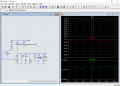
I gave you the answer in a previous post. What is the open loop gain of an LT1013? If your reference is at 4.5 volts and the voltage divider is at 4.501 volts, what is the output of the OpAmp? That's right it goes to the rail. What happens if the output of the voltage divider is 4.499 volts. Yup, it goes to the other rail. This is called bang-bang control and it is a notorious introducer of non-linear oscillations. In your case what you have is called a limit cycle. They are characterized by the non sinusoidal appearance of the oscillations. If you could get a phase plane plot you could see it clearly.Thanks.
I will play with it and see if I can break it.
I am wondering if you have an idea why the original circuit had the sawtooth oscillation.
Looking back, I am thinking that the culprits might be the huge input capacitance of M3 in combination with the high value of R1 as well as the high output capacitance load. I suspect that either removing the 47 uF cap or at least putting a small resistor in series with it might help.
Along similar lines, do you think that using a faster op-amp would allow smaller values for your compensation network?

A faster OpAmp would -- probably make the situation worse.
\(A_{VOL}\;=\;8 \times 10^6\;=\;138\;\text dB\)
The rail to rail range around the threshold is ±1.875 μV. Any output from the voltage divider within 1.875 μV of the 4.5V reference will surely cause oscillation.
Final suggestion: How about summing the reference and the voltage divider with a gain of 3 to 4 instead of 8 million
Last edited: