Power supply pulling too many amps?

Thread Starter

yero1

Joined Oct 25, 2024
4
Beginnner with electronics just trying to understand how things work.

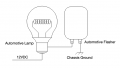
I have laptop power suppy which is hooked up to a 12v cigarrette lighter socket in a car. The power supply connects its positive wire to one terminal of a car flasher and its negative wire to the other. When I plug in the output to the socket, it blows a 20a fuse on the 12v output. What is happening here? Apologies if this is a stupid question.pwr.png

 

WBahn

Joined Mar 31, 2012
32,702
Would need a lot more information about the flasher, but most flashers I have worked with were intended to go in series with a load (such as the turn signal lamps) and acted as a pulsing switch which, like a good switch, looks like a short circuit when it is closed.

This begs the question of why you are doing this in the first place?
 

Thread Starter

yero1

Joined Oct 25, 2024
4
This begs the question of why you are doing this in the first place?
Just the materials I have available.

The flasher is a 12v 25a (max) flasher.

I just don't understand the mechanics of why the fuse on the output is blowing. Is it because too many amps are flowing into the output or the power supply is pulling too many amps, or the flasher?
 

crutschow

Joined Mar 14, 2008
38,316
The flasher closes contacts when it flashes, so it shorts the output of the power supply, which then draws sufficient current to blow the fuse.

Planning any other fun electrical projects that make no sense? :rolleyes:
 

Thread Starter

yero1

Joined Oct 25, 2024
4
The flasher closes contacts when it flashes, so it shorts the output of the power supply, which then draws sufficient current to blow the fuse.
Why does the power supply draw more current than it is supposed provide. The power supply says it provides 8a.
 

Papabravo

Joined Feb 24, 2006
22,058
Why does the power supply draw more current than it is supposed provide. The power supply says it provides 8a.
Ohms Law. What do you think you mean by "supposed to provide?" What is the current at 19VDC through a 0.1Ω resistance. If you answered 190 Amperes that would be correct. This condition will only last long enough for the fuse to blow or the power supply to shut down due to overcurrent.
 

Thread Starter

yero1

Joined Oct 25, 2024
4
Ohms Law. What do you think you mean by "supposed to provide?"
I'm thinking I plug in the power supply, set it to output 8a foward and all it does is draw 8a from the input socket. In other words, I'm expecting the power supply to set up enough resistance to only move 8a foward. This is where I'm missing information on how things work.
 

Papabravo

Joined Feb 24, 2006
22,058
I'm thinking I plug in the power supply, set it to output 8a foward and all it does is draw 8a from the input socket. In other words, I'm expecting the power supply to set up enough resistance to only move 8a foward. This is where I'm missing information on how things work.
Yes, indeed that is not how power supplies work. MOST power supplies are designed to output a constant voltage. They would work happily if the current drawn by the load is between 0 Amperes and some maximum value. The actual current drawn by a power supply is COMPLETELY determined by the load. If the maximum is 8 Amperes, but the load only requires 100 milliamperes, then 100 milliamperes is all the current that the power supply will provide to that load at the constant voltage. Period, full stop.

Some power supplies can be setup to operate in CONSTANT CURRENT mode. They do this by adjusting the output voltage for the load in such a way that Ohm's Law is not violated. For example, suppose I have a 0.1Ω resistor and I want to put 8 amperes through it from a Constant Current power supply. The only possible voltage that can appear across that resistor is 0.8 Volts.
 

boostbuck

Joined Oct 5, 2017
1,032
Why does the power supply draw more current than it is supposed provide. The power supply says it provides 8a.
The power supply likely says it is capable of supplying 8A at the voltage it is designed to output.

That doesn't mean it is LIMITED to 8 amps (although some are current limited). Without current limit as part of its design, it will put out as much as it can and more into a short circuit (which is what your flash is, when it flashes).

If you keep up with this experiment, you will blow up the power supply. Even with a fuse protecting it, repeated overloads will kill it soon enough.
 

MisterBill2

Joined Jan 23, 2018
27,164
The drawing in post #1 makes no sense at all!!!
In addition, as already stated, a two pin flasher is a switch that closes a connection between the two terminals. it is not ever intended to connect across a voltage supply. NOT EVER!!
And the "experiment" does not make a bit of sense at all.
 

Tonyr1084

Joined Sep 24, 2015
9,744
It blows the fuse because it's a dead short.
Screenshot 2024-10-26 at 6.35.19 AM.png
The right way to wire a flasher into a 12 volt circuit is to wire it in series. Give me eight min's and I'll bang out a drawing of the typical flasher circuit.
 
Last edited:

Tonyr1084

Joined Sep 24, 2015
9,744
Screenshot 2024-10-26 at 6.42.50 AM.png
Current must pass THROUGH the flasher in order to make the bulb flash.
The way you show it drawn you're putting +12VDC directly into one lead and the other lead is connected to negative. That's a direct short.
 

WBahn

Joined Mar 31, 2012
32,702
I'm thinking I plug in the power supply, set it to output 8a foward and all it does is draw 8a from the input socket. In other words, I'm expecting the power supply to set up enough resistance to only move 8a foward. This is where I'm missing information on how things work.
What would you expect to happen if you put a crowbar across a car battery? Lots of current will flow. Lots.

The rating on the power supply is how much it will draw (or deliver, depending on whether you are looking at the input or the output rating) when it is operated at the edge of it's rated range of operation. How it behaves if you try to force it to operate beyond that is anyone's guess. One supply might go into a limiting mode where it drops the voltage to prevent excess current, while others might just do their best to deliver as much current as they can until something melts or catches fire.
 

WBahn

Joined Mar 31, 2012
32,702
Just the materials I have available.

The flasher is a 12v 25a (max) flasher.

I just don't understand the mechanics of why the fuse on the output is blowing. Is it because too many amps are flowing into the output or the power supply is pulling too many amps, or the flasher?
So... just because you have a flasher and a power supply you feel the need to connect the flasher directly across the power supply?

I hope you never find yourself in a room having only a knife and a puppy.
 

BobTPH

Joined Jun 5, 2013
11,463
Tell us what you expected the flasher to do when hooked up as you did. Then maybe we can help you accomplish whatever it is.
 

MisterBill2

Joined Jan 23, 2018
27,164
I seem to recollect many years ago some kid soldered a detonator into a transistor radio as an experiment and do himself terrible damage when he turned it on.
Electrical blasting caps do look like electrical stuff.
And just a few weeks ago a whole bunch of folks suffered from exploding walkie-talkies. I think it was bad batteries.
 
Top