Uncomplicates the schematic until you find 8 decoupling capacitors and 9 chips.uncomplicates
There are other reasons for paralleling caps, besides the bad schematic-drafting practices already mentioned: You can sometimes get better performance by paralleling more smaller caps than by using one large one. It depends on what you are doing, and on the properties of the caps. For example, you might get a lower effective ESR (Equivalent Series Resistance) by paralleling, than you would with one larger cap. Or maybe you could need multiple caps at different distances from a device, to get a spread of trace inductances, or even to parallel the trace inductances to attempt to reduce the effective inductance. It could also sometimes be cheaper to use multiple smaller caps than using one larger one. And sometimes redundancy might be a good thing, too.Hi,
I see a lot of decoupling capcitors connected in parallel on power rails . I would like to know why they choose to do this? Why not have 1 capacitor instead? How does it help?
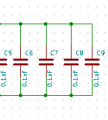
View attachment 92477
The difficulty that brought Rock_Slate here is that his schematic was NOT annotated, and that is what I'm calling, "bad". There are plenty of schematics that only show a row of small caps with no instructions about where they are physically located.in those cases, would annotate that they should go as close as possible to such-and-such component,
It would seem that, "time to market" can be so paramount for some manufacturers that they don't take the time to annotate at all.(time to market was paramount in that business).
This is where I think I really benefited from doing IC design before I did large board design. On an IC, you do NOT try to put everything on one page or to make it flat in any way shape or form. Not when there are tens of thousands of transistors on even a tiny IC and many millions on a large one. You make your design very hierarchical and your top level design consists of your I/O pads. Even these tend to be in the form of several functional blocks because an IC might have several hundred I/O pins.I am going to have to disagree with a few people here. When you have a 21 layer board with every square centimeter populated, there will be 20 to 30 pages of schematics for it. I learned to appreciate that drafting put the decoupling caps on one or two pages. I also appreciate when they put the I/O connectors on separate pages. So, what am I saying? A four layer board with 40 components is one thing, a 21 layer board with 800 components is another. When the board is HUGE you have to make concessions to keep it simple otherwise the schematics become unreadable.