Would make the diagram a mess. it's not a database, just enough information to understand the circuit is usually enough.
A BOM (Bill-of-materials) document would contain all the details about the parts.
Sometimes it is, at least for some parts. Depends on what the purpose of the schematic is. If it is a working schematic (i.e., not something like a final schematic for a product), then there might not be much information beyond the schematic, in which case information deemed significant will likely be denoted on the schematic. But for final schematics, there is usually a bill of materials that should have all of the information needed to order the parts. There's a LOT of information that might be important, such as footprint information, connector details, needed spacing to other components, orientation of some components, thermal management information, the list goes on. If all of that were crammed onto the schematic, it would be unusable.
Would make the diagram a mess. it's not a database, just enough information to understand the circuit is usually enough.
A BOM (Bill-of-materials) document would contain all the details about the parts.
Capacitors tend to have both capacitance and voltage, especially if they are electrolytic.
Resistors may have a specified power rating if it is anything unusual. Most resistors will be the smallest power rating available. If a 1W resistor were required, it will often be specified on the diagram (but there's no guarantee)
Most schematics are not intended for a hobbyist to be able to build the circuit, they are meant for the manufacturer to be able to design and, later, produce the product and possibly for testing and/or service personnel. Those people will all have access to any additional documents needed to do their job. If you want to build it yourself from just the schematic, welcome to the exciting, rewarding, and frustrating world of reverse engineering.
Capacitors tend to have both capacitance and voltage, especially if they are electrolytic.
Resistors may have a specified power rating if it is anything unusual. Most resistors will be the smallest power rating available. If a 1W resistor were required, it will often be specified on the diagram (but there's no guarantee)
You could examine the circuit and do a quick analysis of the power dissipated by each component.
You can also enter the circuit into a circuit simulator and calculate the power dissipated.
In a large percentage of hobby circuits, the power dissipated in the resistor is less than 0.1W. For example, 20mA times 5V is 100mW. Hence ¼W resistors will be adequate.
As for another example on device specifications, every electronic component has a maximum operating voltage. You rarely see this posted in the circuit schematic except for electrolytic capacitors.
The trick is to figure-out what the designer of the Circuit was thinking,
and exactly how and why the Circuit works.
To do that You have to know how each Component works,
and how each Component interacts with all of the other Components.
Also, there is normally a "flow" in the Circuit from the Input to the Output,
which is "usually" from Left to Right, ( when practical ), it may also depend on
the competence of the person drawing the Schematic,
and how much care he puts into it's creation.
The Voltage-Level, and the expected Current-Level,
and therefore the amount of Power or Wattage,
at any particular point in the Schematic,
start to become obvious when You gain an understanding of how the Circuit works.
Learning the inherent idiosyncrasies of the component types used, or specified in the Circuit,
comes with hands-on experience with those particular types of devices.
.
.
.
That's what hobbyist magazines are for - the circuits have all the gnarly details have been worked out for those with less skills, hence are 'projects'.
That's what hobbyist magazines are for - the circuits have all the gnarly details have been worked out for those with less skills, hence are 'projects'.
Magazines with schematics, In my experience, also put a BOM / information as well. It may be a note on lines of "all resistors 1/4 watt, unless other wise stated" but its there
It schematics of boards that are not aimed at the hobbyist , that have missing information, which I'd say is often done to prevent minimise the possibility of copyright encroachment,
You could examine the circuit and do a quick analysis of the power dissipated by each component.
You can also enter the circuit into a circuit simulator and calculate the power dissipated.
In a large percentage of hobby circuits, the power dissipated in the resistor is less than 0.1W. For example, 20mA times 5V is 100mW. Hence ¼W resistors will be adequate.
As for another example on device specifications, every electronic component has a maximum operating voltage. You rarely see this posted in the circuit schematic except for electrolytic capacitors.
All simulators that can do voltage drop across a component and current through a component are by definition of w = v *a , able to give you power
Some easier than others. .
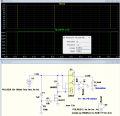
The free analog simulator LTspice from Analog Devices will plot the instantaneous dissipation of any component if you put the cursor over the component and press ALT/Left-Click, after a transient analysis has been run.
Then you can put the cursor over the plot title and press CTRL/Left-Click to show the average power dissipation and the energy dissipated during that time period (in Joules).
(Example below showing the instantaneous plotted and calculated average power dissipation in R_Load).
I'm not familiar with TINA but you may be able to generate a plot arithmetic function to plot voltage times current in a component after a transient analysis to show its power dissipation.
Otherwise you can separately plot the component's voltage and current, and then manually multiply them to get the power.
All simulators that can do voltage drop across a component and current through a component are by definition of w = v *a , able to give you power
Some easier than others. .
In the drawings of designs I have released, I have included wire size in locations where it mattered. For a hobby construction project, look at the fuse sizes to guess the current rating required.
But most of those systems were not hobby related. AND the BOM, often included with the drawing, usually gives ratings of components, or model numbers. And any adequate simulator can report voltages and currents, and if that is not adequate to decide ratings then you need more study time before building.

 Facebook
 Google
 GitHub
 Linkedin