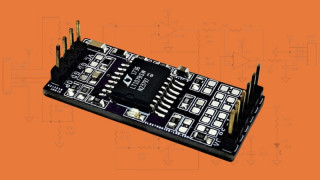
power for an ARM MCU...12V to 3.3V

Thread Starter

Gibson486

Joined Jul 20, 2012
360
I have always powered using a 12V supply and 12V to 3.3V linear regulator. My latest design got pretty dam hot....so I am guessing going 12V to 3.3V is not the greatest idea if you are actually using all 100 or so pins. It still worked, but the regulator was pretty dam hot to the touch. In general, was going from 12V to 3.3V directly a bad idea? I have used a switcher to 5V, then an LDO to 3.3V, but I only do that when I actually need to use 5V for something.
 

MrChips

Joined Oct 2, 2009
35,018
How much current at 3.3V do you need?
I would suggest using a raw supply voltage that is just 2-3V higher than the LDO linear regulator output.

I use a 7.5VDC adapter followed by 5V and 3.3V LDO regulators, not cascaded.
I am drawing less than 100mA from each regulator.
 

dl324

Joined Mar 30, 2015
18,448
How much power is the regulator dissipating? Does it have a heatsink? What temperature does hot mean? Uncomfortable to the touch doesn't necessarily mean too hot for the device.

My ARM SBC has an on-board power management IC. I can power from USB, Li-ion battery, or 3.7-6.3V on a DC input.
 

rsjsouza

Joined Apr 21, 2014
430
Despite I have used the older uA78xx family for many applications, the experience quickly showed that for anything higher than 300mA it was not a great idea to use a linear/LDO regulator to drop such large voltage difference.

I then have been using the LM2592 for lower currents or LM2678 for higher currents, but others may have other suggestions.

The LM2678 is part of a good video from Afrotechmods:
 

Thread Starter

Gibson486

Joined Jul 20, 2012
360
I use 12V because that seems to be what everyone's standard is. If it was 24V, then I would use a switcher and then an LDO or something. From the comments, it seems that using a an LDO (in my case, a 1117) is alright if the current is low. As of now, current draw is around 350mA, so I guess i am kind of on the edge or at least just about to pass it.
 

MrSoftware

Joined Oct 29, 2013
2,273
A linear regulator has to dissipate all of the energy lost to the voltage drop, like a big resistor. So if your input is 12v, output is 3.3v and current is 350mA, then the regulator is dissipating ((12-3.3) * 0.35) watts, or 3W which can be a lot for a small package to dissipate. Check the data sheet for your linear regulator to see the current limit is, and whether a heatsink is required at 3W. A heatsink would go a long way, or you could switch to a more efficient switching buck. They come in module form, if you look hard enough you might even find one with the same footprint if you're using a relatively large part, for example:

https://www.digikey.com/products/en/power-supplies-board-mount/dc-dc-converters/922?k=&pkeyword=&pv183=6782&FV=403e01,4000db,401c68,ffe0039a,17d4005e&quantity=0&ColumnSort=0&page=1&stock=1&nstock=1&pageSize=25

You can also use a switching buck to get down to 5, then use a linear from 5 to 3.3 if noise from the switching circuit is a problem. If you're powering a processor then it's likely fine, just check the data sheet and see if they recommend any extra caps.
 

Thread Starter

Gibson486

Joined Jul 20, 2012
360
Thanks...I never used anything from Recom before. For switchers, I have always used the simple switchers from TI (with the inductor built in). I may have to try this....
 

dl324

Joined Mar 30, 2015
18,448
Thanks...I never used anything from Recom before. For switchers, I have always used the simple switchers from TI (with the inductor built in). I may have to try this....
You can get a 5V adapter at thrift stores for a few dollars and use it with your 3.3V regulator; assuming it's LDO.
 

Dodgydave

Joined Jun 22, 2012
11,395
I have always powered using a 12V supply and 12V to 3.3V linear regulator. My latest design got pretty dam hot....so I am guessing going 12V to 3.3V is not the greatest idea if you are actually using all 100 or so pins. It still worked, but the regulator was pretty dam hot to the touch. In general, was going from 12V to 3.3V directly a bad idea? I have used a switcher to 5V, then an LDO to 3.3V, but I only do that when I actually need to use 5V for something.
If you just need 3.3V, 5V, 12V, then why dont you use an Atx psu...
 

ScottWang

Joined Aug 23, 2012
7,504
Using a 5V adaptor and the LM1117 drop to 3.3V is the better choice, but if you want to use the 12V to drop to 3.3V then the power dissipation will be too high for the small regulator, but you can use the power resistor to take care the heat to replace the regulator.

The minimux Vdrop of LM1117 is 2V,
Vin_min = 3.3V+2V = 5.3V.

The calculation for the power resistor :
R = V/I
= (12V-5.3V)/350 mA
= 6.7V/350mA
= 19.14 Ω

If use 20Ω then the Vdrop should be a little higher and the Vout will be a little lower, so use 15Ω to try.
Vdrop = I*R
= 350mA * 15Ω
= 5.25V

The Vin of LM1117 :
Vin = 12V - 5.25V = 6.75V, 6.75V is higher than 5.3V(Vin_min), so the Vin is fine.

The power dissipation of LM1117 is :
P = V*I
= (6.75V-3.3V)/350mA
= 3.45V*350mA
= 1.2W
So the power dissipation should be ok, if the draw current is a little higher than 350mA as 400mA then it won't increase too much power dissipation.

The power dissipation of power resistor is :
P = V*I
= 5.25V*0.35A
= 1.84W
Choose the real value at least 3 times of calculation.
It seems there is no the standard value is 15Ω/6W, so choose the 15Ω/10W power resistor.
 

Thread Starter

Gibson486

Joined Jul 20, 2012
360
Anyone ever use the LMZM23061 or LMZ21701? These things are tiny. I got the demo boards in and the ripple is in the single digit milli-volts. The (much bigger) LMZ12001 has AL LEAST 4x more amplitude on the ripple from what I have seen. Any thoughts on what the trades off are here?
 
Top