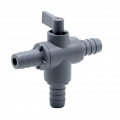
Potentiometers 5 amp

Thread Starter

jorrit spek

Joined Jul 26, 2023
2
So im building a water fountain for myself an i want to be able to controll the force of the water so i put in a potentiometer but it goes up in flames so

Is there a potentiometer that can handle 5 amps or not?
 

MrChips

Joined Oct 2, 2009
34,812
So im building a water fountain for myself an i want to be able to controll the force of the water so i put in a potentiometer but it goes up in flames so

Is there a potentiometer that can handle 5 amps or not?
Welcome to AAC!

Of course it went up in flames.
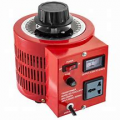
If the water fountain is powered by 240VAC, then what you need is a power variac.
Something like this:

1690382791836.png
 

Ya’akov

Joined Jan 27, 2019
10,235
The problem you are having is that a potentiometer, or any kind of variable resistor, is not the right component for your application. When @crutschow says:

“Yes, but it would be big, expensive, and dissipate a lot of power.”​

What he is saying is, it will get very hot. Too hot to be practical, and that heat is pure wasted electrical power that you have to pay for. The variac that people have been suggesting will work, but I think they probably suggested it because it is like a rheostat from the user’s perspective (though it is very different electrically) and they tend to be very expensive.

The truth is we can’t even be sure what you need unless you provide more information, like the make and model of the pump, and maybe some photos. It may well turn out the @LowQCab’s suggestion of regulating the water flow is more practical that regulating the pump, but either way we can‘t really know without more info.
 

Hymie

Joined Mar 30, 2018
1,347
Although others have said a variable resistor is not the way to go, I think this lower priced rheostat will probably work – it is 50W / 7.5Ω.
If we consider that the pump is supplied at 14V@5A it has a notional impedance of 2.8 Ω.

With the7.5 Ω rheostat at 50% adding 3.75 Ω to the circuit, the current to the motor would be reduced to 2.14A, with a power dissipation in the rheostat of less than 20W, and the power delivered to the motor at around 13W (rather than the full power at 70W).

https://www.ebay.co.uk/itm/303643533252?hash=item46b2909fc4:g:Jn0AAOSwmwxfKtRS
 

Ya’akov

Joined Jan 27, 2019
10,235
Although others have said a variable resistor is not the way to go, I think this lower priced rheostat will probably work – it is 50W / 7.5Ω.
If we consider that the pump is supplied at 14V@5A it has a notional impedance of 2.8 Ω.

With the7.5 Ω rheostat at 50% adding 3.75 Ω to the circuit, the current to the motor would be reduced to 2.14A, with a power dissipation in the rheostat of less than 20W, and the power delivered to the motor at around 13W (rather than the full power at 70W).

https://www.ebay.co.uk/itm/303643533252?hash=item46b2909fc4:g:Jn0AAOSwmwxfKtRS
Admittedly with estimated mass and specific heat, after about 5 minutes without active cooling you’d be able to boil water on that thing at 20W. So, all of the power is being thrown away, and something has to be done with it. There is a reason that thing is a big, ceramic casting, and it still makes no sense to throw away that power when other methods can reduce losses dramatically.
 

schmitt trigger

Joined Jul 12, 2010
2,089
Before the advent of electronic control, theater stage lighting employed enormous rheostats. I saw a listing on Ebay for a vintage one which measured almost 50 cm in diameter!
 

Ya’akov

Joined Jan 27, 2019
10,235
Before the advent of electronic control, theater stage lighting employed enormous rheostats. I saw a listing on Ebay for a vintage one which measured almost 50 cm in diameter!
I used those dimmers as a lighting tech. They were dealing with filament bulbs up to a kilowatt! Of course they could get very hot and were mounted in enormous cabinets with plenty of air space. But even as early as 1936, autotransformers were being used because the heat from dealing with a really big house with a lot of battens made pure resistive boards untenable.

1690475962614.png
 

Externet

Joined Nov 29, 2005
2,635
If the water pump outlet is fed to a 'T' or 'Y' and one branch is attached to an adjustable return-to-reservoir adjustable valve, the pressure and flow for the other branch of the 'T' feeding the fountain can be tailored as you please.
It is "a controlled leak" method of decreasing the supply to the fountain with no rheostats, dimmers, variacs, electrons...

1690480654069.png
Or,
1690480953732.png
 

Ya’akov

Joined Jan 27, 2019
10,235
If the water pump outlet is fed to a 'T' or 'Y' and one branch is attached to an adjustable return-to-reservoir adjustable valve, the pressure and flow for the other branch of the 'T' feeding the fountain can be tailored as you please.
It is "a controlled leak" method of decreasing the supply to the fountain with no rheostats, dimmers, variacs, electrons...
I am guessing this is a submersible pump and so the source is the reservoir it is submerged in, while the output is local to the pump. It that’s the case, using a valve may be impractical.
 
Top