Potentiometer tolerance and expected measurement

Thread Starter

jacopo1919

Joined Apr 12, 2020
115
when I select a pot with 20% tolerance i expect to measure ''random'' values within the range of +-20% of the declared resistance.
For example a 10k pot can vary between 8k and 12k.

But I have measured several potentiometer and i noticed that only around 1/10 has higher resistance and if so, the resistance is just slightly above what declared.
9/10 of the pots measure around -10/20%.

This doesn't seem random to me and maybe is determined by some building criteria?

Do you know something about it?


This could influence the choice of the resistors in the same network.
 

Thread Starter

jacopo1919

Joined Apr 12, 2020
115
the voltmeter is decent: Uni-T UT61B.
i bought the pots from various suppliers (with the time) and i measured 26 of them, all different models ( 2 each model)
only 3 on 26 have resistance > than declared
 

dl324

Joined Mar 30, 2015
18,216
This doesn't seem random to me and maybe is determined by some building criteria?

Do you know something about it?
Why are you expecting a random distribution?

I had an open box of 100 Beckman 1k pots and measured 25. 18 were less than 1k and 7 were > 1k. Apparently they're 10% tolerance, but most were within 5%. I noted 2 that were less than 1% tolerance (999 ohms with my Fluke27).
 

Tonyr1084

Joined Sep 24, 2015
9,744
the voltmeter is decent: Uni-T UT61B.
i bought the pots from various suppliers (with the time) and i measured 26 of them, all different models ( 2 each model)
only 3 on 26 have resistance > than declared
A declared resistance is merely what the manufacturer targeted as a production run. To find variances of ±20% when declared to be ±20% is just that. You're buying something that the manufacturer guarantees (sort of) to be within 20% of the labeled resistance. What it says to me that you're finding the greater number being below the declared resistance suggests that the manufacturer is erring on the side of saving a little money as opposed to giving you a resistor (pot) with more carbon in it (common to use carbon as a resistive element).

Rather than comparing Toyota to Honda to Chevy to Ford, get a batch from ONE manufacturer and compare the numbers. Comparing different pots from different manufacturers is like the Toyota versus Ford analogy. It's not a good comparison. Each has their advantages and disadvantages.
 

Tonyr1084

Joined Sep 24, 2015
9,744
Apparently they're 10% tolerance, but most were within 5%.
Sounds like a valid statistical comparison. Touted as being 10% and they were mostly within 5%. That would be exactly what one would expect. And given that the majority were under 1K further suggests a manufacturer who wants to keep costs under control as best as possible while still maintaining a 10% range. In your case the MFR. gave you a reliable product. One any engineer would be happy to work with.

Since a pot is an adjustable resistor one can not expect precision. Not unless one orders specific values at a very tight tolerance. But then the MFR would simply make a batch and then have someone go through and sort out the number of pots that may have been ordered to be within 1%. Little extra cost having someone sort the product, but given that 18 were low and 7 were high (within tolerance) suggests that if you ordered 20 pots at 1% the manufacturer wouldn't bother to retool their machines but rather pay some lacky to sit there and sort out pots that were at or above 999Ω and at or below 1001Ω. The rest would just go into the general bin for sale as 20%er's. Hire a temp to do the job. Then when finished, conclude the temp contract.
 

crutschow

Joined Mar 14, 2008
38,316
This doesn't seem random to me
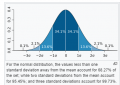
It is random but the "randomness" is not uniform. being generally a normal distribution (gaussian curve below) with the tolerance being likely the 3 sigma (3 standard deviation) value, thus more of the values are nearer to design nominal and only a few near the ends of the tolerance.

1717776278419.png
 

WBahn

Joined Mar 31, 2012
32,702
when I select a pot with 20% tolerance i expect to measure ''random'' values within the range of +-20% of the declared resistance.
For example a 10k pot can vary between 8k and 12k.

But I have measured several potentiometer and i noticed that only around 1/10 has higher resistance and if so, the resistance is just slightly above what declared.
9/10 of the pots measure around -10/20%.

This doesn't seem random to me and maybe is determined by some building criteria?

Do you know something about it?


This could influence the choice of the resistors in the same network.
The only thing that the manufacturer is claiming is that the total resistance from end-to-end will be within the specified tolerances under the specified conditions. Absolutely nothing is claimed about the mean, the standard deviation, the type of distribution, or anything similar. If that is important to your design working properly, it is almost always an indication that your design has serious shortcomings. Instead of relying on assumptions about the distribution of component values within their tolerance range, you need to specify component tolerances so that the distribution within that range doesn't matter.
 

Tonyr1084

Joined Sep 24, 2015
9,744
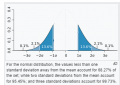
It is random but the "randomness" is not uniform. being generally a normal distribution (gaussian curve below) with the tolerance being likely the 3 sigma (3 standard deviation) value, thus more of the values are nearer to design nominal and only a few near the ends of the tolerance.

View attachment 324053
It's still a bell curve. Skewed to the lower side but still a bell. That predicts there would be more at the lower end value than there would be at a higher end value. And the greater number of failures would be due to being below the stated tolerance. But then they'd ship the bad ones to China where we can buy them as 10%er's, then be dissatisfied with their performance.
 

MisterBill2

Joined Jan 23, 2018
27,159
When you measure parts listed as+/- 20%, most of them will be more than 10% away from the claimed value because those closer will be in the +/- 10% group. Mostly, parts are sorted into categories, not produced to be in categories. So likewise, those in the 10% group will not be within the 5% range. It is cheaper to sort than to hold production tighter. At least for some production processes.
 

ronsimpson

Joined Oct 7, 2019
4,645
I was buying high voltage/current capacitors for a resonant power supply. (5%) One batch came in like this picture where they sorted out the 2% capacitors. I have to compensate for the tolerance by tuning other components. I do not like one cap being +4% and the next being -4%. I called and asked if I could get either +5 to +2 in one box and -5 to -2 in a different box. They said they were charging some one extra for the +/-2% caps and would not charge me extra to get the leftovers sorted.
1717848813169.png
My point is, nice bell-shaped curve but might not be reality. I often see the curve lean to one side a little.
----edited----
I often see the curve cut off at the edges. There might not be any at the extreme edges.
 

MisterBill2

Joined Jan 23, 2018
27,159
Like I cautioned in post #10, the grouping is done by testing after production. So the 20% tolerance group will probably not have any values inside the 10% tolerance range. The fact that those caps are all ready sorted and you can get the ones that were in specific windows outside the other groups requirements is interesting.
 
Top