Facebook
 Google
 GitHub
 Linkedin
"In the following circuit, RL is a potentiometer which varies from 0 to 30 Ohms. Plot (1) The voltage of R2 and (2) the power dissipated by R2."
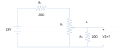
I understand the overall concept of a potentiometer, and I've read several web sites on them, but I'm still not 100% sure how to use standard nodal or mesh analysis to solve a circuit with a potentiometer and our textbook doesn't address the subject.
Here is what I did. Can someone please tell me if this is correct or not?
I replaced the potentiometer circuit with this second circuit, where the potentiometer is replaced with two separate resistors which resistance values that must sum to 30 Ohms (if one is 5 Ohm the other must be 25 Ohm). This diagram shows 15/15, but it could be two values that sum to 30.
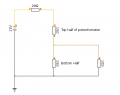
From there, for a given RL setting, I can solve for the current, voltage, and power across R2.
Is this valid? Is there a better way?
I understand the overall concept of a potentiometer, and I've read several web sites on them, but I'm still not 100% sure how to use standard nodal or mesh analysis to solve a circuit with a potentiometer and our textbook doesn't address the subject.
Here is what I did. Can someone please tell me if this is correct or not?
I replaced the potentiometer circuit with this second circuit, where the potentiometer is replaced with two separate resistors which resistance values that must sum to 30 Ohms (if one is 5 Ohm the other must be 25 Ohm). This diagram shows 15/15, but it could be two values that sum to 30.
From there, for a given RL setting, I can solve for the current, voltage, and power across R2.
Is this valid? Is there a better way?