Ahhhh... let me add my two cents then...
If you have enough resolution on the PWM signal, then simply use a comparator to detect when the signal has been completely nulled... you could then infer the load value and report it... no ADC needed!
Well, you first define null value, and then calibrate accordingly. You could add another comparator to detect on which side of null the cell is currently at, and then increase or decrease PWM's duty cycle as needed. Still cheaper and with less hassle than an ADC... but probably much slower...
So can you utilize PWM to read all voltage values? Both positive and negative? In my case strain gauges are experiencing both tensions and compressions, so I should expect both positive and negative output voltages from the bridge! The internal ADC of micro-controllers tend to only provide an analogue input range between ground and some positive voltage. If as you say no ADC needed, your method has to operate with positive and negative voltages!
Servoing the PWM to keep the bridge balanced, and then inferring the input from the required PWM value, is a cute idea and theoretically possible, but in practice forget it: it's WAYYYY too slow due to the settling time of the ripple filter. Far better to let the PWM do its job of compensating for zero offset, and feed the bridge output to an appropriate amplifier and then on into the uC's ADC input.
Servoing the PWM to keep the bridge balanced, and then inferring the input from the required PWM value, is a cute idea and theoretically possible, but in practice forget it: it's WAYYYY too slow due to the settling time of the ripple filter. Far better to let the PWM do its job of compensating for zero offset, and feed the bridge output to an appropriate amplifier and then on into the uC's ADC input.
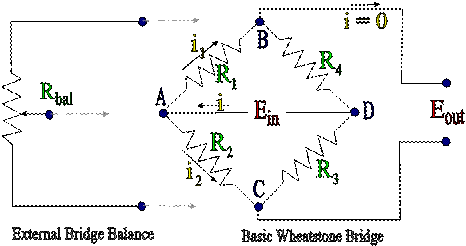
However, I would recommend putting a resistor between the wiper of the digital pot and the junction of R1 and R2, with the value of that resistor chosen so that you get all of the adjustment range you need, but no more; this will allow your adjustment steps to be as fine as possible.
I've done some calculations and I've noticed that the resistor between the wiper of the digital pot and the junction of R1 and R2 is very important to maximize the range of values I want to compensate! So I have understood how to make the right choice of this resistor. But I don't know how determine digipot's resistance. How can I choose it? Are there any parameters I have to keep in consideration to define the right digipot's resistance? Any advice?
I've done some calculations and I've noticed that the resistor between the wiper of the digital pot and the junction of R1 and R2 is very important to maximize the range of values I want to compensate! So I have understood how to make the right choice of this resistor. But I don't know how determine digipot's resistance. How can I choose it? Are there any parameters I have to keep in consideration to define the right digipot's resistance? Any advice?
I don't think the resistance value of the digipot is particularly important, other than that it should be relatively small compared to the resistor between the wiper of the digital pot and the junction of R1 and R2.
I don't think the resistance value of the digipot is particularly important, other than that it should be relatively small compared to the resistor between the wiper of the digital pot and the junction of R1 and R2.
Yes, you are right! I think so too. But why? Could be due to the fact that the smaller the resistance the smaller percentage changes? I have done this reasoning: if so bridge's balance is more accurate. Am I right?
For example, in my application I have to use a 33-34 kohm resistor directly connected to the wiper and I have thought to use a 1 kohm digipot.
Yes, you are right! I think so too. But why? Could be due to the fact that the smaller the resistance the smaller percentage changes? I have done this reasoning: if so bridge's balance is more accurate. Am I right?
No, it's simply that the smaller the digital pot resistance relative to the resistance you connect in series with the wiper, the more even will be the adjustment steps across the range of the pot. With a large digipot resistance, you would find the steps near each end of the pot would be a lot larger than the ones in the middle.
For example, in my application I have to use a 33-34 kohm resistor directly connected to the wiper and I have thought to use a 1 kohm digipot.
What about a circuit like this? Why doesn't it work? The Rbal is connected to the output terminals of the bridge. And its value should be greater than the bridge resistor. For example, if you bridge has 1k ohms resistors, the pot value could be 100K ohms.

 Facebook
 Google
 GitHub
 Linkedin