Facebook
 Google
 GitHub
 Linkedin
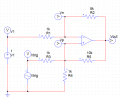
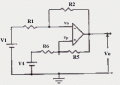
I see the real circuit is much more complicated than this. However, I am still confused with the charateristic of this opamp.
When postive input (Vp) equals negative input (Vn), what is the output of opamp Vcc or -Vcc?
Aslo for the Vin-Vout characteristic above, is the arrow direction important? Is it possible that when Vin decreases from infinity, Vout will cross at VH instead of VL? And the same for Vin increases from negative infinity Vout will cross at VL instead of VH?
In that case we still have the same shape but different arrow direction.
For this circuit, Vin = (-R1/R2)*Vout. When Vin decreases from infinity, to calculate for the toggle point, why do we choose (-R1/R2)*Vcc instead of (-R1/R2)*(-Vcc) which is posive?

Back to the original circuit:
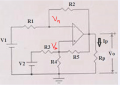
And then calculate for Vn, Vp:
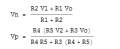
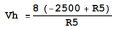
And solves for the value of V1 at which Vn = Vp, let's call it Vh:

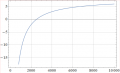
I think Vh is the hysteresis value of this circuit but it is not easy to see how Vh decreases as R5 increases.
When postive input (Vp) equals negative input (Vn), what is the output of opamp Vcc or -Vcc?
Aslo for the Vin-Vout characteristic above, is the arrow direction important? Is it possible that when Vin decreases from infinity, Vout will cross at VH instead of VL? And the same for Vin increases from negative infinity Vout will cross at VL instead of VH?
In that case we still have the same shape but different arrow direction.
For this circuit, Vin = (-R1/R2)*Vout. When Vin decreases from infinity, to calculate for the toggle point, why do we choose (-R1/R2)*Vcc instead of (-R1/R2)*(-Vcc) which is posive?
Back to the original circuit:
And then calculate for Vn, Vp:
And solves for the value of V1 at which Vn = Vp, let's call it Vh:
I think Vh is the hysteresis value of this circuit but it is not easy to see how Vh decreases as R5 increases.
Attachments
-
 2.5 KB Views: 3
Last edited: