Polarity on a single speaker...

MrChips

Joined Oct 2, 2009
34,872
Nope. Phase discrimination contributes to directional awareness.

ak
No. Directional awareness is determined by amplitude and time of arrival of the sound.
By phase, we are discussing cycle to cycle phase difference, not the initial sound lag.

Let us take for example, a 2 kHz tone. The half-cycle period is 1 ms.
Can the human auditory system discern a 1 ms time lag?
I don't know.
 

MrChips

Joined Oct 2, 2009
34,872
According to Google AI, the ear can discriminate differences of 10-20µs, which is how we locate the direction of a sound.
Good to know.
I am not disputing this. Thus, we can detect sound direction by the lag of time of arrival of sound in our binaural system.
I have a demo on an STM32 demo board that illustrates this with two mems microphones on the board,

Again, this is not the same as detecting signal phase.

Further reading:
https://pubs.aip.org/asa/jasa/artic...Highly-directional-pressure-sensing-using-the
 

AnalogKid

Joined Aug 1, 2013
12,158
According to Google AI, the ear can discriminate differences of 10-20µs, which is how we locate the direction of a sound.
At 1 kHz, 10 us of time delay is 3.6 degrees of phase shift. At STP (Standard Temperature and Pressure), that works out to 0.135", around 3.4 mm of displacement. I know this has nothing to do with the "phase" of a mono signal path. Just sayin'

Agree. Back in the 80's I worked with a group of experimental psychologists who had some fun toys: a small TV studio, a Lear/Singer flight trainer, an assortment of analog and digital computers, and a small anechoic "soundproof" room. The things we are discussing here were so well established back then that they were cited as fact.

And, although I'm not a big Sony fan, here is another bit. In the 70's when component stereos were all the rage, Sony (and I'm sure others) had a speaker with planar "cones". This was their solution to the problem of how most speakers had the two or three internal elements mounted. The Sony speaker had noticeably sharper transient response. You didn't need a quiet listening room to hear the difference; it was clear in the CES booth in the middle of the convention center main floor. And again, I know this has nothing to do with the "phase" of a mono signal path.

ak
 

MrChips

Joined Oct 2, 2009
34,872
There is a known deficiency with transient response of traditional paper-cone loudspeakers. This led to a lot of research and experimentation with electrostatic and plasma loudspeakers.

A colleague of mine successfully built his own electrostatic loudspeakers.
 

MrChips

Joined Oct 2, 2009
34,872
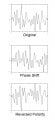
Let not start to confuse phase and inversion again. They are not the same. Phase is time related. Polarity is an inversion a property of the wave.. You can detect the difference with signals that are not continuous.

https://www.prosoundweb.com/its-just-a-phase/
So Misunderstood: Clearing Up The Confusion Between Phase & Polarity
I think we can all agree on the difference between phase and polarity. The question is, can the listener discern the difference?

phase shift.jpg
 

nsaspook

Joined Aug 27, 2009
16,340
I think we can all agree on the difference between phase and polarity. The question is, can the listener discern the difference?

View attachment 351020
We can obviously tell when part of a single source audio wave has been delayed for some reason because animals evolved advanced stereo hearing with microsecond time discrimination between ears for likely survival reasons. At normal voice level sources, unadulterated inversion (linear transducer and medium) has the same energy content and force. As we increase energy and the rise time of that energy, things are not so linear. it depends.


Last edited:

Futurist

Joined Apr 8, 2025
787
Not true.
Have you never had a stereo music system?

Stereo is two distinct channels but all stereo recording's bass frequencies are generally common to both channels.
The wavelength of a 100Hz tone is about 10 ft.
Thus there is a significant loss in apparent bass response if the two speakers are out-of-phase, that is readily heard by any human (and I would presume some animals).
Also there is a more noticeable separation that there are two separate speakers with apparent loss is center sound.

At one time in an early stereo system I had, I added a cross-coupled DPDT switch in one of the speaker leads to easily reverse the leads while listening to music.
I could easily tell which connection was in-phase and which was out.
Good evening.

Yes, I grew up in the 60s and well remember the popularity of the term "stereo". I'd hear things like "have you heard Eddie's new stereo?" and similar things.

It was huge, HiFi was huge, magazines dedicated to audio, some of the more adventurous and well heeled even invested in the new wave "quadrophonics" yes, there were four channel amplifiers.

Stereophonic recordings of large orchestras were big news back, then, the marketing was intense, everything had "stereo" in the name, poor people even wired up two speakers to a their (mono) amp to impress the lady who might visit.

The concept of phase never arose, the separation of microphones in London's Philharmonic Hall was certainly bigger than 10 ft.

1749870517349.png
 
Last edited:

AnalogKid

Joined Aug 1, 2013
12,158
No human could tell the difference between the various possible pairings of the four wires in a test with the piece of music.
I can.

ak

And - because there are more than two possible pairings, the differences would be among them, not between them.
<pedantic twit mode OFF>
 
Last edited:

AnalogKid

Joined Aug 1, 2013
12,158
Confirmation bias?
Direct experience in an acoustics research lab, two recording studios, and a 250 seat auditorium. Note that this was nothing special; all of the audio professionals I knew back then could do this. Rather than some special skill, it was a job requirement.

And, even further off topic, the same thing goes for eyeballs. After years of staring at, using, repairing, and calibrating color TV monitors, I learned the visual equivalent of perfect pitch. I was good, some guys on the studio crew were better, and the crew chief was a freak of nature.

ak
 
Last edited:
This is categorically false.
A quick search on the internet will provide research on phase audibility.
You misunderstand my position still. I want YOU to provide the evidence for your claims in this topic. If you don't have direct experimental evidence, that's fine but then reference a paper or stats that you have personally reviewed. Telling me to go find it on the internet is deflecting from the task.

Back to the topic.. I was thinking about this question over the past day and I came up with at least one scenario where the polarity on a single speaker would likely be felt physically. I don't have the means to test it in a satisfactory way but it appears maybe you do.

Here's the setup:

1) A person and a single large speaker are arbitrarily placed in a large empty room.

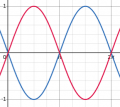
2) A 1Hz waveform is played one time then played again with the speaker's terminal reversed like this:

4kf9d-1.png

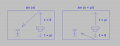
The red line represents the diaphragm moving in the forward direction and the blue line in the reverse direction starting at time zero. I used trusty LTspice to make a diagram:

4kf9d-2.png

My hypothesis is for a single oscillation at 1Hz with a large speaker, the direction of the forward pressure wave felt by the person will be distinctly different than the reverse pressure wave because its coming from the opposite direction. In the case depicted above, the forward pressure wave would also take longer to arrive in the first trial than the reverse pressure wave in the second trial.

In other words, the information perceived by the person over its effective duration in the first trial will be opposite to the second trial because it is physically opposite in origin. I chose to represent sound with a single vector but obviously it travels radially from the source but I hope it gets the point across.

Now someone might say that feeling sound is different than hearing sound but I say not so fast.. your entire body is technically a receiver and your ears are tuned especially for higher frequencies. Given that sound is made up of many frequencies and is often unique, it's very difficult to predict what would happen in a given scenario since we are all different, hence my concerns on the validity and reliability of answers in this topic.

Would you agree with my hypothesis? Why or why not?

And on a personal note, I feel I offended you but that wasn't my intention. I have high standards for what I put in the truth category and some folks tend to interpret my relentless style of argument as an attack on their character but it's not, I only care about the facts and the methods behind them.
 
Last edited:

MrChips

Joined Oct 2, 2009
34,872
There is no need to conduct this experiment. I will try to explain why this thought experiment is flawed as we can anticipate the outcome.

1) There are two ways a pressure acoustic wave can arrive at the observer. The wave can travel to the observer via a primary path with no other interfering wave. The second case is when multiple paths are involved and the waves interfere at the location of the observer. When there is interference, there will be locations of maximum and minimum which cannot be experienced if the observer remains in the same location.

We can experience interference using the simple case of a loudspeaker transducer that is not housed in a speaker cabinet. In this case, there are two waves that will arrive at the observer. There is the forward wave emitted from the front surface of the speaker cone. Then there is another wave emitted from the back surface of the speaker cone which will be of reversed polarity. The two waves will interfere destructively and the observer will experience a lower amplitude than the case where the speaker transducer is mounted in a speaker cabinet or on a large baffle board. (The purpose of the cabinet or baffle board is to prevent the reverse wave from interfering with the front wave.)

I still claim that the observer cannot perceive a difference if the connections to the speaker transducer were reversed,

Your diagram shows two paths for the pressure wave to travel. Hence, there will be constructive and destructive interference that will occur and which will be location specific.

Again there will be no observable difference if the connections were reversed.

2) The speed of sound in air at 20°C is 343 meters per second. One can determine the time taken to travel any given distance. You can do the calculation and determine the time difference for sound to travel two different paths.

Again, we are discussing the effects of changing the polarity of the electrical connection and hence the polarity of the acoustic pressure wave. In this case, the first wave will arrive at either higher or lower than normal pressure. Can the observer tell the difference?

3) A reminder that we are not discussing the detection of a single pressure wave, regardless of the polarity of the wave. We are discussing a continuous wave.

4) The lowest audible frequency is 12 Hz for humans. Music range is generally accepted to be 20 Hz to 20 kHz. Thus humans cannot audibly detect sound at 1 Hz. You can still conduct your thought experiment at 20 Hz or even 100 Hz. The results will still be the same.

In conclusion, I will state my position as stated before. There is no situation where the human ear can detect a difference when the two connections to a loudspeaker are interchanged when using a single transducer.
 

MrChips

Joined Oct 2, 2009
34,872
POLARITY REVERSAL EXPERIMENT

Here is a simple experiment anyone can do.

Generate 10 cycles of 100 Hz sine-wave followed by a similar burst with reversed polarity. Listen to this continuously and see if you can discern the difference. You can generate the signal in different ways, with commonly available electronic components, with an MCU, or with an arbitrary waveform generator.

You can apply a different frequency, burst duration, and burst spacing. The only criteria is there must be an equal integer number of wave cycles in each burst and with equal amplitude.

sinewave polarity reversal.jpg

(Time delay between bursts not drawn to scale.)
 

MrChips

Joined Oct 2, 2009
34,872
Top