Polarity on a single speaker...

Thread Starter

Externet

Joined Nov 29, 2005
2,629
Hi.
When the positive signal is applied to a speaker terminal marked (+) and the negative to its terminal marked (-) ; the cone is supposed to retract towards the magnet or extend way from the magnet ? What is the standard motion ?
If it does not matter nor alters the sound; what is preferred mechanically ? The coil to be repelled or attracted by the magnet when polarities are as above ? (like applying small direct current to the speaker)
 

Hymie

Joined Mar 30, 2018
1,347
I don’t believe the polarity makes any difference on a single speaker to the sound perception, but it is very important on stereo or other multi-speaker systems because there will be a tendency to cancel sound waves if the speakers are wired in differing polarities.
 

nsaspook

Joined Aug 27, 2009
16,298
I've never seen a standard that says "the cone shall always move outwards for positive voltage applied to the terminals".
1694633377420.png
I've always used the 9V battery test to check.
 

BobTPH

Joined Jun 5, 2013
11,503
It makes a difference in 2-way and 3-way speakers systems. If I remember correctly, even order crossovers have the signals in phase at the crossover frequency and odd order have them anti-phase. So you wire the tweeter and woofer with opposite polarity with an odd order crossover so the two do not cancel each other. This assumes they will move the same way if the - terminal is common.
 

nsaspook

Joined Aug 27, 2009
16,298
Don't do the 9v battery test on tweeters. I would say for any mid-range speaker size smaller than about 3 inches or a tweeter the speaker polarity is much less important because of small cone displacement, the number of acoustic wavelengths between the tweeter and the listener plus room reflections that muddy high frequency phase relationships. At 3 kHz it's only 11.44 cm or 4.5 inches so turning your head to a slight offset from the speakers can completely change the ears phase relationship.
 

MrChips

Joined Oct 2, 2009
34,758
For your information, positive current moves the cone outwards. (Ref: Philips Speaker Systems)
For single speaker systems, polarity does not matter.
 

nsaspook

Joined Aug 27, 2009
16,298

bertus

Joined Apr 5, 2008
22,917
Hello,

With a single speaker the polarity is not that important.
In a stereo setup, when one of the speakers has wrong polarity, it may look like the sound is coming from outside the speakerset instead of in between the speakerset.
The sound image is wrong with one speaker on the wrong polarity in a stereo setup.

Bertus
 

crutschow

Joined Mar 14, 2008
38,481
Really there is a convention but no actual standard I've ever seen about the direction of speaker cone displacement. I seriously wonder if there is an offical industry standard today.
Don't know if there's an official one, but If there wasn't a standard convention they all used, then mixing speakers from different manufacturers could result in out-of-phase operation even if there were all connected plus to plus.
 

MrChips

Joined Oct 2, 2009
34,758
Don't know if there's an official one, but If there wasn't a standard convention they all used, then mixing speakers from different manufacturers could result in out-of-phase operation even if there were all connected plus to plus.
Good point. Hence there is a standard.
 

meth

Joined May 21, 2016
303
Theoretically if you bring mono signal with opposite polarity to 2 speakers facing each other on a certain distance and you stand right between them the sound waves should completely cancel each other out (?) :D I find this amusing but I have never tried to do this, has anyone done this experiment?
 

MrChips

Joined Oct 2, 2009
34,758
Theoretically if you bring mono signal with opposite polarity to 2 speakers facing each other on a certain distance and you stand right between them the sound waves should completely cancel each other out (?) :D I find this amusing but I have never tried to do this, has anyone done this experiment?
Yes and no. In theory yes, in practice, no.

Look up an online calculator and determine the wavelength of sound at different frequencies. You need the half-wavelength for waves in-phase to cancel.

In practice, the two sound waves will reach your ear along different paths. When the difference in paths is comparable to the wavelength, then they will cancel.

This is a quick way to check if speakers are in or out of phase. Put the two speakers beside each other and you will hear a noticeable difference at the bass frequencies. That is because at low frequencies, the wavelength is long enough to cancel regardless of the position of your head.

In principle, you can cancel acoustic pressure with another transducer that produces a wave that is out of phase. That is how noise cancelling headphones work.
 

MrChips

Joined Oct 2, 2009
34,758
Phase Distortion

You can get into heated debate about phase distortion.

All low-pass, high-pass filters, tone controls, equalizers, and speaker cross-overs, etc. create phase distortion. Frequency filters create phase distortion at the cross-over region because that is how filters work.

One can expect strange things to happen with respect to phase at the cross-over region when a sinewave is applied.

One does not generally listen to sinewaves for entertainment. Fortunately, music content is so varied that phase distortion is masked out by other frequencies.

Nevertheless, there are persons who would argue that their golden ears are sensitive to phase distortion.
 

MrChips

Joined Oct 2, 2009
34,758
The dual loudspeaker experiment

Imagine sitting in your living room listening to music coming from your stereo speakers separated as usual, one to the left and one to the right.

A though experiment would suggest that you could experience sound cancellation depending on where you sat in the room. This is true only in theory.

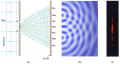
A popular experiment in the physics of light waves is Young's Double Slit Experiment. Here a single light source shines on two slits. Since the light emitted from the two slits, S1 and S2, are coherent, they interfere constructively and destructively. There are minimum and maximum points as shown in the diagram below.

The same thing would happen with two loudspeakers emitting sinewaves at the same frequency. We do not experience this because music content varies in frequency.

1749550531298.png

Reference: https://courses.lumenlearning.com/suny-physics/chapter/27-3-youngs-double-slit-experiment/
 
I've wondered this myself and never got a reliable answer. I think for a normal speaker it doesn't matter because the speaker construction is meant to oscillate in both directions regardless of the phase of the signal.

But for a multi speaker system in phase, the pressure waves generated by a speaker are unique to the construction so an inward movement might generate a stronger pressure differential compared to an outward movement, unless it's perfectly symmetrical which most are not. If 3 speakers are moving inward and 1 is moving outward, there might be some interference. I'd like to test this if I get my hands on a speaker array.
 

MrChips

Joined Oct 2, 2009
34,758
I've wondered this myself and never got a reliable answer. I think for a normal speaker it doesn't matter because the speaker construction is meant to oscillate in both directions regardless of the phase of the signal.

But for a multi speaker system in phase, the pressure waves generated by a speaker are unique to the construction so an inward movement might generate a stronger pressure differential compared to an outward movement, unless it's perfectly symmetrical which most are not. If 3 speakers are moving inward and 1 is moving outward, there might be some interference. I'd like to test this if I get my hands on a speaker array.
What do you consider to be a reliable answer?
The physics of acoustic systems is well understood.
 

AnalogKid

Joined Aug 1, 2013
12,114
Theoretically if you bring mono signal with opposite polarity to 2 speakers facing each other on a certain distance and you stand right between them the sound waves should completely cancel each other out (?) :D I find this amusing but I have never tried to do this, has anyone done this experiment?
Beginning back in the 1930's, yes. It is the core concept beneath active noise cancellation, and Bose has made a fortune with it.

ak
 

AnalogKid

Joined Aug 1, 2013
12,114
With a single speaker the polarity is not that important.
Disagree, and I disagree with part of that linked page about old JBL speakers. It does matter, even with a single speaker.

Audio in air is a series of alternating compressions and rarefactions. As I understand it, the (unwritten?) rule is that compression pushes a dynamic microphone's diaphragm inward, and this produces a positive-going voltage. Rarefaction pulls the diaphragm outward, and this produces a negative-going voltage. Obviously these voltage directions can be swapped by transposing the mic coil connections, but someone decided that this was the way to go. To reproduce this at the listener's ear, the magnet orientation and voice coil winding direction combine such that a "positive" voltage across the voice coil moves the speaker cone outward, creating a compression wave that pushes the eardrum inward in the same way the mic diaphragm was pushed inward. Even at a non-geek level, this makes sense.

Does this matter? Usually not. But for something like the 1812 overture with an actual cannon, psycho-acoustic research shows that there is a difference in the perceived sound between that initial *crack* of the cannon being the compression part or the rarefaction part of a cycle, because positive pressure can be directed, but negative pressure cannot. The difference is independent of the number of speakers. If you substitute a microphone for the human ear, it is very easy to see differences in the higher-order harmonic energies between the two cases. A violin string will sound the same in both cases when stroked, but not when plucked. The difference is in the transients.

ak
 
Last edited:
Top