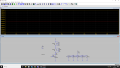
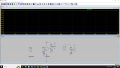
Hi , I've designed a pnp cascode setup as current source and npn current mirror.
In design , I've used Vbeon value and given current value from datasheet.
Is this a good method of making design ?
If Q3 was meant to be your current mirror input, then R6 should not be there (as above).
Q1 and Q2 and associated resistors are Vbe multipliers. They behave more like a zener diode (but not a very good zener diode) and are used to compensate for changes in temperature.
A resistor to a fixed voltage will bias it.
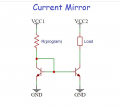
A simple current mirror is not very accurate because of the base currents. The base currents for both transistors come from the input, so the output current is the input current minus the base current. The transistors have to be very well matched for it to work properly.
Adding some matched resistors between the emitters and 0V improves the accuracy.
A resistor to a fixed voltage will bias it.
A simple current mirror is not very accurate because of the base currents. The base currents for both transistors come from the input, so the output current is the input current minus the base current. The transistors have to be very well matched for it to work properly.
Adding some matched resistors between the emitters and 0V improves the accuracy.
That's not a good design if you want a temperature stable current source since Vbe changes about 2mV/°C.
And putting two current sources in series (Q1 and Q2) is not a good idea since the one with the lower current will determine the current and the other won't do anything.
I understand that.
But unless you have perfectly matched resistors and transistors, the tolerance differences between the two cascade circuits will make Rout largely determined by the one with the lower current.
I understand that.
But unless you have perfectly matched resistors and transistors, the tolerance differences between the two cascade circuits will make Rout largely determined by the one with the lower current.
I get it. So I have related questions. What can I try to improve the design ? Does is bring larger Rout with being determined by the lower current.
Btw I've calculated the resistors assuming Vbe 0.62v , that was what I was asking for at the beginning.
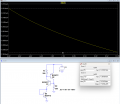
Below is the sim of a 2-transistor constant-current source, that is fairly stiff due to the negative feedback from Q2 to control the current.
The current through Q1 only changes about 77µA for a supply voltage change from 5V to 10V
The current is approximately 0.55V / R1.
But note that this circuit is also temperature sensitive, with the current changing about 0.3% / °C.
Hi , I've been trying some circuits and wondered smth.
Since Vd is not constant and Is value is not given in datasheet of the diode , how can I calculate the Vd ?
Start from the value given in the datasheet, which will specify the temperature and current at which it applies.
Subtract 2mV for each °C above the specified temperature
Add 60mV for each decade of current above the current at which it was specified.
I could not made it. Since it is hard to design it using these values in ideal conditions , this design procedure is wrong. How can I make it better can you give me any hints ?
I will work on wilson's too.
Here's the datasheet. https://www.vishay.com/docs/85622/1n914.pdf
You will see that the typical voltage drop is 0.61V @ 1mA @ 25°C (see fig.1)
at 10mA it is 60mV higher (0.67V) and at 100uA it is 60mV lower (0.55V).
at 75°C the voltage is lower.
But these are typical values - the only clue you get about how much it can vary from one diode to another is that its maximum value is 1V @ 10mA. That's an awful lot of variation!
So how do you design it more accurately? You don't! Only put a diode in a circuit where the forward voltage doesn't really matter. Make sure that the circuit will work properly whether the diode voltage is 0.5V or 0.8V or anywhere in between.
Here's the datasheet. https://www.vishay.com/docs/85622/1n914.pdf
You will see that the typical voltage drop is 0.61V @ 1mA @ 25°C (see fig.1)
at 10mA it is 60mV higher (0.67V) and at 100uA it is 60mV lower (0.55V).
at 75°C the voltage is lower.
But these are typical values - the only clue you get about how much it can vary from one diode to another is that its maximum value is 1V @ 10mA. That's an awful lot of variation!
So how do you design it more accurately? You don't! Only put a diode in a circuit where the forward voltage doesn't really matter. Make sure that the circuit will work properly whether the diode voltage is 0.5V or 0.8V or anywhere in between.

 Facebook
 Google
 GitHub
 Linkedin