Facebook
 Google
 GitHub
 Linkedin

Hi Peeps,
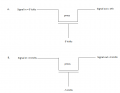
i have a question about Pass transistors.
assume the MOSFETs are allways biased so they are conducting.
input on drain, output from source and bulk is tied to source.
an NMOS can pass 0 well. ok
an NMOS can Pass (1 - Vth). ok
a Pmos can pass 1 well. ok
BUT
the PMOS trying to pass a 0... my notes say the output is Vth, i can see why it should be this ( if Vgs = 0, Vds = 0 the channel is high resistance and only at (Vgs = 0 - Vth) does low resistance in the channel form)
but as far as i can tell, this mosfet is generating voltages that come from nowhere. could anyone explain the 'magic Vth on the output of a conducting PMOS pass transistor with a 0 on the input'.
Thanks.
p.s also a completely unrelated observation. why is it ok to say
"an NMOS" but is not ok to say "an PMOS"?