Soft start circuit pmos

Thread Starter

lawofsine144

Joined Jun 9, 2025
24
Hello,

Can anyone explain to how this circuit work? ( i got the picture from youtube but i didnt understood the explanation.. also searched on the internet and only found little information)
I want to know how to select the correct resistors, caps to result to certain delay/rise_time.
Thank you
1000006383.png
 
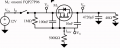
The 100nF capacitor initially starts out discharged, which keeps the MOSFET turned off. As the capacitor charges through the 500K resistor, the gate voltage eventually drops low enough to turn the MOSFET on, allowing current to flow to the load. The 10nF capacitor softens the turn-on, by feeding some of the rising output voltage back to the gate. The 4720uF capacitor also helps soften the turn on, since it will take a while to charge. The 40 ohm resistor represents the load being powered, it is not part of the soft start circuit per se. The component values required to achieve a specific start time will be dependent on the gate threshold voltage of the specific MOSFET used, and the current draw of the load.
 

Thread Starter

lawofsine144

Joined Jun 9, 2025
24
thanks! Is it correct that only the 500k affects the start time delay and the 1Meg is only to limit the Vgs to around 8V?
 
Last edited:
The 1M is to ensure the 100nF capacitor discharges when the power is off. I would not increase the 500K unless you ensure you will still get enough voltage on the gate to turn the transistor fully on (depends on gate threshold voltage of the MOSFET). If you need a longer delay, increase the capacitor values.
 

xox

Joined Sep 8, 2017
936
Is it correct that only the 500k affects the start time delay and the 1Meg is only to limit the Vgs to around 8V?
No, the 500KΩ and 1MΩ resistors form a voltage divider which sets the gate voltage ON state to 12×(500,000÷(500,000+1,000,000)) = 4V.

Note that the 100nF capacitor basically sets the rise time whereas the 4.72mF cap both softens the load's ON and OFF transition characteristics.
 

crutschow

Joined Mar 14, 2008
38,313
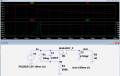
Below is the LTspice sim of the circuit:
I didn't have the FQP27P06 model so I used one that was close.
The sim showed oscillations in the supply current, which were eliminated when I removed the 10nF capacitor between the MOSFET gate and drain (which didn't seem to significantly affect the circuit operation otherwise).
Note the peak surge power-supply current is about 13A for the circuit values shown.
Increasing the value of C1 will reduce that peak current and somewhat increase the delay time.

1771804560195.png
 
Last edited:

Thread Starter

lawofsine144

Joined Jun 9, 2025
24
No, the 500KΩ and 1MΩ resistors form a voltage divider which sets the gate voltage ON state to 12×(500,000÷(500,000+1,000,000)) = 4V.

Note that the 100nF capacitor basically sets the rise time whereas the 4.72mF cap both softens the load's ON and OFF transition characteristics.
hmm yes thats what im thinking, the 100nF capacitor together with the 500k resistor determine the rise time, and the 1Meg was only used as voltage divider for the gate voltage. is it correct?
 

Thread Starter

lawofsine144

Joined Jun 9, 2025
24
Below is the LTspice sim of the circuit:
I didn't have the FQP27P06 model so I used one that was close.
The sim showed oscillations in the supply current, which were eliminated when I removed the 10nF capacitor between the MOSFET gate and drain (which didn't seem to significantly affect the circuit operation otherwise).
Note the peak surge power-supply current is about 13A for the circuit values shown.
Increasing the value of C1 will reduce that peak current and somewhat increase the delay time.

View attachment 363827
Thanks @crutschow , thats why im seeing some designs without that 10nF at the gate-drain.
and that surge current looks dangerous to the mosfet.
 

xox

Joined Sep 8, 2017
936
hmm yes thats what im thinking, the 100nF capacitor together with the 500k resistor determine the rise time, and the 1Meg was only used as voltage divider for the gate voltage. is it correct?
It's a little more complicated than that. The 1MΩ limits how quickly the capacitor charges up too so there's that. All in all it's not exactly a perfectly designed circuit, but the trade off is that it is relatively simple and gets job done alright. Personally I would keep the resistors at their present setting to ensure that the circuit draws as little current as possible and just adjust the capacitor accordingly to achieve an acceptable rise time.
 
The Vgs is calculated by measuring the voltage at the gate and the voltage at the source. The difference is your Vgs. Here, the voltage divider 1MΩ and 500kΩ divides the 12v to 1/3 and 2/3 of the source. All measurements are referenced to the GND. Therefore, your Gate gets +4v and your Source is +12v. The difference between gate(4v) to source (12v) is: 4-12= -8. That is, your gate gets -8V which is the voltage that drives the P-Channel MOSFET.
As for the values, the combination of the voltage divider (1MΩ and 500kΩ) plus the 100n capacitor, the bigger the capacitor, the longer it takes to fill up = slower ramp up.
As @crutschow simulation shows, it takes 33ms for the MOSFET to fully turn on but again, for 20ms, nothing is happening at all, so, reducing those resistors while keeping the same ratio will help to start faster. The calculations are very longwinded, so, LTSpice is there to do the job for you in a second.
 

panic mode

Joined Oct 10, 2011
4,864
btw if this is used on circuits with higher voltage make sure that Vgs of mosfet is not the problem.
it does not hurt to add a zener diode across R1. also depending on chosen component values (longer ramp) it may be a good idea to consider fast discharge of the capacitor. that way soft start ramp would work even after brief off time.
 
Last edited:

Thread Starter

lawofsine144

Joined Jun 9, 2025
24
btw if this is used on circuits with higher voltage make sure that Vge of mosfet is not the problem.
it does not hurt to add a zener diode across R1. also depending on chosen component values (longer ramp) it may be a good idea to consider fast discharge of the capacitor. that way soft start ramp would work even after brief off time.
Thanks. Yes I see, i'll take note on that.
 
Top