The assembly takes too long. So ive let it sleep some time.
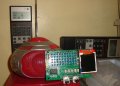
Now i have added RGB LEDs. It works fine! In the video voltage is just 2.65 volts.
The code is for the scrolling message but it lights up the LEDs and produced various colors.
They are not modulated so its 100% or 0% only.
Modulating the LEDs in software adds complexity.
I will convert the 16f716 code soon.
As well this PCB will be for sale around $10 assembled and $2 more for the dcdc converter built.
The voltage is adjustable actually. It is using the MCP1640.
There are several 4.7uF 0805 capacitors for buffering the voltage.
The LED display has serial interface and can be detached completely from the IO ports even if built (but not needed).
One problem is the via clearance to some LEDs. Assembly is possible but you have to check carefully.
There is one bug- the MCLR line is input only. So, one wire bridge is not made instead a small 1cm wire connection is made on the other side of the PCB.
The dcdc converter has two solder bridges one for the enable input, the other to connect the voltage rail.
The PIC is far more poweful than the commonly used 16f84 and 16f628. 1K Flash is good for almost nothing only small scripts are possible. While 16K are very comfortable you dont run out of memory all too soon.

 Facebook
 Google
 GitHub
 Linkedin