Makes sense, I'm mostly confused by the formula for cut off frequency for low pass pi-filter.
fc = 1/(2 * pi * sqrt(C * L))
I thought C would be the capacitor close to load impedance.
Is it correct to assume C would be the sum of both capacitors?
Example formula: Ctot = C1 + C2
You use both capacitors AND the load impedance AND the source impedance. They all make a difference. The formula given is for an LC section assuming the other capacitor is absent or does not significantly affect the result, and that the load and source impedances have no effect.
Do you have an example filter that you are working with or are you trying to design one for some purpose?
You use both capacitors AND the load impedance AND the source impedance. They all make a difference. The formula given is for an LC section assuming the other capacitor is absent or does not significantly affect the result, and that the load and source impedances have no effect.
Do you have an example filter that you are working with or are you trying to design one for some purpose?
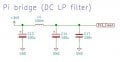
I attached the filter I'm working with,
What I'm trying to do is remove noise from a 3.3V source, and I wanted to figure out what the frequency cutoff was. Source and load impedance should be negligible.
Is that really 100mH? Not 100μH?
It looks like a power-line interference filter, in which case the load impedance may well be unknown. (The load impedance is not negligible, as that would be a dead short, and if the source impedance is negligible then the first capacitor is pointless)
Also, with those values, parasitic capacitance in the inductor, and parasitic inductance in the capacitors will dominate at higher frequencies, and tolerances may be as much as ±20%, especially as the inductance could possibly reduce by50% at full load current.
It‘s probably difficult to estimate better that f≈1/(2π√(LC)) plus or minus an octave.
I had a suspicion that it was for a power line filter at 50Hz. Low and behold there is a resonance peak at 50 Hz. What this is doing is enhancing the noise. It seems you threw this thing together without setting out any requirements and without doing any design.
Some other points:
You cannot ignore the source impedance, but you know that for a typical power supply it will be small. I chose 200 mΩ
You cannot ignore the load impedance, but you have to bound it as a minimum.
C1 & C2 cannot have the same value.
Did you compute the reactance of each component at your frequency of interest, 50 Hz?
XL1 = 31.42 Ω
XC1 = XC2 = (1/31.42) = 0.318 Ω
I had a suspicion that it was for a power line filter at 50Hz. Low and behold there is a resonance peak at 50 Hz. What this is doing is enhancing the noise. It seems you threw this thing together without setting out any requirements and without doing any design.
I see, I'm very new to designing filters. I knew only that around 50-60Hz is the noise from my source voltage, so I should have a lowpass filter to filter out as much as I can. I'll have to watch some videos to understand this better. Thanks for your guys help.
I see, I'm very new to designing filters. I knew only that around 50-60Hz is the noise from my source voltage, so I should have a lowpass filter to filter out as much as I can. I'll have to watch some videos to understand this better. Thanks for your guys help.
That's OK we all had to start somewhere. I'm not sure videos is the way to go about it, however. It is unstructured and difficult to assimilate. I did not come to my present state of knowledge overnight. It took over half a century. If 50-60 Hz. is your problem you might want to consider a notch filter, or other ways to eliminate the source of the noise.
Filters are best for high-frequency noise. If your problem is 50Hz, then it's ripple not noise, and your best bet would be a voltage regulator. An LP2951 will reduce 50Hz ripple by 75dB.
Or perhaps, you have the 0V connection in the wrong place.
It depends what you are using it for, which i dont think you said yet?
If the first capacitor is in parallel with a very low impedance source it will have less effect so the cap will be mostly the output cap.
If the impedance of the source is significant then the capacitor value is the series combination.
It's a little hard to tell what is significant and what isnt though because even a low impedance source can cause both capacitors to have an effect.
You would have to know more about the source and the load.
Is this for a rectifier filter application? That would be a different case too.

 Facebook
 Google
 GitHub
 Linkedin