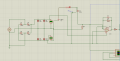
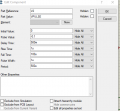
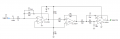
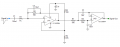
I add R8 for making a negative signal, and I add 1/2VCC because author of circuit in the first post add too.( sorry I am not electronic engineer.) So I can make mistakes. I am learning
You don't seem to understand what I'm saying. R8 should be 50 ohms and there should not be a connection from the cathode of D2 to the 1/2 Vcc junction of R6-R7.
You don't seem to understand what I'm saying. R8 should be 50 ohms and there should not be a connection from the cathode of D2 to the 1/2 Vcc junction of R6-R7.
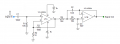
Okay, did you see first had drawn schematic. I have a question why he add 1/2 VCC to the cathode of photodiode. Why R8 should be 50 ohms? There is no r8 in the original schematic I add it to schematic.
The data sheet for D2 shows using a 50 ohm resistor where you added R8. Adding R8 is fine but try changing the value to 50 ohms in the simulation.
Looking at the first drawing there should not be a connection from the cathode of D2 to the 1/2 Vcc. I don't know why he showed that.
In your schematic in post #19 you should remove the connection from the cathode of D2 to the junction of R6-R7.
If you are going to do the simulation start off with using a bipolar supply and bipolar opamp just to get things working. We can modify the circuit at a later time.
The data sheet for D2 shows using a 50 ohm resistor where you added R8. Adding R8 is fine but try changing the value to 50 ohms in the simulation.
Looking at the first drawing there should not be a connection from the cathode of D2 to the 1/2 Vcc. I don't know why he showed that.
In your schematic in post #19 you should remove the connection from the cathode of D2 to the junction of R6-R7.
If you are going to do the simulation start of with using a bipolar supply and bipolar opamp just to get things working. We can modify the circuit at a later time.
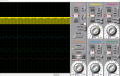
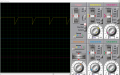
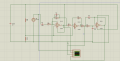
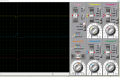
I didn't find VCC in my simulator, but I add bipolar power supply and TL071. this time I get different signal shape but I don't know which one was correct. Square waves? which I get before or Sine wave.
I think this is what MrChips was suggesting.
In this circuit I'm using a LM2904 you had in your previous circuit. The LM2904 is a dual op amp and by connecting the signal to the positive input will only require 2 stages. Notice the polarity of the 9 volt batteries on pins 4 and 8. U1A is set for a gain of 101 followed by the filter/buffer U1B
I agree with MrChips based on the input waveform. The problem is trying to simulate what the output from the actual sensor should look like in my opinion.
I agree with MrChips based on the input waveform. The problem is trying to simulate what the output from the actual sensor should look like in my opinion.
I don't know but I tried to put a negative small pulse like real pulse and I expect an positive wide pulse on the output. I think small changes on input pulse maybe affect hugely output.

 Facebook
 Google
 GitHub
 Linkedin