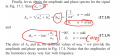
It's merely a convenient definition. If both a_n and b_n are zero, then the angle is indeterminate, but it also doesn't matter because the amplitude is zero. So defining the angle to be zero under those conditions just keeps it from being undefined.
A simple way to look at this is to use the two argument inverse tangent function instead of the single argument version they show there. The two argument version would then look like this:
atan(bn,an)
with 'bn' being the imaginary part of an expression and 'an' being the real part.
Sometimes the angle can be found by looking at the angle before both an and bn become zero. If you ONLY need the angle at (0,0) though then it does not matter because the amplitude is zero also.
Very often (0,0) is taken to be undefined as in:
limit(atan(a,a)) as a->0
but when we do this:
limit(atan(1/a,1/a)) as a->inf
we get pi/4, which is interesting.
For your problem though I would probably just take it to be zero.

 Facebook
 Google
 GitHub
 Linkedin