Facebook
 Google
 GitHub
 Linkedin
Let's say we have the following circuit, where R=0.5 Ω, L= 10uH, C=10uF.
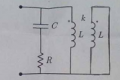
Determine the value of the coupling coefficient for which the angular frequency of the phase anti-resonance (frequency for which phase difference between voltage and current at the input is equal to zero) is equal to ω=400 000 rad/sec.
Phase anti-resonance occurs when imaginary part of admittance (or even impedance) is equal to zero. So basically all i have to do is to determine admittance or impedance of the given circuit and then set the imaginary part equal to zero and then get the value of k for given angular frequency.
Now, since i have pair of coupled coils, the best way to find admittance is to determine equivalent inductance so i would have a circuit with R and C (which are in series) in parallel with L equivalent. Is this a legitimate thing to do?
Now, when i calculated L equivalent i got Le=(1-k^2)L
Then admittance is Y=(jωRC)/(R+jωC) +1/(jωL)
But when i solved it this way i got a very strange answer (irrational number) which makes me think that i either made a mistake in calculations or i did something wrong with the circuit, maybe i am not allowed to find Le the way i did or maybe i did admittance wrong? Any advice or suggestion appreciated!
Determine the value of the coupling coefficient for which the angular frequency of the phase anti-resonance (frequency for which phase difference between voltage and current at the input is equal to zero) is equal to ω=400 000 rad/sec.
Phase anti-resonance occurs when imaginary part of admittance (or even impedance) is equal to zero. So basically all i have to do is to determine admittance or impedance of the given circuit and then set the imaginary part equal to zero and then get the value of k for given angular frequency.
Now, since i have pair of coupled coils, the best way to find admittance is to determine equivalent inductance so i would have a circuit with R and C (which are in series) in parallel with L equivalent. Is this a legitimate thing to do?
Now, when i calculated L equivalent i got Le=(1-k^2)L
Then admittance is Y=(jωRC)/(R+jωC) +1/(jωL)
But when i solved it this way i got a very strange answer (irrational number) which makes me think that i either made a mistake in calculations or i did something wrong with the circuit, maybe i am not allowed to find Le the way i did or maybe i did admittance wrong? Any advice or suggestion appreciated!
Last edited: