Persistant noise from solenoid valve

MaxHeadRoom

Joined Jul 18, 2013
30,690
And you've already contributed a lot of advice, but can you explain why SMPS is not good for this application?
Thanks!
SMPS are potentially very noisy, electrically.
I would suggest the linear supplies, it may be necessary to earth ground them also, but this could be explored if you do go that route.
Max.
 

BR-549

Joined Sep 22, 2013
4,928
How are you connected to rat? How are you sensing? What are the signal levels?

Show us the signal without any interference.

Does a clean empty IV tube produce the interference?

Does the rat have to drink or touch milk, for the interference to occur?

Does milk have to touch cage, for the interference?
 

Berzerker

Joined Jul 29, 2018
623
@KG0403
Please don't get me wrong KG! I'm new to electronics and when I see something I don't understand, I ask.
I was always told "the only stupid question is an unasked one"
Brzrkr
 

Thread Starter

KG0403

Joined Oct 5, 2018
33
How are you connected to rat? How are you sensing? What are the signal levels?

Show us the signal without any interference.

Does a clean empty IV tube produce the interference?

Does the rat have to drink or touch milk, for the interference to occur?

Does milk have to touch cage, for the interference?
Connected to the rat via high-impedance (50-100 kohm) platinum-iridium electrodes in the brain soldered to a connector fixed to the skull. A cable connects that to the pre-amp.
Sensing with a National Instruments A to D converter, Labview for acquisition. Signal levels from the back of the pre-amp (1000x gain) are between 1 and 2 volts, measured as single-ended ground referenced (RSE) with the ground being a low-impedance electrode in a different area of the brain.

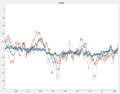
Signal without interference:
upload_2019-7-2_16-25-15.png

^those deflections in the orange trace are neurons firing, not noise, fyi

Great troubleshooting tip with the clean, empty IV tube. I will try that tomorrow. (I can only run rats once per day, dictated by experimental protocol, and I don't see the interference when I'm using a fake test rat). I don't think that the rat has to touch the milk for the interference. The timing seems a little too regular from trial to trial for that to be the case... but I will try to test it.
 

BR-549

Joined Sep 22, 2013
4,928
10-4 let's determine the exact moment and condition of the interference.

Might be more than one problem, or something too simple.

It's a peculiar dynamic.

Or your rat really loves chocolate milk. And you dislike solenoids.

Hee Haw

(it's the medication)
 

BR-549

Joined Sep 22, 2013
4,928
A "milk air gap" might stop it. That does not mean a bubble in the tube.

A real air gap. Drop by drop the milk thru air into cage tube.

A plumbing solution.
 

Thread Starter

KG0403

Joined Oct 5, 2018
33
10-4 let's determine the exact moment and condition of the interference.

Might be more than one problem, or something too simple.

It's a peculiar dynamic.

Or your rat really loves chocolate milk. And you dislike solenoids.

Hee Haw

(it's the medication)

Oh chocolate milk is rat nirvana, they go crazy for the stuff. And it wasn't always the case, but I rather dislike solenoids now..

The interference starts right at that t=0, which is when the rat pokes it's nose into a PVC pipe port, and the solenoid opens and the milk starts flowing. The upward deflection is right as the valve closes. The amplitude of the deflections is not consistent, but the timing is spot on from trial to trial. When I remove the milk spout from the feeder, it appears to go away. But I don't know if that's because the rat is not touching the milk, or if maybe I've changed the orientation of this milk-antenna. I should've paid more attention in my antennas course, I could kick myself now!
 

Thread Starter

KG0403

Joined Oct 5, 2018
33
A "milk air gap" might stop it. That does not mean a bubble in the tube.

A real air gap. Drop by drop the milk thru air into cage tube.

A plumbing solution.
Might take some mechanical engineering, but that's a solution worth testing
 

BR-549

Joined Sep 22, 2013
4,928
It can be done in a few moments for testing. Route tubing above cage, cut a gap in vertical entrance to cage. Milk can not touch anything but air from the dropper.

How fast can that stinker drink?

It might be worth the isolation, for future studies and different equipment.

How long are the milk tubes? What is the milk tube detention time? Do you rinse often?

Dripping might even require less house keeping.
 

Thread Starter

KG0403

Joined Oct 5, 2018
33
It can be done in a few moments for testing. Route tubing above cage, cut a gap in vertical entrance to cage. Milk can not touch anything but air from the dropper.

How fast can that stinker drink?

It might be worth the isolation, for future studies and different equipment.

How long are the milk tubes? What is the milk tube detention time? Do you rinse often?

Dripping might even require less house keeping.
If the tubing is above the cage, the rat will spend most of its time raised up trying to get at the ceiling, which is not good for the experiment or the cable coming out of its head. But it could work for testing purposes. Milk tubes are about 6 inches, not sure what you mean by detention time. I rinse the tube and flush out the solenoid once daily.
 

BobaMosfet

Joined Jul 1, 2009
2,211
Audible noise. I hear a click when the valve opens and a click when it closes.

When I press a wire to the metal mount of the solenoid and view the continuous voltage in labview, I get a 60 Hz wave at 0.5-1V amplitude. When the valve opens, there is a sharp downward deflection in voltage, followed by a flat line, then a sharp upward deflection when the valve closes. Then we return to that 60-cycle. It just seems that whenever I try to ground that mount it gets worse, be it Pi ground, power supply ground, 12V ground, or earth ground from a wall outlet.
What do you think your switch is? It's an inductor. Current creates a magnetic field which pulls a metal contact towards or away from the inductor, so you here a click. A spring drives it the other way when the inductor coil is demagnetized. Why is it so hard for people to understand that inductive relays all CLICK!

As for the 60Hz signal- that's through your ground plane and your wall transformer. 60-Hz signal is everywhere- it's from the power-grid powering your equipment. You need to either filter it with a notch filter, isolate your power away from MAINs using opti-isolators, or live with the 60Hz signal.
 

BR-549

Joined Sep 22, 2013
4,928
I can not see your lab. And can not be specific without all the details and restrictions.

Dueling with a rat is another matter. How well do you know this rat?
 

Thread Starter

KG0403

Joined Oct 5, 2018
33
What do you think your switch is? It's an inductor. Current creates a magnetic field which pulls a metal contact towards or away from the inductor, so you here a click. A spring drives it the other way when the inductor coil is demagnetized. Why is it so hard for people to understand that inductive relays all CLICK!

As for the 60Hz signal- that's through your ground plane and your wall transformer. 60-Hz signal is everywhere- it's from the power-grid powering your equipment. You need to either filter it with a notch filter, isolate your power away from MAINs using opti-isolators, or live with the 60Hz signal.
Yes, I understand that inductive relays click.. I know the operating principles of a solenoid valve. I was just making sure I understood MaxHeadroom's question.. I thought he was asking about electrical noise.
As for the 60Hz coming from the solenoid mount, I know where it's coming from, I just don't know how to make it go away, as when I ground the mount I get bigger problem than before. I thought maybe there might be a clue to a solution in there. The faraday cage keeps the 60-Hz from distorting the signals coming from the rat.

But thanks for the input.
 

Thread Starter

KG0403

Joined Oct 5, 2018
33
I can not see your lab. And can not be specific without all the details and restrictions.

Dueling with a rat is another matter. How well do you know this rat?
Some are more ill-behaved than others. It's kind of funny the difference in personalities they have.
But I think your suggestions have merit. I can easily test, and if the air gap idea works, I can hack something together (I hope)
 
Ok I gotta ask! WTF am I reading in this post? Chocolate milk ground? a rat in the drawing? and I was told post a schematic.
I thought a solenoid was either off or on? there was no in between.
Brzrkr
\

So what's wrong with trying to "ground the milk"?

I think I know how to solve it, now that we have been immersed in lots of information.

For a test, do not ground the solenoid power supply. have rat touch the dispense button and you activate the solenoid manually. See what happens?

What I'm going to suggest is to optoisolate the solenoid power and use an isolated 12 V supply.

i think the milk is effectively shorting out the sensors on the rat. It's acting as a wire. So, breaking that makes sense. A drip chamber,https://www.saveritemedical.com/pro...15-filter-in-drip-chamber-swivel-luer-lock-92 may also makes sense.

You have a rat and a "milk wire" and probably no isolation amp on the rat?

The Rat is probably a nice 60 Hz antenna. If you grab a scope probe, you would see what I mean.

This https://pdfs.semanticscholar.org/d413/4baa3ea1f19eb21e9dc9b9dc33ad0ba89a34.pdf may be a good read.

https://www.egr.msu.edu/classes/ece445/mason/Files/7-BioAmps.pdf

https://www.biopac.com/product-category/research/amplifiers/biopotential-amplifiers/
 

BR-549

Joined Sep 22, 2013
4,928
We ain't sure of anything yet. But hopefully, momentarily dripping the milk might give us a clue.

We might have to start all over.

A curious condition of a phenomena.

Surely, this isn't the first time for other applications. Some one has run across this before, some where.

And probably went straight for electrical isolation. Which is fine. Some IV media might require pressure.

The electrical isolation should be done. The drip confirms and temporarily resolves the problem.

And gives the rat a chocolate milkshake.
 

Thread Starter

KG0403

Joined Oct 5, 2018
33
Putting an air gap between the rat and the milk helped. I achieved this by retracting the tip a little bit from the hole in the wall of the chamber, so it might not have been perfect isolation, but it definitely helped:

Wide view:
upload_2019-7-3_13-17-27.png

Close-up solenoid open:
upload_2019-7-3_13-17-45.png

Close-up solenoid close:
upload_2019-7-3_13-18-17.png

I'll work on some ideas to get full isolation. The drip chamber is a great idea if I can get it to work. I'm using hydrostatic pressure, I just have to make sure the final delivery has adequate precision in the timing and the quantity.

I personally love the ground the milk idea, it seems simple to me. It's just that it makes the distortion worse when I try it, whether the 12V supply is grounded to the same supply as the pre-amp or left as its own ground. I don't know why that is. I will try the manual dispense idea, operating the solenoid from a battery. In the end though, I'll need to drive it from the Raspberry Pi GPIO. If I use the driver circuit shown in the original post, the grounds would have to be connected. But maybe I could optically isolate the input to the gate/base somehow..

As for an isolation amp on the rat, we use something called a "headstage" with is a set of JFETs with unity gain, but it's external to the rat itself. It attaches right into the plug on the rat's skull, and the cable attaches to that.

I'll report back with more information.

Thank you all.
 

BR-549

Joined Sep 22, 2013
4,928
One might consider using a peristaltic pump for precise flow, instead of your solenoid. This with an un-grounded milk reservoir might work.

No air gap would be necessary with this setup.
 
Top