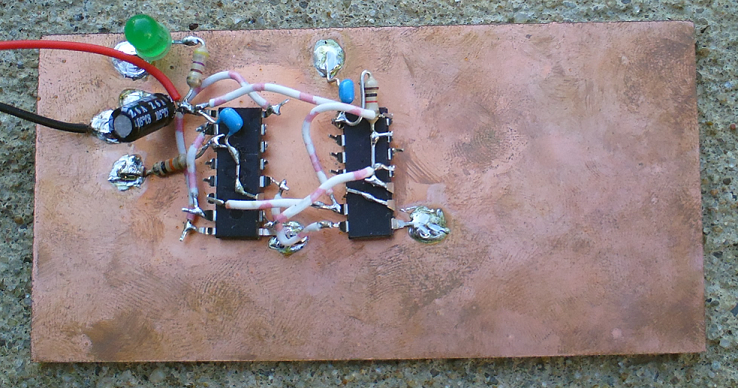
Build this with 74HC14, 2.2k, and a trimmer cap that includes 10pF within its range. Vcc must be 5V, and build the breadboard on copperclad with a ground plane. The "dead bug" technique will minimize stray capacitance (see example below). You should be able to get at least 12.6MHz.
DON'T use a solderless breadboard. Their stray capacitance is too high.
I used perfboard (without copper pads) for my recent USB powered speaker project, and it worked well. Besides eliminating the need to drill holes, it avoids the problem of the copper pads melting when soldering and decreases the likelihood of a short. I also prefer it to stripboard because it's not necessary to scrape strips of copper off in order to build a circuit on it.
I usually mark trace cuts with a permanent (alcohol) marker, review for errors, then cut with a small ball engraver bit on a Dremel using a low angle sweeping motion to cut across the strip or trace. I clean the debris and any remaining marker off with a stiff nylon brush and alcohol. This method leaves wide, cleanly routed, easily seen cuts that won't easily short or arc over.
I usually mark trace cuts with a permanent (alcohol) marker, review for errors, then cut with a small ball engraver bit on a Dremel using a low angle sweeping motion to cut across the strip or trace. I clean the debris and any remaining marker off with a stiff nylon brush and alcohol. This method leaves wide, cleanly routed, easily seen cuts that won't easily short or arc over.
A couple problems with Wikipedia is anyone can post anything and make edits. That means you can't believe everything you read there; though I've found most information I've read there to be correct. Some schools don't allow citing anything from Wikipedia as fact...
I don't understand what it is designed for then? Is the same thing true of perfboard?
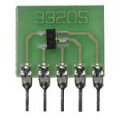
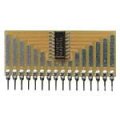
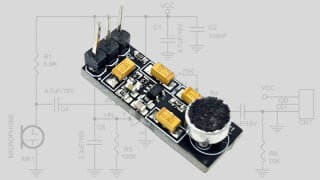
Stripboard was designed before the advent of what most think of as surface mount components, but I see no reason why one would think it can't be used for surface mount. There are surface mount to SIP adapters that are basically stripboard without holes, like this:
The terminology used for prototype boards is sometimes ambiguous. When I hear perfboard, I think of a board with holes and no copper. Then there's pad-per-hole, pad-per-multiple-holes, strip board, clad sheet with holes, strip board with bussing, ...
Some of the confusion comes from people using the generic term veroboard to mean strip board, but Vero also manufactures plain and other varities; all referred to as Veroboard on their website. However, they use qualifiers such as "Veroboard stripboard" or "Plain board Veroboard", so it's the people using veroboard generically that are causing the confusion.
Perfboard (meaning no copper) could be used for SMD (or SMT if you prefer) if you use copper strips; adhesive or not. I have several widths of adhesive backed copper I use for board repair. Some was originally sold for that purpose and some was sold for stained glass work or snail control in gardens.
It boils down to personal preference. Once I re-discovered etching PCBs 10 years ago, I stopped using protoboard and make a board; even if it's a one-off.

 Facebook
 Google
 GitHub
 Linkedin