ONCE AGAIN, I suggest using the resistance measure function of the multi-meter to check the bulbs that you have. The bulb resistance should be not a lot, less than 100 ohms for certain.
It is entirely possible for a connection to have a high enough resistance to not light a bulb while being able to show a reasonable voltage on a digital meter with an input resistance of several million ohms.
So I am saying that the problem is in the lantern connections some place.
ONCE AGAIN, I suggest using the resistance measure function of the multi-meter to check the bulbs that you have. The bulb resistance should be not a lot, less than 100 ohms for certain.
It is entirely possible for a connection to have a high enough resistance to not light a bulb while being able to show a reasonable voltage on a digital meter with an input resistance of several million ohms.
So I am saying that the problem is in the lantern connections some place.
Have you not been following the thread? It has been determined that the “bulb” is an LED replacement bulb and the polarity at the socket is wrong for it. Nothing more to explain.
Have you not been following the thread? It has been determined that the “bulb” is an LED replacement bulb and the polarity at the socket is wrong for it. Nothing more to explain.
I first mentioned the LED replacement and suggested that polarity MAY be an issue. I also saw the post where it was mentioned that they needed to verify the actual polarity. I seem to have missed the post where the light was finally working as intended.
Worse yet, adding rectification would raise the cost without any benefit to most of the users. But certainly adding a note on the package would have been a good choice.
Then how does it light a 3.2V white LED when the 3V battery has dropped to 2V?
My solar garden lights have a voltage stepup IC so that the 3.2V white LED works fine when the rechargeable Ni-MH cell has dropped to 0.9V. My colors-changing LEDs have the control IC inside them.
Many LED devices have circuitry that is more complex than just a current limiter. But since it is integrated into the package some place it is not obvious at all, except by it's function. Just because you don't recognize it does not mean it is not there!!
That was pretty stupid of me to get my polarity backwards only my multimeter. I think over half the reason why I wanted to post for help was that this didn't make sense--so I was either missing something about how electronics work, or just making a stupid mistake. Either reason meant that I needed to learn or correct myself.
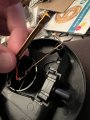
It does appear to be a polarity issue with this lamp, with the side being positive and the bottom negative. From what I gather, this doesn't really matter for a traditional lightbulb, but matters for most LEDs. Since they only had LEDs at the hardware store, it sent me down a rabbit hole. I'm glad it did though, since I've now learned a lot. Throwing in a regular bulb and it working would have allowed me to go on in my ignorance lol.
So, here's the solution I realize last night:
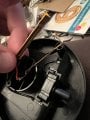
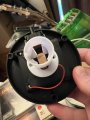
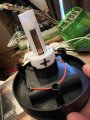
Since the LED is brighter, more energy efficient, and has a wider voltage tolerance, I'd prefer that. I realized the metal contact were the same shape and length (probably cheaper and easier to manufacture this way), I ended up bending them to make the bottom contact the positive, and the side contact the negative.
I even went ahead and labeled the inside lol.
Of course, my luck: after changing the polarity, I was testing the LED bulb, installing and removing it a few times, just to make sure everything fit well, and the stupid bulb came apart on me (the top/inner LED part from the bottom/outer casing). I'm pretty annoyed about that. I put it back together and had it working for a bit, but it wasn't reliable anymore. There's a thin wire that connects the bottom positive connector of the LED inside to the bottom of the bulb housing, and it snapped when the 2 parts came apart. I could try to put some solder in there to remake the positive connection, but it's tiny, and I'm over it lol. I'll have go out and buy 2 new bulbs after work, but I think I'm all set after this.
Also, I just went to put it all back together and snapped the negative wire's cheap solder connection to the metal connectors. I just threw on some new solder and not read about 7.09v (compared to 7.06v). Pretty funny. More importantly, it's stronger.
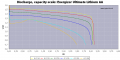
PS: I think I'm getting that high of a voltage due to using Energizer Ultimate Lithium AA. I get a little less than 7v when using alkalines.
7.06V vs 7.09V is not significant.
I would not be concerned with ±0.1V from a battery,
Note than while the nominal voltage of an AA-sized battery is 1.5V, the no-load voltage of the Energizer lithium battery can be as high as 1.8V. Four cells would make it 7.2V.
7.06V vs 7.09V is not significant.
I would not be concerned with ±0.1V from a battery,
Note than while the nominal voltage of an AA-sized battery is 1.5V, the no-load voltage of the Energizer lithium battery can be as high as 1.8V. Four cells would make it 7.2V.
7.09 vs 7.06 is 0.4% different. Your multimeter is not that accurate. It is more likely a difference in temperature that caused
the change than a difference in resistance.
Edit to add: Actually, most likely is how you held the probes.

 Facebook
 Google
 GitHub
 Linkedin