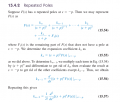
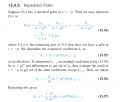
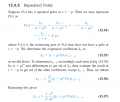
Any partial fraction expansion can be checked by combining the terms to get the original function back. I find it curious that in your example the poles are in the right half plane. No real system could survive this situation.
Any partial fraction expansion can be checked by combining the terms to get the original function back. I find it curious that in your example the poles are in the right half plane. No real system could survive this situation.
I see the method, tried the method, got the same results, which failed the check of reproducing the original function. I can't tell you where we both went wrong.
I see the method, tried the method, got the same results, which failed the check of reproducing the original function. I can't tell you where we both went wrong.
I do not know what you guys are doing but I get a completely different values for K2.
I did it two different ways, including the way where you multiply, then equate terms with 's' and terms without 's'.
In other words, if you multiplied out and got:
a+b*s=c+d*s
then you form two equations:
a=c
b=d
Then solver for c and d which is easy.
In the given problem, you have to solve for k1 first, then you can solve for k2.
k2 comes out over 42000 or less than -42000 (do the problem again.
Do the problem again and see if you can get k2 this time.
BTW, I took the original constants to be 767 and 50065, so try it with that first.
With the original constants, I get k2 a little greater than 26. I get the original problem back when I use that.
The handwritten original is absolutely atrocious, but if you note carefully, the commas are used for the decimal point and what you think is 767, should be 1.67 says me. The 7 has a crossbar and the 1 does not. What you think is 50065 is actually 50.065
It is the European fashion to do things in this way.
The handwritten original is absolutely atrocious, but if you note carefully, the commas are used for the decimal point and what you think is 767, should be 1.67 says me. The 7 has a crossbar and the 1 does not. What you think is 50065 is actually 50.065
It is the European fashion to do things in this way.
Yes, I had asked him to clean up the text but he didn't do that for some reason. I had to look in several places to make sure I got the digits right
I did realize that the comma was for the dot because we can't resolve 7,67 and 50,065 into 767 and 50065 because there's no number like 1,23 if the comma was for "thousands" because that would make no sense, it would have to be more like 1,230 and then it would be hard to tell the difference without some previous example.
Anyway, I did 767 and 50065 and that shows some results without giving away the actual problem result. I'll show the example in my next post.
Yes, I had asked him to clean up the text but he didn't do that for some reason. I had to look in several places to make sure I got the digits right
I did realize that the comma was for the dot because we can't resolve 7,67 and 50,065 into 767 and 50065 because there's no number like 1,23 if the comma was for "thousands" because that would make no sense, it would have to be more like 1,230 and then it would be hard to tell the difference without some previous example.
Anyway, I did 767 and 50065 and that shows some results without giving away the actual problem result. I'll show the example in my next post.
Here is a worked example similar to yours, but the results are not the same of course. This should illustrate clearly the method. The results here have been verified. If you use differentiation you get the same results.
First we start with a different example:
(767*s-50065)/(s-10)^2
Note the coefficients are different for this problem so the result will be completely different.
Next we form the equation like you did already with the original problem:
(767*s-50065)/(10-s)^2=k1/(10-s)+k2/(10-s)^2
Everything up to this point is the same as what you did except with the alternate coefficients.
The next thing we do is multiply this by the denominator of the left hand side and we get:
767*s-50065=-k1*s+k2+10*k1
Next we form equations that equate like powers of 's'. We have s^1 and s^0 so we will have two equations. They are:
767*s=-k1*s
which resolves down to:
767=-k1
and
-50065=k2+10*k1
We can't solve for k2 right away, but we can see right off that k1=-767. Substituting that into the second equation we get:
-50065=k2-7670
and solving for k2 we get:
k2=-42395
Using these two values insert them in the right hand side of the equation above and get:
-767/(10-s)-42395/(10-s)^2
Here is a worked example similar to yours, but the results are not the same of course. This should illustrate clearly the method. The results here have been verified.
First we start with a different example:
(767*s-50065)/(s-10)^2
Note the coefficients are different for this problem so the result will be completely different.
Next we form the equation like you did already with the original problem:
(767*s-50065)/(10-s)^2=k1/(10-s)+k2/(10-s)^2
Everything up to this point is the same as what you did except with the alternate coefficients.
The next thing we do is multiply this by the denominator of the left hand side and we get:
767*s-50065=-k1*s+k2+10*k1
Next we form equations that equate like powers of 's'. We have s^1 and s^0 so we will have two equations. They are:
767*s=-k1*s
which resolves down to:
767=-k1
and
-50065=k2+10*k1
We can't solve for k2 right away, but we can see right off that k1=-767. Substituting that into the second equation we get:
-50065=k2-7670
and solving for k2 we get:
k2=-42395
Using these two values insert them in the right hand side of the equation above and get:
-767/(10-s)-42395/(10-s)^2
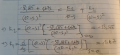
I tried it, you can see below, the comma is the dot, like -50,065 means -50.065. sorry for different character system. You click on view attachment. View attachment 1737282964518.jpeg

 Facebook
 Google
 GitHub
 Linkedin