Facebook
 Google
 GitHub
 Linkedin

Hello,
I am reading "Use of dual-trace oscilloscopes" by Charlie Roth.
It has in it this question:
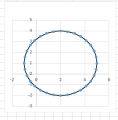
"If x = 2 + 3 cos wt and y = 1 + 3 sin wt what is:
maximum x deflection =
minimum x deflection =
max y deflect =
min y deflect =
now sketch a rectangle on the screen showing the limiting values of the x and y deflections. The trace must lie within this rectangle."
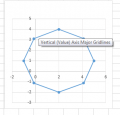
I managed to get the rectangle correct, but getting the circle is a little tricky. I am not using a calculator and there is only a grid of (10,8) squares like an oscilloscope screen. I looked on line by entering the main formula above and found parametric equations of an ellipse. this explained the first numbers (2 and 1) 3 is the amplitude so the circle will have a max of x = 3 and y = 3 and a min of x = -1 and y = -2. i think this is correct. Problem I am having is that this is not in the trig books that I have, or explained in the oscilloscope book. Is there a good site that will explain this?
I am reading "Use of dual-trace oscilloscopes" by Charlie Roth.
It has in it this question:
"If x = 2 + 3 cos wt and y = 1 + 3 sin wt what is:
maximum x deflection =
minimum x deflection =
max y deflect =
min y deflect =
now sketch a rectangle on the screen showing the limiting values of the x and y deflections. The trace must lie within this rectangle."
I managed to get the rectangle correct, but getting the circle is a little tricky. I am not using a calculator and there is only a grid of (10,8) squares like an oscilloscope screen. I looked on line by entering the main formula above and found parametric equations of an ellipse. this explained the first numbers (2 and 1) 3 is the amplitude so the circle will have a max of x = 3 and y = 3 and a min of x = -1 and y = -2. i think this is correct. Problem I am having is that this is not in the trig books that I have, or explained in the oscilloscope book. Is there a good site that will explain this?