Parallel and series AC question

Thread Starter

2nowman

Joined Jan 14, 2017
17
This is going to be the death of me, i'm on the verge of a nervous breakdown - i've spent so much time staring at this and it makes less sense now than when i first looked over a week ago, i honestly feel like crying.

I'll probably have another look tomorrow, but i need some sleep now.

thanks
 

JoeJester

Joined Apr 26, 2005
4,390
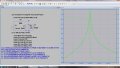
Here is the frequency of resonance:
23.725418113905900000 HzParallelResonance.jpg

He might stumble on it by varying the frequency a bit. I took it out a few extra digits when I calculated it in excel.
 

JoeJester

Joined Apr 26, 2005
4,390
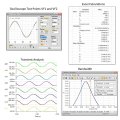
I had about a 4.6 mS delay in the zero crossing between the voltages at the source and R2, but I can not attribute that to the difference in amplitudes on the scope trace. These virtual scopes don't have verniers to adjust the presentation. The same delay shows up in a transient analysis.

I will be contacting my simulator support people about that issue, after I check it against another circuit.

The AC analysis shows a minor phase shift in the currents. by minor I'm talking about 35 micro degrees off of 90 or less which should NOT have shown up on the transient analysis or the virtual oscilloscope.

I constructed a circuit with a fr of a little over 5k. There was a 5.x uS phase shift on the virtual oscilloscope and transient analysis when there should have been no shift. The AC table showed micro degrees of shift.

Neither circuits were close to the calculated bandwidths.

I increased the readings to 6 decimal places, and where we expected an in phase condition, it showed an in phase condition. The graphing tools seem to be at fault, whether it's the transient analysis or the virtual oscilloscope.


That's the frequency he is using in his simulations and the phase isn't zero. Can you see any reason why it shouldn't be zero at the calculated frequency of resonance?
No I do not see any reason. I'll be opening a support issue with my software support.
 

Motanache

Joined Mar 2, 2015
652
At first sight, the resonance frequency depends only on L or C parallel.
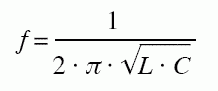
Thomson formula f=1/(2Pi*(LC)^0.5)

I have not calculated you have to check if it is.
The two resistors form only a resistive divider.

But the parallel resistance to LC has an impact on Q. Q is related to bandwidth.
To encourage you, I tell you that I have seen LC parallel with R in the radios to shrink the bandwidth.
 

Motanache

Joined Mar 2, 2015
652
a) the resonant frequency

b) the dynamic resistance
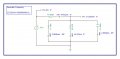
Three parallel components R, L and C. all this in series with another R
So,
1/Z=1/R1+1/ZL+1/ZC
Z+R2=Zt=answer


c) the current at resonance
You know Zt and the resonance frequency. replace

I=U/R for DC
And I=U/Z dor DC.

If Z is complex you calculate the module

That's why you need to know the generator voltage.

d) the circuit 'Q' factor
reactive energy on total energy

e) the voltages across all 4 components
This depends on the frequency.
 
Last edited:

MrAl

Joined Jun 17, 2014
13,704
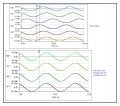
Funilly enough, 1/sqrt(LC) was the first formula i tried, but when i tested it in multisim it was reading out of phase in the scope:

that reading made me believe it was the wrong formula.... and on Monday when i spoke to our tutor, he spotted my notes and laughed, realising i'd got it right then wasted a few days banging my head against the wall.

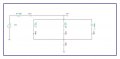
Upon trying the formula again, i moved the osc probe to include the 990k resistor and it was exactly as i originally wanted/expected:

I didn't think the resistor on it's own would affect the phase angles, so again, this has me confused.
Hello again,

A mathematical analysis of the circuit does show the resonant frequency to be w=1/sqrt(LC) which means the frequency f=23.7254 to six significant figures. That is the point where the circuit becomes purely resistive and se we end up with a resistive divider with transfer function:
Vout=Vin*470/(990000+470)

It was a good idea to look for phase shift because that would say that it is not all resistive. In a circuit simulator program that should be possible. However as Electrician pointed out, circuit simulators sometimes have parasitic elements that are added to the circuit for various reasons and that could be changing the phase shift. It could also be that the frequency you set it too is not exact enough to see the circuit behavior in resonance. For example using 23.7Hz probably is not good enough, while using 23.725 probably is. It could also be the combination of the parasitic elements and a frequency setting that is not exact enough.
Circuit simulators sometimes have settings for the default behavior so you could look for that too in your software.

Also, you could look for amplitude normalization by multiplying the output:
VoutB=Vout*990470/470

and now you should see both waveforms come out to exactly the same amplitude in the simulation:
VoutB=Vin.

As a side note, it looks like for this circuit the resonant peak occurs at the same frequency as the physical resonance.
 
Last edited:

JoeJester

Joined Apr 26, 2005
4,390
In a circuit simulator program that should be possible. However as Electrician pointed out, circuit simulators sometimes have parasitic elements that are added to the circuit for various reasons and that could be changing the phase shift.
That is true MrAl. I do know LTSpice adds series resistance to their voltage sources and parallel resistance to their current sources that reduces the "irregular" circuit type errors from articles written before, but I don't know if the current version kept the same. I assume so since it certainly helps speed up the simulations. I certainly will be asking questions at the support site. I hadn't had this type of problem before and I've been using this program since version 4.x.
 
2nowman, if you get back to this problem soon, I think the next thing you should do is to change the 900 uF capacitor to a 9 uF capacitor. This will increase the resonance frequency by a factor of exactly 10. So change the frequency of the voltage source to 237.254181139059 Hz, change the sweep speed of the simulator's scope to 10 times as fast and see if the amount of phase difference is the same. If it's different this will help us figure out what's happening.

Changing the capacitor to 9 uF and increasing the excitation frequency by a factor of 10 increases the circuit impedance by a factor of 10, so it may be necessary to increase the resistors by a factor of 10 also to get exactly the same behavior.

I would first run the simulation with only the capacitor changed to 9 uF and the frequency increased by a factor of 10; report the result. Then increase the resistors by a factor of 10 and re-run the simulation, reporting the result. These changes may give us a clue as to the problem.

JoeJesteer, you might also try these changes.

I'll check back after the Thanksgiving riot.
 

MrAl

Joined Jun 17, 2014
13,704
That is true MrAl. I do know LTSpice adds series resistance to their voltage sources and parallel resistance to their current sources that reduces the "irregular" circuit type errors from articles written before, but I don't know if the current version kept the same. I assume so since it certainly helps speed up the simulations. I certainly will be asking questions at the support site. I hadn't had this type of problem before and I've been using this program since version 4.x.
Hi,

Yeah i forgot to mention that the time step might affect it too. A smaller time step might help to reduce accumulated errors which helps keep the phase shift right.
 

JoeJester

Joined Apr 26, 2005
4,390
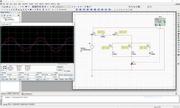
True. Time step was the issue. Reduced it to 100n and everything was fine. What upsets me the most is I typically change the TR time step when working with oscillators.

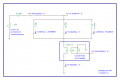
here is the circuit with the current and voltage probes. The solution only shows those currents that are in phase. I only used 45 v pk, so when the meters indicated the peak voltage, it would represent the rms values without doing any calculations.

CIRCUIT.jpg

fixed.jpg
 
Last edited:

Bordodynov

Joined May 20, 2015
3,431
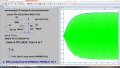
Amplit.png I will warn of the large error in the calculated amplitude. But first see the results of my calculations.
Output Amplitude of high-Q systems increases gradually. The higher the quality factor, the longer the amplitude increases.
Vout=V(x)=max(V(x))*(1-exp(-time/tau)
For an acceptable, relative error of 0.001 ==> Tmax=0.8459867812*Ln(1000)=5.84sec
So, that two seconds is clearly not enough. It may be necessary to increase the relative error reltol = 10u
 
Last edited:

MrAl

Joined Jun 17, 2014
13,704
View attachment 139975 I will warn of the large error in the calculated amplitude. But first see the results of my calculations.
View attachment 139973
Output Amplitude of high-Q systems increases gradually. The higher the quality factor, the longer the amplitude increases.
Vout=V(x)=max(V(x))*(1-exp(-time/tau)
For an acceptable, relative error of 0.001 ==> Tmax=0.8459867812*Ln(1000)=5.84sec
So, that two seconds is clearly not enough. It may be necessary to increase the relative error reltol = 10u
Hi,

AAC Error: Attached file could not be found.

Try posting the pic right here or something else.

A way to get rid of the exponential part fast is to use a cosine wave drive instead of sine and set the initial voltage of the cap to 47/99047 volts. That sets the correct solution voltage at t=0 and so there is no waiting for the exponential part to die off. There might be another way too.
Of course when doing this it is good to make sure the response does not change well into the future too, in order to ensure we set the right starting conditions.
 
Last edited:

MrAl

Joined Jun 17, 2014
13,704
True. Time step was the issue. Reduced it to 100n and everything was fine. What upsets me the most is I typically change the TR time step when working with oscillators.

here is the circuit with the current and voltage probes. The solution only shows those currents that are in phase. I only used 45 v pk, so when the meters indicated the peak voltage, it would represent the rms values without doing any calculations.

View attachment 139967

View attachment 139966
Hi,

Interesting simulation. We can see the current flow from cap to inductor and back again.
 

Thread Starter

2nowman

Joined Jan 14, 2017
17
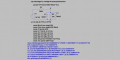
Apologies for not replying earlier, and thanks for the time step advice (and all the other help), altering that has corrected the issue:


I've only had chance to work out the total current so far, but will carry on with the rest of it later this evening.
 

JoeJester

Joined Apr 26, 2005
4,390
Here are the changes used for oscillators ...

Oscillators:
Tighten RELTOL to 0.0001 because oscillators accumulate phase error.
Set TMAX so that there are at least 10-25 time steps per period.
Increase TR time intrv. subdivisions parameter (e.g., set it to 1E6).
I did review the material on my program and there is no parasitic elements with resistors, capacitors, or inductors ... unless I set them. Even the voltage sources and signal generators are pure, so internal resistances or shunt resistances must be added via setting a parameter or adding components. That is the one area I read the LTSpice does automatically to "speed up" some calculations, especially the operating points.

All in all, this was an interesting exercise.
 
Top