Parallel and series AC question

Thread Starter

2nowman

Joined Jan 14, 2017
17
I'm sorry about this, but i still have absolutely no idea what to do with this circuit...
at the minute i have found:
frequency: 23.725...Hz
total current: 45.45453303uA
Xl = 7.453559924 ohm
Xc = 7.453559926 ohm
dynamic impedance: 0.1182033096 ohms
Q: 0.015858

my next step was to try and find the currents in each branch of the parallel section, so i tried to use mesh analysis for the 3 loops,
i ended up with the left loop as 45.45437569uA, the middle loop as 22.90598133uA and the right loop as 22.5483945uA which is wrong, and that was circuit analysis by guessing, as i've never been shown how to approach this with ac (only dc).

As an example of how i calculated (guessed) current in the middle loop, i came up with the equation (I2 - I1)(7.453559924)+(I2 - I3)(470) = 0
i don't know if i should be using the resistance with inductive reactance values (which i did above), or the impedance or dynamic impedance.

someone mentioned earlier that to find current i should use: I=U/R for DC And I=U/Z dor DC. what is U?
 

Thread Starter

2nowman

Joined Jan 14, 2017
17
I think one of my issues is that i'm adding/subtracting the resistor value to the inductive reactance, which should be something like sqrt of the resistor squared + Xl squared
 

MrAl

Joined Jun 17, 2014
13,704
Hello,

Do you know the voltage divider formula:
Vout=Vin*Z2/(Z1+Z2)

and do you know how to combine impedances in parallel:
Z=1/(1/Z1+1/Z2+1/Z3)

if you know how to do that, you can use Z2=Z and Z1=990k and calculate the voltage at the single unknown node of the circuit and go from there.
Did you ever work with complex impedances?
 

Thread Starter

2nowman

Joined Jan 14, 2017
17
Yes, i do know those formulas, but i've only used them with dc circuits... and i wasn't sure if i could just add, subtract and multiply etc, so i think it's that relationship between reactance, impedance and resistance where i'm getting confused, as i know sometimes pythag is needed.

So when you use Z in those formulas above, can Z refer to either; the resistance of a resistor, and/or the reactance of a capacitor/inductor?
and if so, would i be ok to use:
Z = R470 * XL / R470 + XL

then;
ZPARALLEL = Z * XC / Z + XC
then;

ZTOTAL = ZPARALLEL + R990k

PS I've never used complex numbers before, but i know it's holding me back from studying online, as most tutorials/videos seem to use complex numbers with their examples - i will learn about them at some point, but i simply dont have time for now.
 

JoeJester

Joined Apr 26, 2005
4,390
If you showed your work .... it would be easier to help you.

If you use engineering notation or scientific notation to three decimal places, our answers would be easier. i.e. Rd =118.203 e-3 (engineering) 1.182 e-3 (scientific). Don't forget to track your units.
 
If you showed your work .... it would be easier to help you.

If you use engineering notation or scientific notation to three decimal places, our answers would be easier. i.e. Rd =118.203 e-3 (engineering) 1.182 e-3 (scientific). Don't forget to track your units.
This should be: Rd =118.203 e-3 (engineering) 1.182 e-1 (scientific).
 
You right. So much for paying attention. Guilty as charged.
The day we, the living, stop making mistakes, is the day we die. :)

I'm surprised that the TS's problem was a too large time step. Do you recognize what simulator he's using? I would have thought that the default step would have worked.

I set up the simulation with MicroCap which is my usual simulator. I found that a time step of 100 microseconds was sufficient to give the correct result.
 

JoeJester

Joined Apr 26, 2005
4,390
The day we, the living, stop making mistakes, is the day we die. :)

I'm surprised that the TS's problem was a too large time step. Do you recognize what simulator he's using? I would have thought that the default step would have worked.

I set up the simulation with MicroCap which is my usual simulator. I found that a time step of 100 microseconds was sufficient to give the correct result.
MicroCap must be doing something different to shorten the simulation time. Typically I start with zero volts on everything and do not allow the operating point calculation. That simulates power-up conditions.

The TS is using multisim.

Most come with pre-packaged parameters. Default usually works with most circuits. However ... here are some items one can try:

Circuit with very small currents or voltages:
Tighten DC absolute current error to 1 picoamp (ABSTOL - absolute current error tolerance. The default value is 1 nanoamp. ) and DC absolute voltage error to 1 nanovolt (VNTOL - absolute voltage error tolerance of the program. The default value is 1 microvolt. )

DC Convergence of nonlinear circuits:
Increase GMIN to 1 n to 10n. GMIN defines the minimum conductance connected in parallel to a pn junction. It helps converge in deep nonlinear circuits by linearly routing some currents out of the nonlinear element.

Increase transient simulation speed #1:
Increasing TR maximum value relative error to 100m or 1 will speed up the simulation with a loss of precision.
Increasing TR Truncation error factor (TRTOL) to a large value (14 - 35) for circuits where there is an interest in the steady state but not in how it was reached.

Increase transient simulation speed #2:
Relax the DC relative error to 0.01. The default value is 10-3 [ % ].You may increase the value of this parameter in order to get the results faster but with less accuracy.
Loosen DC absolute current error to 1 microamp (Spice ABSTOL - absolute current error tolerance. The default value is 1 nanoamp. ) and DC absolute voltage error to 1 milivolt (Spice VNTOL - absolute voltage error tolerance of the program. The default value is 1 microvolt. )

Irregular Circuit problems caused by floating nodes.
Set Shunt conductance
The conductance specified here is added from each node to the ground. The default value is zero. Specifying 1p or similar value might solve some convergence problems or irregular circuit problems caused by floating nodes.

To solve DC Convergence Problems when circuit exhibits very large currents or voltages:
Loosen DC absolute current error to 1 microamp (Spice ABSTOL - absolute current error tolerance. The default value is 1 nanoamp. ) and DC absolute voltage error to 1 milivolt (Spice VNTOL - absolute voltage error tolerance of the program. The default value is 1 microvolt. )

Oscillators:
Tighten RELTOL to 0.0001 because oscillators accumulate phase error.
Set TMAX so that there are at least 10-25 time steps per period.
Increase TR time intrv. subdivisions parameter (e.g., set it to 1E6).

Parameter settings for faster simulation of SMPS circuits
Increase DC relative error(%) to 10m
Increase TR maximum value relative error (%) to 1
Decrease TR maximum time step (s) to 200n

Transient Convergence Solutions:
Increase the TR max iteration number which is the maximum number of iterations on a step in transient analysis. (Default = 20). Increasing to 50-100 helps to solve "Time step too small" errors.
Relax the DC relative error to 0.01. The default value is 10-3 [ % ].You may increase the value of this parameter in order to get the results faster but with less accuracy.
Loosen DC absolute current error to 1 microamp (Spice ABSTOL - absolute current error tolerance. The default value is 1 nanoamp. ) and DC absolute voltage error to 1 milivolt (Spice VNTOL - absolute voltage error tolerance of the program. The default value is 1 microvolt. )
I typically don't think about the parameters, however, I need to start. I can remember in the 1980s when I was sweeping notch filters that had narrow bandwidths. Sweeping too fast, the nadir was incorrect. Sweeping a smaller window and longer time, the proper nadir was seen. I use to compare the RFI to the notch and when necessary, center the notch on the RFI. It was totally against the current policy to do such a thing, but, when your right, all they can do is take a bite of your ass and save some for the next time. Time to apply some associative learning when using these simulators and sampling. :)
 
Last edited:

MrAl

Joined Jun 17, 2014
13,704
The day we, the living, stop making mistakes, is the day we die. :)

I'm surprised that the TS's problem was a too large time step. Do you recognize what simulator he's using? I would have thought that the default step would have worked.

I set up the simulation with MicroCap which is my usual simulator. I found that a time step of 100 microseconds was sufficient to give the correct result.
Hi,

Doesnt MicroCap let you change the *maximum* step time?
In other words, it may use a smaller time step if the algorithm requires that. So stating that 100us is sufficient may not be a good enough description, although it may in fact be using that.
Also, you may want to state if you are using Gears or Trap.
 

MrAl

Joined Jun 17, 2014
13,704
Yes, i do know those formulas, but i've only used them with dc circuits... and i wasn't sure if i could just add, subtract and multiply etc, so i think it's that relationship between reactance, impedance and resistance where i'm getting confused, as i know sometimes pythag is needed.

So when you use Z in those formulas above, can Z refer to either; the resistance of a resistor, and/or the reactance of a capacitor/inductor?
and if so, would i be ok to use:
Z = R470 * XL / R470 + XL
then;

ZPARALLEL = Z * XC / Z + XC
then;

ZTOTAL = ZPARALLEL + R990k

PS I've never used complex numbers before, but i know it's holding me back from studying online, as most tutorials/videos seem to use complex numbers with their examples - i will learn about them at some point, but i simply dont have time for now.

Hi,

Well it is hard to work with networks without complex numbers. All you have to do is add, subtract, multiply, divide and maybe a few other little things. Let me illustrate a few.

Add two complex numbers a+bj and c+dj:
(a+bj)+(c+dj)=a+c+(b+d)*j

Subtract two:
(a+bj)-(c+dj)=a-c+(b-d)*j

Multiply two:
(a+bj)*(c+dj)=a*c+a*dj+c*bj+bj*dj=ac+(ad+bc)*j+bd*j^2

Division is a little harder to do so we can wait on that one, but see how simple the other three are?

Also, because j=sqrt(-1) then j^2=-1 so the above multiplication comes out simpler:
ac+(ad+bc)*j+bd*-1=ac-bd+(ad+bc)*j

Because the circuit is at resonance though, see if you can use that fact to calculate the voltage across the cap and inductor.

Complex numbers makes this so much easier and you can learn enough about them in one or two nights to do these second order networks.

The impedances using the Laplace variable 's' is:
zL=s*L
zC=1/(s*C)
zR=R

The parallel combination is just:
Z=1/(1/zL+1/zC+1/zR)

so we get:
Z=1/(1/(s*L)+s*C+1/R)

which comes out to:
Z=1/((s^2*C*L*R+R+s*L)/(s*L*R))

which comes out to:
Z=(s*L*R)/(s^2*C*L*R+R+s*L)

If you can follow that logic then you are half way there.
 
Hi,

Doesnt MicroCap let you change the *maximum* step time?
In other words, it may use a smaller time step if the algorithm requires that. So stating that 100us is sufficient may not be a good enough description, although it may in fact be using that.
Also, you may want to state if you are using Gears or Trap.
MicroCap (I'm using an older version) does reduce the step size automatically if the rate of change of a variable is large, but that's not the case here.

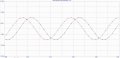
Here is the result of plotting the voltage across the tank and the current through R1, using a 3 millisecond step. The points where the evaluations are made are marked. You can see the bad result:

Reso1.jpg

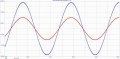
Here's the simulation with a step size of 200 uS. This is a much better result:

Reso2.jpg

I don't know what Gears or Trap is.
 

Thread Starter

2nowman

Joined Jan 14, 2017
17
thanks again for the help, but none of the above makes any sense to me, i've no idea what a complex number is or laplace, and it's not something we will learn on the course i'm on, so we definately dont need it.

I've got a job with long hours and a long commute then two elderly parents (one very ill) that i spend a lot of time helping, i've then got to balance college with coursework on my HNC (which i'm about 2 weeks behind), so thanks for the help, but i'm just getting more questions than answers, so thats it, i give up, it's not worth the stress.

Thanks again for trying.
 

JoeJester

Joined Apr 26, 2005
4,390
thanks again for the help, but none of the above makes any sense to me, i've no idea what a complex number is or laplace, and it's not something we will learn on the course i'm on, so we definately dont need it.

I've got a job with long hours and a long commute then two elderly parents (one very ill) that i spend a lot of time helping, i've then got to balance college with coursework on my HNC (which i'm about 2 weeks behind), so thanks for the help, but i'm just getting more questions than answers, so thats it, i give up, it's not worth the stress.

Thanks again for trying.
Look through this tutorial This might help you.

HNC, I assume is the Higher National Certification as described by wiki.
 

MrAl

Joined Jun 17, 2014
13,704
MicroCap (I'm using an older version) does reduce the step size automatically if the rate of change of a variable is large, but that's not the case here.

Here is the result of plotting the voltage across the tank and the current through R1, using a 3 millisecond step. The points where the evaluations are made are marked. You can see the bad result:

View attachment 140059

Here's the simulation with a step size of 200 uS. This is a much better result:

View attachment 140060

I don't know what Gears or Trap is.

Hi,

Oh yes much better with the smaller step size.

Gears and Trap (Trapezoidal) are two of the methods of solving the ODE's numerically that simulators often use. MicroCap should give a choice of which one to use with some checkbox or something. Gears is considered much more accurate but is slower because it uses an intermediate iteration stage. I think LT Spice might give this option too. Gears may work when Trap doesnt for example.
What i noticed about MicroCap is that the default setting for the step size (where we dont enter one ourselves) is always too large and gives results that look like they are pieced together with straight lines. They may have ujpdated it after my version though.
 

MrAl

Joined Jun 17, 2014
13,704
thanks again for the help, but none of the above makes any sense to me, i've no idea what a complex number is or laplace, and it's not something we will learn on the course i'm on, so we definately dont need it.

I've got a job with long hours and a long commute then two elderly parents (one very ill) that i spend a lot of time helping, i've then got to balance college with coursework on my HNC (which i'm about 2 weeks behind), so thanks for the help, but i'm just getting more questions than answers, so thats it, i give up, it's not worth the stress.

Thanks again for trying.
Hi,

Sorry to hear it sounds like you are getting a little discouraged. Maybe what you are looking for is a formula for this particular network. I can provide that for you but i hesitate because then you will only know how to do it with this network and not other networks that are even slightly different.

What i attempt to do is provide a general method that works on all networks so that method can be used by anyone on any network. For AC circuits i always recommend the complex number method because it is so general it works on all linear networks as far as i know.

What you might be experiencing is a mental block when you read the word "complex" because it sounds like it will be very complicated to learn. The word "complex" in history was probably a bad choice of words because it gives that impression and people are often turned away because of that. A better choice might have been, "two component numbers" because they are just like ordinary numbers except they have two parts. Everything else works the same like addition, subtraction, etc., except we work with two numbers at the same time instead of just one at a time.

If you still reject complex numbers, then you have to realize it will be difficult to learn circuit analysis because you will have to learn some new trick for every network you run into. Given you are going to do that, then what you might try is to try to find out how to combine series impedances so after you compute the impedance of the RLC section you might be able to apply that. It will be tricky in itself though.

One thing that helps a lot here is automated math software. It helps compute these things so we dont have to do a lot of work by hand.

So the answer to your questions is a set of formulas that will give the desired results being asked for, but i am not sure what good it will do you if we just hand you the formulas.

At the risk of asking one more question you dont want to hear, are you sure you just want the formulas thrown at you?
 
What i noticed about MicroCap is that the default setting for the step size (where we dont enter one ourselves) is always too large and gives results that look like they are pieced together with straight lines. They may have ujpdated it after my version though.
That could be a good thing. You would notice that and realize that you needed to reduce the step size. You can see that piecewise linear effect in the first image in my post above.
 

MrAl

Joined Jun 17, 2014
13,704
That could be a good thing. You would notice that and realize that you needed to reduce the step size. You can see that piecewise linear effect in the first image in my post above.
Hi,

Well for a very complicated slow moving circuit it could be good because we get a quick idea what is going on, but for almost everything we do on this forum for example i always have to set it myself. That gets old fast :)
In other words, for almost everything we do here i would have to notice that and reduce the step size, or really just enter a step size i thjink would be appropriate. Im so used to it now that i dont even run it like that most of the time so when i set the time span i just set6 the imin step too. I find that a step size of 1/1000 times the total sim time seems to work good for a first pass, and sometimes 1/10000 of the total time. So i just set that now when i set up the circuit for the first time.
I almost always use Gears too because the circuits are usually simple enough. I've used Trap a few times for switching power supplies because of the filter initial time to steady state when i dont set the initial values for the components. Often works a little faster with only a little reduced accuracy.
 
Top