Don't worry, this happens sometimes.
What appears to be copper probably isn't. If this was a green masked PCB then you need to follow where the trace went and if needed you can scrap off some green mask and solder thin jumper wire's to make connections. Or you can follow the
trace to the next pad and connect there.
If I'm making no sense , then why not post a clear picture of the area in question.
Thank you for these helpful replies! Yeah, I do know what you mean--I should have thought of that! Guess this is my first time trying to repair something like this. I've got plenty of solid-copper wire around so I'll just take some of that and run it to the next pad. I should have a chance to try that tonight. I'll post back with the results....... Thanks people!
Update: OKAY! I got in there and soldered up some wires to the pins and viola, it works!
Or at least the right channel works now. I tested it on FM, AM, & aux, none have any output on the left channel. And the VU meter for the left never moves except when you turn the unit on. The right one goes from min to max depending on the radio station strength. Any ideas what I should check next to see where my problem might be? I might post up some more detailed pictures of the insides this weekend.
That's promising!
Listen very closely to both speakers. If both amplifier channels are working, you should hear a very soft hiss equally through both speakers with no signal applied. If not, make sure there is no DC remaining on the speaker outputs.
Double check the connections, and that the left speaker fuse is still OK.
Have you worked the controls and switches ? May be just a dirty pot or switch.
Some receivers have preamp out/power amp in jacks for attaching an external equalizer for example. They would normally be jumpered or have an in-out switch to bypass. If that is the case the power amp input is a convenient spot to run a test signal. Just be careful in case the main volume control is before that.
Update: OKAY! I got in there and soldered up some wires to the pins and viola, it works!
Or at least the right channel works now. I tested it on FM, AM, & aux, none have any output on the left channel. And the VU meter for the left never moves except when you turn the unit on. The right one goes from min to max depending on the radio station strength. Any ideas what I should check next to see where my problem might be? I might post up some more detailed pictures of the insides this weekend.
So I should update this thread with the resolution of the issue:
I was feeling happy, having replaced the modular power amp and fixed the right channel, but also feeling a little daunted by the prospect of trying to troubleshoot the left channel which was still out. The Panasonic, along with a whole mess of tools and other junk, cluttered up my dining room table for a few weeks. My buddy who helped me install the modular power amp came back for another visit last weekend and we had sat down to chow on some tasty salmon burger action.
I had turned on the radio because it was there, and there was a blues station on. My buddy, a guitarist, decided he wanted to hear this better, so he turned up the volume a bit. A ferocious crackle came from the dead channel... followed by music! Apparently my pal has got the magic touch?!
I had tried working the volume control around, wondering if the potentiometer might be dirty, but I didn't get any crackles trying it. Guess I just didn't try long enough? I gave it a good blast of deoxit from both sides and the crackle is gone now too. Sweeeet. So it's seemingly 100%! I replaced the burnt out bulb and the dials light up now too. I don't have any 8-tracks to test out the player, but maybe I might get on eBay and pick some up soon. Thank you to all on here who provided me with guidance. Could not have done it without y'all!
If you can reach it, or even see it. Check the tape head in the 8 track for any smears of a dark brown or black nature. The oxide from the tapes wears off and deposits on the head. You can clean it off with high proof alcohol and a Q-tip. Also look closely at the rubber drive tire next to the tape head. It will sometimes 'glaze' with the same brownish oxide junk. It can also be cleaned, but I recommend using WD-40 on the Q-tip and following that with the alcohol. Note that neither of those chemicals is good for the rubber, but if used sparingly and cleaned off carefully, one or two applications for cleaning purposes will do no noticeable harm there.
Great to read the experience above and to see the support - maybe you guys can help me??
I imported an RA-6600 into the UK about 10 years ago - hasn't had much use due to personal circumstances but I'm now ready to team it up with a '74 Sony open reel deck, an '84 a Technics 1210 turntable and a pair of '84 Wharfedale Diamond MkII speakers to create the vintage system I've had in my head since I pressed "Buy Now" on eBay all those years ago. The RA-6600 is powered via a separate step-down transformer because it is 120v only.
What I recall from before is that there's a persistent crackle on the output of both channels. It crackles all the time and it isn't affected by the volume level or adjustment of any other pots. Given that I can be reasonably sure it isn't from the pre-amp, plus I don't get it when fed through another amp via the tape-outs. It's been suggested that tired capacitors are the cause and that I should replace any faulty ones.
Question is - would you guys agree, and how do I identify which caps are at fault? Or does anyone suspect the step-down transformer??
Grateful for any guidance and/or a link to a workshop manual.
good day sir, do you still have this unit? the transformer died in mines and i would really like to get the part number or the voltage and current values of the secondary windings
-noted! I ordered the STK040 replacement off eBay today. Only $10 but it's coming from China so it'll be a week or more before I see it probably. I'll update this thread when I get the chance to install. Might be a while, but hopefully this does the trick! Thanks everybody.
I did an output amplifier on a Marantz receiver once and I had to also replace the power transformer and then redo the power supply. So while it can be done it can be a very big project. So my suggestion is to locate a separate power amplifier able to provide however much power that you want. And since all of the controls are on this receiver, all that the additional amplifier really needs is a power switch, although a level control can be handy. You may even be able to use one of those high powered car amps, substituting a mains powered DC supply for the inverter supply inside the unit. Those amps generally have much better specifications. 0.9% distortion is not great for most listening you can do a lot better.
I did an output amplifier on a Marantz receiver once and I had to also replace the power transformer and then redo the power supply. So while it can be done it can be a very big project. So my suggestion is to locate a separate power amplifier able to provide however much power that you want. And since all of the controls are on this receiver, all that the additional amplifier really needs is a power switch, although a level control can be handy. You may even be able to use one of those high powered car amps, substituting a mains powered DC supply for the inverter supply inside the unit. Those amps generally have much better specifications. 0.9% distortion is not great for most listening you can do a lot better.
OK, thanks for the notification. Nothing popped up like it used to pop up when I would go to address an old thread. So I guess the problem is somebody needs a power transformer. If they have the failed one, one very tedious option is to count turns on the low voltage windings, presuming that the pilot lights are 6 volts. The voltage ratio should be close to the turns ratio.
I think you only get the big warning when you're the one resurrecting an old thread. If you're the second one in, it just looks like any other thread. This has been an issue here for as long as I can remember. If you don't look at the dates, you read and read to get caught up and then try to write a useful post, only to discover the world has moved on long ago.
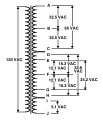
@Lonramsingh Here's a schematic of a transformer I took out of an old stereo. It had an STK4192 amplifier chip in it. I have it in my cabinet for if ever I need any of these voltages. I'm going to guess yours is probably similar in voltages. Depending on your power, these values will possibly change.
@Lonramsingh Here's a schematic of a transformer I took out of an old stereo. It had an STK4192 amplifier chip in it. I have it in my cabinet for if ever I need any of these voltages. I'm going to guess yours is probably similar in voltages. Depending on your power, these values will possibly change.
Probably the 65 volt winding is the high current one for the output stages and the 24 volt one provides power for the rest of the electronics and the tape drive. And the 5.1 volts would be for the lights.
@MisterBill2 Yes, the 65 V was the heaviest gauge wire in the transformer. It was rectified and then sent to the amplifier board with the two large capacitors. There is a microprocessor on the main board as well. My guess is that the 5 volts also powered that.

 Facebook
 Google
 GitHub
 Linkedin


 , then why not post a clear picture of the area in question.