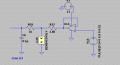
Hi, I need to protect a pin of a microcontroller at all cost, so there an a efective way to protect the pin? what components or circuit can I put for me to prevent that voltage to go higher? It cannot go higher than 3.3v
I actually did this but the problem is that if the voltage of the power supply goes up, the current that the zener needs to work (5mA) goes up too and therefore the zener stops working properly... I don't know if I'm explaining myself haha
When voltage stability is a concern.
look at a data sheet of a nice voltage reference, on page 6. ADR4533 fairly stable 3.300 V 2ppm. page 22 fig 56 keeping the component
at 40 degrees C is important. Starting with Vref, less noise and possibly accuracy low ppm makes for stable reference. https://www.analog.com/media/en/tec...a-sheets/ADR4520_4525_4530_4533_4540_4550.pdf
The simulation may not show the stability of the zener Voltage reference, the quality Vref in the data sheet has an improved approach.
When discussing a circuit the datasheet specifies the component's tolerance in terms that our measuring instruments will reflect.
When there is a real concern for voltage stability and possibly accuracy, What goes into the op amp should be reliable first.
Like someone building a house from the roof down is frustrating but it all pays the same.
What comes out of the op amp is another issue. The schematic calls for a BZX zener 5%. logically the op amp follower is not critical.
The narrative says it is critical. Defining a final output tolerance is relevant to the supply. The supply is a good place to start.
The selection of an appropriate op amp based on final output tolerance is sketchy since we cannot assume what the other parts are.
Are you talking about an input pin? Normally all you need is a resistor in series, the micro usually has diodes to the two power supply rails for protection. The resistor is chosen to limit the current to what is allowed in those protection diodes.
You really need to explain what you are actually doing. What is the nature of the source?
In the absence of any additional information, the first thing is an optoisolater. That way your only problem is protecting an opto from overvoltage not an MCU pin. Then you can do a variety of things depending on where the potentially damaging voltage is coming from.
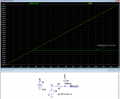
A 1kΩ series resistor at the micro input with a Schottky diode (e.g. BAT54) to the 3.3V supply (cathode) should protect against a 12V (or greater) input (LTspice sim below):
The micro input voltage is about 3.6V with an input voltage of 12V.
The input can generally tolerate a voltage that is below one silicon-diode drop (≈0.6V) greater than the supply voltage.
I did once need to provide a serious voltage clamp to protect a load, in a similar situation. My solution was a forward biased string of power diodes rated at 15 amps short term. I started with the assumption of 0.7 volts forward drop at the rated current, and used enough diodes to be fully conducting at that level. That worked but it was too high a voltage, so the string was two diodes shorter than calculated to protect at 12 volts.
To protect a 3.3 volt load a forward biased string of four power diodes should be able to protect the load. The diodes current rating should be greater than either the supplies rating or the fuse rating.
You will need to verify the protection level is adequate, different brands of diodes are a small bit different. You might possibly get away with only 3 diodes in the string, but probably not. And they will probably be conducting a small amount at 3.3 volts, even though the math says 2.8 volts.
BUT it will be reliable and quite fast acting.

 Facebook
 Google
 GitHub
 Linkedin