Oscilloscope Differential Measurement

Thread Starter

cl10Greg

Joined Jan 28, 2010
67
Hello,

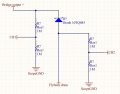
I have been tasked to obtain a waveform across a TVS for a power supply. The TVS is connected between the input voltage and the flyback offline switcher. We don't have a differential probe so my boss and I came up with a design to simulate one with the math function. I just wanted to get some feedback/input on the methodology. The AC ground and scope ground are not connected so there is no ground loop.
 

Attachments

MikeML

Joined Oct 2, 2009
5,444
So, what is the voltage at "Flyback Drain" with respect to "Scope Ground"?

Your circuit effectively puts a 50% attenuator in each scope channel. Is this enough? Your scope manual will specify what the max allowed single-ended input voltage is. Both with and without a 10X attenuator probe.

Depending on your scope specs (and/or the 10X probe specs), the 2:1 attenuator is superfluous, or not enough...
 
Last edited:

MrChips

Joined Oct 2, 2009
34,817
Most modern scopes allow you to make a differential measurement using the MATH function.
Simply connect CH1 and CH2 probes and set the MATH function to CH1-CH2 or CH2-CH1 as desired.
 

MikeML

Joined Oct 2, 2009
5,444
Most modern scopes allow you to make a differential measurement using the MATH function.
Simply connect CH1 and CH2 probes and set the MATH function to CH1-CH2 or CH2-CH1 as desired.
Provided you do not exceed the maximum-allowed single-ended input voltage for each channel.
 

MrChips

Joined Oct 2, 2009
34,817
Good point. I can't always remember to point out all the limitations and caveats
such as put one hand in your pocket when making high voltage measurements.
 

KL7AJ

Joined Nov 4, 2008
2,229
Most modern scopes allow you to make a differential measurement using the MATH function.
Simply connect CH1 and CH2 probes and set the MATH function to CH1-CH2 or CH2-CH1 as desired.
Most dual channel scopes, even ancient analog ones, allow you to do a differential measurement using two probes. Set up both channels for the same vertical gain, but reverse the polarity of channel B. (Be sure your probes are both set to the same attenuation!)

Eric
 

tindel

Joined Sep 16, 2012
939
http://www.testunlimited.com/pdf/an/3AW_19134_0_2010.02.19.10.47.40_3214_EN.pdf

Thee above Tektronix App Note describes the different ways to take differential measurements...

Tek conveniently left one way out the cheapest way to take a differential measurement (presumably to sell more of the isolated scopes)... the way they left out was to use an isolation transformer on the circuit under test. Every lab should have one (or more) isolation transformer, without the ground passing through. They are cheap and could save your life if testing high voltage circuits.

Pros:
You can make your diff measurement
This is the preferred method of testing electrical circuits to avoid shock hazards
Parasitic capacitance to earth ground are usually low.
Cons:
Do note that you can only take one differential measurement at a time because all of the scope probe grounds are connected together - don't short something out!
Be aware that the voltage you attach the scope ground to will be earth grounded, this means that the potential for electrical shock goes up if you're testing high voltages.


Yet another way is to use a battery operated scope while unplugged from the wall.

Pros:
You get your diff measurement
Cons:
Scopes are pricey
Only one measurement
 
Top