thanks for your answer !The geometric interpretation of orthogonal means perpendicular, or at right angles. There are several mathematical tests for orthogonality, but the easiest is to take the dot product of two vectors and if it is zero then the vectors are orthogonal. Wait a minute you say what do vectors have to do with waves? Glad you asked that, but that is left as an exercise for the reader.
The OP asked for "not in the same frequency". Does the above applies to it? That would mean an occurrence every so many (miliseconds or whatever), right?The geometric interpretation of orthogonal means perpendicular, or at right angles. There are several mathematical tests for orthogonality, but the easiest is to take the dot product of two vectors and if it is zero then the vectors are orthogonal. Wait a minute you say what do vectors have to do with waves? Glad you asked that, but that is left as an exercise for the reader.
If the waves are not coupled by some mechanism, say Maxwell's Equations, how can they remain orthogonal if they are independent of each other. I'm looking for an example here of waves that have different frequencies and yet are orthogonal.

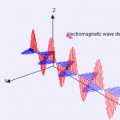
And not of the same frequency, keep in mind. And nothing else.When most of the people here read “Orthogonality of waves definition”, we tend to think of the orientation of the electric and the magnetic fields and the direction of travel of a radio wave.
But in your written post you ask about the orthogonality between two separate waves.
| Thread starter | Similar threads | Forum | Replies | Date |
|---|---|---|---|---|
| M | Does wood attenuate radio waves? | Wireless & RF Design | 21 | |
|
|
Strange waves appear | Test & Measurement | 4 | |
|
|
Does a Series Cap Prefer Unipolar or Bipolar Square Waves | Analog & Mixed-Signal Design | 152 | |
| Y | proving radiation orthogonality between two antennas | Wireless & RF Design | 0 | |
|
|
Orthogonality ... a memorable example | Off-Topic | 4 |