Optimal fan configuration for TO-220 heatsink (RA‑T2X‑64E) with active cooling

Thread Starter

Zebananos

Joined Jul 30, 2025
10
Hello,

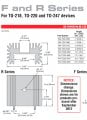
I’m working on a power electronics project using a single TO-220 MOSFET mounted on a RA‑T2X‑64E extruded heatsink (cylindrical shape with vertical radial fins).
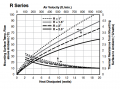
I’m aiming to reach at least 1000 feet per minute of airflow using active cooling, but the datasheet doesn’t specify how fans should be positioned to achieve the expected Rθ values.
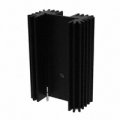
1000175977.jpg

System details:

Heatsink: Boyd RA‑T2X‑64E
• Total diameter: 63.5 mm
• Height: 21 mm
• Central base diameter: 25.4 mm
• Designed for TO-220 / TO-218 / TO-247 packages
• Three flat mounting faces with radial fins

MOSFET: TO-220 (single device)

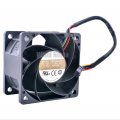
Fans considered: 12 V PWM adjustable, 60×60×38 mm, up to 16,300 RPM

Thermal interface: High-performance thermal paste (targeting RθCS < 0.1 °C/W)

Assembly: Open PCB setup (not enclosed in a chassis)

---

I want to optimize airflow through the heatsink and have considered the following options:

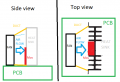
1. Two side-mounted fans blowing directly into the heatsink fins (dual push configuration). I wanted to put a third one in front of the mosfet to 220 for the fins on its face but that's a bit much I imagine...
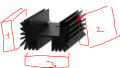
1000175979.png


2. One top-mounted fan either blowing downward or extracting warm air upward
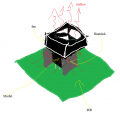
1000175978.png

image taken from a forum where the subject has already been discussed but I did not find satisfaction there : https://electronics.stackexchange.com/questions/161227/mosfets-cooled-with-heatsink-and-fan

3. Side push-pull setup: like the first one, but here one fan blowing into the fins, another on the opposite side pulling air through

I’d like to know which configuration offers the best thermal performance by ensuring strong airflow through the heatsink without turbulence or recirculation issues.
I’m also unsure whether a top-mounted fan is really effective in an open-air environment.

Additional question:
Can I wire multiple PWM fans to the same power and PWM signal lines, while keeping their tachometer outputs separated?

Thanks in advance for any guidance or shared experiences with similar heatsinks or setups.
 

Irving

Joined Jan 30, 2016
4,996
Welcome to AAC.

As a general rule, a fan blowing up through the fins of the heat-sink gives the best cooling. A further fan sucking up on top can help. The important thing is to get as smooth an airflow through the fins as possible. Air impacting onto the fins is less effective than air flowing past them. Most heat-sink manufacturers publish details of their products thermal performance under forced cooling with charts of thermal resistance v air flow in volumetric or velocity form and this manufacturer does so too as you found, and as they say in their guidance notes "Plate fin heat sinks do not perform well when the fins are oriented perpendicular to the direction of airflow." PCB mounted heat-sinks are very difficult to adapt to forced cooling and are marginal for high-power applications, but as you haven't said what power in your TO220 device you want to alleviate its hard to advise further.

1753877827038.png
 

crutschow

Joined Mar 14, 2008
38,316
The most efficient would be to have a fan on the bottom blowing upward with a duct closely mounted around the heatsink.

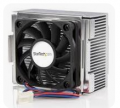
There are heatsinks with integral fans which provide efficient cooling (example below).

1753891689170.png
 

MisterBill2

Joined Jan 23, 2018
27,159
I suggest cheating a bit, and looking at on-line catalogs of honest electronics companies that sell heat-sinks with cooling fans. Seeing what is being sold by those who know what they are doing is a good way to learn. And it only takes some time.
 

Irving

Joined Jan 30, 2016
4,996
The issue here is that heatsinks with integral fans are intended for very high-power requirements and are generally very expensive. The TS' requirement, using a PCB-mounted heatsink isn't in that league, but we don't (yet) know his requirements/expectations. Only once we know that we can proceed...
 

Irving

Joined Jan 30, 2016
4,996
Thermal interface: High-performance thermal paste (targeting RθCS < 0.1 °C/W)
Just re-reading your OP, you'll be lucky to get much below 0.5K/W with a TO220 case, the surface finish isnt good enough and there's too little cross-sectional area. If you want 0.15K/W or better you need to be looking at TO247-plus cased devices; 30% more area and much better Tjc as well. I've achieved a measured 0.12K/W with those at >250W on a very big 300mm H x 200mm W x 75mm (65mm fin/10mm base) with 700cfm ducted fan.
 

Thread Starter

Zebananos

Joined Jul 30, 2025
10
Hello everyone,

Thank you for your many replies.

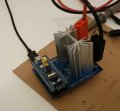
I want to cool a MOSFET mounted on a PCB like this:
WhatsApp Image 2025-08-03 à 01.46.30_28cd50f6.jpg

Oops, I made a mistake in the total Rth value I'd like: 1°C/W. The 0.1°C/W I indicated corresponded to the thermal path.

To be more precise, I'd like to be able to dissipate up to 100W (although I'd often be closer to 5/10W). The MOSFET I need must be a TO220 and not a TO247 because I need a low Vgsth, which is often not the case with TO247s. I managed to find a To220 mosfet with a maximum JC Rth of 0.4°C/W according to the datasheet (IRLB3024), a 12.4 W/MK thermal paste, so <0.1°C/W normally, and this heatsink (RA‑T2X‑64E) is supposed to be one of the best for To220 in forced ventilation (0.5°C/W at 1000 fpm). This makes a total of 1°C/W which allows me to stay below the 125°C/150°C maximum junction temperature not to be exceeded for the mosfet.

But I'm wondering how best to optimize the fan layout and airflow to obtain good ventilation allowing to approach 1000 fpm which allows an Rth of 0.5°C/W. The fans and heatsinks combined therefore seem compromised to me.

If I keep the same heatsink, do you think that three 60x60 PWM-controlled fans placed on the sides of the heatsink in push mode in the fins and one on the top in pull mode that exhausts the air (same fan screwed in upside down), all with a custom 3D shroud, could provide good ventilation?

Won't a shroud prevent heat dissipation without a fan if I only need to dissipate 10W?

I'll send you the specifications of the fan, heatsink, and MOSFET in question. Don't hesitate to ask if you have any comments.
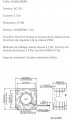
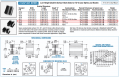
WhatsApp Image 2025-08-03 à 01.45.23_c321bac1.jpgWhatsApp Image 2025-08-03 à 01.45.23_50019a37.jpgWhatsApp Image 2025-08-03 à 01.45.23_bb860e88.jpgWhatsApp Image 2025-08-03 à 01.45.23_53e4536a.jpg

Thanks in advance.
 

Irving

Joined Jan 30, 2016
4,996
Don't believe datasheets at extremes.

#1 You'll never get 1000ft/min linear flow with that heatsink. That's purely a theoretical number based on surface area and assumes pure laminar flow through the fins. You won't get that attached to a PCB. These charts are designed to compare heatsinks under general operations, not to demonstrate real capability at upper extremes.

#2 It has a very small thermal mass - From the datasheet its theoretically rated for 20W absolute max., @3.1K/W natural convection. In reality, maybe good for 10-15W tops under ideal conditions.

#3 Small fans pushing into a surface will not generate anything like the flow rate you need; the back pressure stalls the flow. Fans generate pressure or flow; they are mutually exclusive. A well-spec'd fan will chart flow rate at a given revs v static pressure. No chart, no dice.

A rough calculation, for TO220: centrally mounted on a 100mm wide heatsink, 76mm long fins on a 4mm base, 100mm high, centrally located in a 100mm x 100mm vertical duct with a 700lfm 100mm dia fan blowing up would maintain a case temperature of 85degC @ 30C ambient. This might just support 100W @ Rjc 0.4C/W

Couldn't find a IRBL3024 only a IRBL3034...

What exactly are you trying to achieve? What's the underlying purpose here?
 

Irving

Joined Jan 30, 2016
4,996
Yes, that's what I found, but there are many 'LogicFETs' that fit this mold.

a 12.4 W/MK thermal paste, so <0.1°C/W normally,
That's the paste, but the bulk of the thermal resistance, case-to-sink, is the thermal interface between the case and sink to the paste which is dependent on the surface finishes and the material. The typical value quoted in most datasheets for a TO220 case is 0.5C/W based on a standard 6W/mK paste, but nearly 0.3C/W is due to the thermal interfaces. Improving the paste might go from 0.5C/W to 0.4C/W but not to 0.1C/W.
 

Thread Starter

Zebananos

Joined Jul 30, 2025
10
Hello,

Thank you for your replies.

My setup involves constant current discharging of NiMH and Li-Ion batteries. I was considering going up to 20A discharge currents for these two technologies, but on a 4.2V Li-Ion, that's 84W to dissipate (I rounded it up to 100W). For NiMH batteries, this isn't a problem (20 x 1.2 = 24W to dissipate, which is achieved almost without ventilation with the setup I proposed).
So, either I try to optimize the dissipation to dissipate these 84W, or I would limit myself to 15A for Li-Ion batteries, which would mean more than the 63W maximum to dissipate. As mentioned before, I rarely experience such high discharges, but I'm anticipating the limits of my setup.
See if you think 63W is more reasonable than 84W with my setup.

That's why I don't plan on going too large; I want to keep it small.

My new questions are as follows:

The Rth JC of the IRLB3034 MOSFET, which according to the datasheet is a maximum of 0.4°C/W, is this an optimistic value, or do you think it's more realistic? (It's one of the lowest logic-level MOSFETs I could find; the others are often around 1 or 2.)

In your opinion, with this RA-T2X-64E heatsink, what is the maximum actual dissipation I can achieve with "conventional" ventilation on a PCB?
What's reassuring about this heatsink is that at 200 feet/min, it already drops below 1°C/W, which already seems good.

Would a shroud be necessary? And what fan layout would be the most optimized, what size and how many?

Ah yes, okay, so the thermal resistance, enclosure-disk cannot go below 0.3 even with a thermal paste like Conductonaut Thermal Grizzly?
 

Irving

Joined Jan 30, 2016
4,996
My setup involves constant current discharging of NiMH and Li-Ion batteries
I did wonder.

I have a similar discharger for which handles 30v @ 80A i.e. 2400W, made up from 6 x 400W modules each using 4 x IXYS Linear2 MOSFETs on big forced-air heat-sinks.

In theory you can do 100W with one MOSFET, but it has to be the right MOSFET on the right heatsink. I don't know why you think that Vgs(th) is an important parameter, maybe you can show your circuit.
 

Thread Starter

Zebananos

Joined Jul 30, 2025
10
Hello,

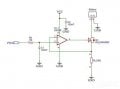
My circuit is a classic DC regulator with an operational amplifier, MOSFET and shunt, similar to this:
montage régulationcourant.jpg

My operational amplifier will be limited to 4V output, so I need a MOSFET with a low Vgs th so that I can drive it at voltages below 4V.
Your reference to TO 247 packages led me to a great discovery: I found exactly the same MOSFET I wanted (IRLB3034) but in TO-247 format (IRLP3034), which I hadn't seen before when searching only for TO 220. That's great! It has exactly the same characteristics, but an RθCS that is half as low (0.24 instead of 0.5). With the right paste, I think this time I can hope for 0.1/0.2 °C/W + 0.44 = 0.6 °C/W.
IRLP3034
What's a shame, given that it's exactly the same configuration as the TO 220 package, is that its RθJC hasn't decreased (it could have been 0.3/0.2 °C/W like many TO-247s), but oh well.

Knowing that I plan to keep the same heat sink (the best one at Digikey, since I'm going to order from them), which is already quite large and still offers fairly good characteristics, I need to be able to reach 0.6/0.8 °C/W with the heat sink at maximum ventilation to achieve a total Rth of less than 1.5 °C/W, which will be good for 80W of dissipation (I don't think I'll go up to 100W because I plan to limit myself to Li Ion 4.2V max at 20A max, which is 84W minus the shunt dissipation, let's say 80W).

According to the heat sink datasheet, I need to be able to reach 400 feet/min.
Could you advise me on how to size the ventilation system (1 or 2 fans, what characteristics for air flow and static pressure, integration of a custom fairing?) to achieve this in the best possible way?

Thank you in advance.
Zebananos
 

Irving

Joined Jan 30, 2016
4,996
According to the heat sink datasheet, I need to be able to reach 400 feet/min.
Could you advise me on how to size the ventilation system (1 or 2 fans, what characteristics for air flow and static pressure, integration of a custom fairing?) to achieve this in the best possible way?
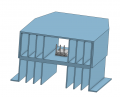
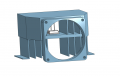
You won't get close to your requirement. The heatsink doesn't have enough thermal mass to shift 30W let alone 80W - it's spec'd to 20W max. No amount of forced cooling will significantly change that; increased airflow reduces the heatsink surface temperature by improving convection off the fins but cannot increase the conduction through the material - that's a physical property related to volume/mass. Lets start with a heatsink that has got enough mass: From Digikey's listing the first available 'in stock' item that comes close is a Wakefield-Vette 421K rated at a 58C rise at 50W, which is 1.16K/W with natural convection. That's more in the right ball-park, and its not significantly more expensive. Equally important is the fact that its spec'd to 100W. It comes with no holes, so you can drill your own to place the TO-247 pad in the dead centre of the heatsink. It has nearly 4 x the mass of the R-series heatsink and 2.6 x the surface area. At 400LFM its around 0.5K/W so should handle 80W. air flow vertically through fins, or around 10% less if mounted horizontally. The x-sectional area of the duct for that heatsink is approx 3" x 5" or 0.1sq ft, so 400LFM is 40CFM or about 45CFM crudely allowing for the dead-area of the heatsink x-sectional area (about 2sq"). The cheapest fan from Digikey that measures up is a 70mm square x 20mm deep 12v fan AFC0712DD-TP10. Duct that into the fins with a short duct say 2" long, as crudely shown below...

1754922675115.png

1754927286679.png
 
Last edited:

Thread Starter

Zebananos

Joined Jul 30, 2025
10
Thank you very much, Ivring, for your detailed and quick answers!

Once again (as with the MOSFET), I had narrowed my search too much to heatsinks designed for TO220, excluding all others, even though I could indeed adapt this one by drilling a hole.

Is the 20W maximum dissipation with the RA-T2X-64E an approximation? Since I can't find this information anywhere, is it the same for the 100W of the Wakefield-Vette 421K?

The Wakefield-Vette catalog containing this heatsink offers heatsinks with astonishing dissipation capacities (up to 0.1°C/W maximum) far superior to what I had seen from Ohmite. But the prices are also much higher; the quality of the design material must justify this. The Wakefield-Vette 421K is far from the best, but certainly the best value for money, and sufficient for my setup.

Since the heatsink is much larger than the MOSFET, I couldn't drill the hole in the center of the heatsink, but probably at 1/3 of the height. And then there's the question of how I could mount this heatsink on a PCB, since it doesn't have a bracket designed for it. I don't know how to support it... Maybe a custom 3D mount, but how can I estimate it?

When you say "Air flow vertically through fins," does that correspond to this situation where the fins point "toward the sky"?

heat dissipation.png

Is a single fan enough? Is a second one on the other side for push/pull not necessary? Or two fans: one on each side?

And the proposed fan doesn't have great static pressure and a high CFM for its price. There are equivalent products on Aliexpress, but I don't know if we can trust their product and specifications...

And doesn't the fan necessarily have to be wider than the heatsink (here 80x100, so 80x80 minimum)? I don't think so, because the shroud will always fit the heatsink size in any case, but maybe a "straight" shroud is better than one that gets bigger or smaller. But I deduce that the channel must therefore, regardless of the fan size, come out exactly the same size as the fan?

Or should I center the center of the fan relative to the center of the heatsink (the shroud in my diagram, seen from the side, looks rather ugly compared to this)?

I initially thought of screwing the fan and heatsink onto the PCB with screws, and adapting them on the PCB to make it look neat.

I don't see how to adapt everything. I've never undertaken such a project, so please excuse the many questions that may seem "obvious."

Zebananos
 
Last edited:

Irving

Joined Jan 30, 2016
4,996
Heatsink fins should ideally be always vertical with air flowing from bottom up through the fins. If sufficient forced ventilation is available it would be acceptable to mount the heatsink horizontally with airflow through the fins. In this instance I would mount PCB external to the duct so as not to impede the airflow. The MOSFET leads pass through the duct. You can't do 20A easily on a PCB (well you can - it needs 5mm wide 4-oz copper which gets expensive and very much more complicated) so don't try to mount the MOSFET directly on the PCB. A short length of suitably sized wire (14AWG copper minimum, 12AWG better) directly from the drain pin (bent carefully 90deg from the body) through the duct directly under a high-current terminal on the PCB; see pics below. Only top half of duct shown, PCB, not shown, would be mounted on short stand-offs above MOSFET. I'd also consider putting the source resistor directly on the source pin so its in the airflow too. Then only need two lightweight wires to gate and source pin for feedback. MOSFET pad should ideally be centred on heatsink to ensure maximum balanced heat transfer. 10% off won't hurt too much but 1/3 would compromise the heatsink; you'd need to de-rate it maybe 15 - 20%.

Static pressure for this layout is negligible so that low-cost fan should be adequate. You could up-size to a 38mm thick fan for increased air flow. There's no need to go to a 100mm or bigger fan, it just makes the ducting more complex.

1755010935190.png1755011033384.png
 

Thread Starter

Zebananos

Joined Jul 30, 2025
10
Good evening,

Thank you, Ivring, for your new, very detailed answer!

You say that "heat sinks should ideally always be vertical, with air flowing from the bottom to the top." However, if I place the heat sink vertically, I wouldn't be able to place the fan under it unless I removed it from the PCB structure, and therefore the MOSFET with it.
The only vertical option would be to place the fan above the MOSFET, but I wouldn't be able to move the air from the bottom to the top unless I used the fan in pull mode. Push mode, from what I understand, is more advantageous. So, I should push the air downwards towards the PCB. This may indeed help cool the shunt; it's a good idea that I hadn't thought of. But it might not heat the PCB too much. And knowing that the hot air will want to rise, this poses a slight dissipation problem...

Perhaps that's why you're advising me (as your diagram suggests) to place it horizontally instead? This might make it easier to place the MOSFET in the center of the heatsink because there won't be any issues with the MOSFET height vs. the middle of the heatsink.

So, a single fan is enough, no need to put another one in a pull-up position to create a push-pull arrangement?
And the Aliexpress fan suggested in post number 7 (60x60x38) could be suitable, and not too small? (I hope its specifications aren't too misleading...)

Is a simple, straight hole with a drill enough to screw the MOSFET into?
And why fold the MOSFET pins upwards?
And I don't really see how to avoid routing the 20A through the PCB. So all my cables that will carry the current (from the battery to the drain) must be routed outside the PCB, via screw terminals?

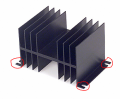
Should the spacers be screwed or placed on the PCB for the fairing structure? In the slots circled in red?

1755034810581.png

And will the fairing be placed on the PCB or screwed on as well?

In your diagram, the fairing part fits the shape of the fins and touches them. Shouldn't there be a margin to prevent the plastic from heating up?
 

Irving

Joined Jan 30, 2016
4,996
Perhaps that's why you're advising me (as your diagram suggests) to place it horizontally instead? This might make it easier to place the MOSFET in the center of the heatsink because there won't be any issues with the MOSFET height vs. the middle of the heatsink.
PCB mounting with a vertical fin arrangement is impractical; such heatsinks may imply they can be force cooled, but actually doing so is difficult to arrange. Airflow directed sideways onto the fins is relatively ineffective; the specs and charts usually describe performance with airflow through the fins for comparison with other manufacturers, Heatsinks specifically designed for PCB mounting in a forced airflow have the fins - or more commonly these days, pins - arranged to allow air to flow horizontally. Or typically a 'cold wall' arrangement is used where air is blown through a finned duct and devices are mounted on the outside of the duct.

So, a single fan is enough, no need to put another one in a pull-up position to create a push-pull arrangement?
And the Aliexpress fan suggested in post number 7 (60x60x38) could be suitable, and not too small? (I hope its specifications aren't too misleading...)
If you can meet the flow requirement with 1 fan no others are needed. The vanes on a fan are usually designed to push air into something. They are quite inefficient at sucking so adding another at the outlet isn't that useful; indeed by blocking the outflow they could actually make thing worse by increasing the static pressure in the duct. The 60mm fan you suggested is too small; its only 38CFM (I eventually found a spec sheet for it).

Is a simple, straight hole with a drill enough to screw the MOSFET into?
A simple hole is all you need but its important to ensure its completely free of burrs and not oversized. The hole in the device is 3.5mm. Its intended to be used with an M3x0.5 screw with a fibre - not metal - washer under the screw head torqued to 0.7 - 0.8Nm for optimal thermal transfer. A tapped hole in the heatsink is best for ease of assembly and accuracy of torquing down. Don't be tempted to over-tighten.

And why fold the MOSFET pins upwards?
And I don't really see how to avoid routing the 20A through the PCB. So all my cables that will carry the current (from the battery to the drain) must be routed outside the PCB, via screw terminals?
To make it easier to connect to the PCB which is mounted directly above the MOSFET on the duct using standoff pillars. What is your source resistor?

Show me your proposed PCB design.

And will the fairing be placed on the PCB or screwed on as well?

In your diagram, the fairing part fits the shape of the fins and touches them. Shouldn't there be a margin to prevent the plastic from heating up?
The feet are not used other than maybe to hold the duct down. Though not shown in my drawing, the sides of the duct would come down to the base of the heatsink. There would be a plate across the bottom to seal the duct. My assumption was that the duct is folded from 1 - 2mm thick aluminium sheet; the heatsink temperature could be 50C or so at the edges, 75C at the device. It could be acrylic sheet or similar, but it might warp though probably not melt, and might need to be oversized.
 

Thread Starter

Zebananos

Joined Jul 30, 2025
10
Hello,

Could you send me the fan datasheet please? I've also looked everywhere for it, but to no avail. The only information is the dubious one provided by the Aliexpress seller, who even lists an air volume of 120, without a unit... CFM? Is this possible, because it seems enormous to me, but it still draws 3A, so it must be blowing...

I don't know if I could find an Aliexpress fan with reliable characteristics and the expected specifications...
I might go with the fan you suggested above; the specifications will be certified, so there won't be any unpleasant surprises.

Oh, okay, I personally thought of mounting the heatsink + MOSFET + fan on the PCB (like in this image of a circuit found on the Internet attached previously), but I don't think that's what you had in mind.
Indeed, if the MOSFET isn't soldered directly to the PCB but connected via wires, there's no point placing it on the PCB and thus wasting space on the PCB to insert the entire fan system if it can be independent, placed next to it.

So the MOSFET would be separate/separate from the PCB? But in this case, the shunt resistor won't be cooled because it will be on the PCB, but is that really important?

The shroud/channel will therefore completely surround the heatsink, but will they be attached together or just nested?

And you said:
To make it easier to connect to the PCB which is mounted directly above the MOSFET on the duct using standoff pillars.
But I don't understand why the PCB would be above the fan system... Would it be possible for you to complete your 3D diagram (if possible) with the PCB (the one that contains the microcontroller, etc.) plus the heatsink + MOSFET + fan mount (which you have already done) so that I can better visualize everything, please.

So the duct will be a 3D-printed plastic design? Or can/should I 3D print the plastic in a rather thicker material, and if necessary, add hand-shaped aluminum between the duct's plastic and the heatsink?

I don't have a PCB design yet, just a schematic that needs refining, but I'm thinking of making something similar to the photo sent above. As soon as I have it, I could send it to you, but if you have any advice specifically for the design, I'd be grateful.
 
Top