Op amp question

Thread Starter

GeorgeAAbraham

Joined Feb 18, 2018
4
Hi

I need some demistifying on bandwidth.

What relationship should an op amp bandwidth have to the frequency being amplified?

Would this change between say a pre-amp and a second stage?

Also. When should a buffer be considered over a decoupling capacitor?

I'm redesigning a known circuit seeing if I can get the circuit as clean as possible.

Also. Is there any benifit in giving some compents their own regulators over sharing regulators over many ic components?

Thanx
 

MrChips

Joined Oct 2, 2009
34,810
Many questions here.

On bandwidth, what you will see quoted is gain-bandwidth product (GBWP). This means that if you see BW of 1MHz, the gain drops off to unity at 1MHz. Hence if you wish any gain greater than unity you will have to limit operating frequency to a much lower frequency.

On opamp power supplies, you need to consider whether the application is a mixed signal one (analog and digital subsystems), operating frequencies, power consumption, noise sensitivity, etc.

For analog only, low power consumption, it is normal to use a single regulator for all components, with proper power supply decoupling capacitors. With medium interference, you can decouple subsections with RC or LC filters on the power supply.

For mix-signal applications with concerns of sensitivity and accuracy, it is common practice to have separate supply and ground planes. Proper PCB layout becomes critical.

In addition, one has to consider the merits and drawbacks of a linear supply and regulator versus a switching supply.
 

ebp

Joined Feb 8, 2018
2,332
Can you tell us a bit more about what you mean by "buffer" with regard to buffer v. decoupling. A circuit sketch, perhaps (photo of something hand drawn on paper is fine).
You always need decoupling capacitors.
 

Tako

Joined Oct 21, 2014
65
What relationship should an op amp bandwidth have to the frequency being amplified?
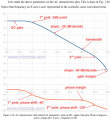
All frequencies in the range of your bandwidth are amplified according to opamp's frequency response. Please refer to Fig. 1.26 from the this position: https://payhip.com/b/5Srt (click Preview button) :

opamp_ac.png
For the example above, lower frequencies are amplified more comparing to high frequencies, e.g., 1 kHz is amplified by 77 dB, while 1 MHz is amplified by 20 dB.

Would this change between say a pre-amp and a second stage?
In terms of analog IC design, usually yes. Generally speaking, the more stages the slower your design is. It is due to the higher number of poles. For different analog IC architectures, you may analyze them in the position given previously (https://payhip.com/b/5Srt). Click Preview button to see the 2-stages class A (ch. 3.1.1). Other are in the paid version, but for sure you may refer to other books (e.g Baker, Razavi, see http://www.designers-guide.org/Books/) or look the specific designs in the net.

Please, specify whether your design is integrated (e.g. analog IC design) or discrete (e.g. you take IC chips, resistors and capacitors and put them together on PCB). It looks for me that you have a discrete electronics:
Is there any benifit in giving some compents their own regulators over sharing regulators over many ic components?
but I would like to be sure.
 

Thread Starter

GeorgeAAbraham

Joined Feb 18, 2018
4
Thank you for your responses and material.

I'm studying some old metal detector circuits and want to build a rock solid and tuned instrument, but I am enjoying the learning curve it's giving me and I am finding myself looking for more. I am avoiding content because I wan't to try a thinking out of context.

So it's good to pick an op amp who's bandwidth is well above the signal. So a 1Mhz would be OK for a 10Khz signal.
My current experience seems to lean towards a silent answer that I should look up fit for purpose in this modern age rather than looking at specs first. Spec sheets often list popular applications that might not include what you are working with. Is this relevant or just a guideline.
Say I had a 20Mhz bandwidth op amp, would there be a reason why it could be a bad choice?

So a smoothing cap on both rails would be good and then an additional bypass for each IC should be optimal and right up against each component. This should eliminate logical noise. My circuit would use a positive and negative rail. It will have a regulator and a negative rail via a charge pump IC. I have glossed over other designs and noticed that someone used a negative regulator following the charge pump IC. What are your thoughts on having regulated negative rail, could it have been neglected?

Regarding the buffer. This came from comparing circuit designs and the way they joined that pre-amp output stage signal to the demodulation channels. Most of them had a decoupler capacitor, some other circuits with a slightly higher frequency signal used a buffer(opamp 1:1).

Thinking and reading about how the logic circuitry(all those upstream demod's etc) could contaminate back to your pre-amp. Any thoughts. I have seen articles, sorta giving me a perspective where designers used to go crazy with buffers, then it became uncool and seen as a waste.. so is there a special case for them or does it's application make sense in this description?

Enough rambling. Thank you for your responses. I'll think of something more intelligent to ask in the meantime.;-)
 

OBW0549

Joined Mar 2, 2015
3,566
So it's good to pick an op amp who's bandwidth is well above the signal. So a 1Mhz would be OK for a 10Khz signal.

(...)

Say I had a 20Mhz bandwidth op amp, would there be a reason why it could be a bad choice?
If you're making an amplifier and wondering which op amp to choose, a good rule of thumb is this: the op amp's gain-bandwidth product (the GBW spec on its data sheet) should be at least 10 times the desired closed-loop gain of your circuit times the highest signal frequency you're wanting to amplify.

For example, if I'm making an amplifier with a gain of 100 and a frequency response up to 10 kHz, I'd pick an op amp with a GBW of at least (100 * 10 kHz * 10), or 10 MHz.

The rule of thumb isn't universal for all op amp circuits (sometimes other characteristics are more important, such as response time, slew rate, full-power bandwidth, etc.), but for simple amplifiers it usually suffices.
 
Top