Op-amp oscillates with gain in feedback.

Status
Not open for further replies.

Thread Starter

RichardO

Joined May 4, 2013
2,270
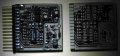
Here is a picture of the PCB's I made for the current sources and a few other googaws such as a 2.5 volt reference and a 5 volt to 7 volt switcher. The board is about 1.5" square and will have a 14-pin SIP connector soldered to one edge.

The panel was made by the toner transfer method. The smallest traces are 8 mils and most of the other small traces are 12 mils. I quit etching early since it is always easier to remove a short than to add a jumper.
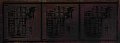

I2I_PCB_panel.JPG
 

Thread Starter

RichardO

Joined May 4, 2013
2,270
I have tested the step-up switcher and it works. I had a devil of a time finding an bit of unetched copper that shorted +5 volts to ground.
After I got the switcher is working safely I mounted the rest of the parts but have done no additional testing yet.


Here is the top layer of both a bare and assembled PCB.
The holes are for jumpers to connect the top layer to the bottom layer. The bottom layer is a solid ground plane.

I2I_Assy_PCB.JPG
 

Thread Starter

RichardO

Joined May 4, 2013
2,270
I (finally) have "first light" for the current sources. The current source PCB assembly has been plugged into a solderless breadboard with the rest of the circuit to create triangle and square waves.

The original board I made had a wiring error on the NPN transistors in the transistor array. I must have been dyslexic the day I did the footprint because I swapped the collectors and emitters on all three NPN transistors.

That board would have been very difficult to cut and jumper so I was forced to etch a version with the corrections. I managed to damage some traces on the revised board so I still needed a couple of jumpers but at least they were doable.
 

Thread Starter

RichardO

Joined May 4, 2013
2,270
Did it end up performing the way you needed it to? The board certainly looks good...
I have not done exaustive testing but it gives nice triangle waves at 1 Mhz. I need to clean up the solderless breadboard to include recent design changes.

I am only getting about 10MHz oscillation right now. :( I think I can do better even with the slow parts I am using on the solderless breadboard.
 

OBW0549

Joined Mar 2, 2015
3,565
I have not done exaustive testing but it gives nice triangle waves at 1 Mhz.
Clean triangle waves at 1 MHz is an accomplishment all by itself. Sounds good.

I am only getting about 10MHz oscillation right now. :( I think I can do better even with the slow parts I am using on the solderless breadboard.
I'd allow for the possibility that the solderless breadboard itself may be a limiting factor because of the row-to-row capacitance, which can easily be several picofarads. At 100 kHz or even a MHz that probably wouldn't cause much trouble; but at 10 MHz and above it could have a significant effect.
 

Thread Starter

RichardO

Joined May 4, 2013
2,270
Clean triangle waves at 1 MHz is an accomplishment all by itself. Sounds good.


I'd allow for the possibility that the solderless breadboard itself may be a limiting factor because of the row-to-row capacitance, which can easily be several picofarads. At 100 kHz or even a MHz that probably wouldn't cause much trouble; but at 10 MHz and above it could have a significant effect.
I will get back to you when I have wrung the most out of the solderless breadboard.

I hope to be getting faster op-amps, comparators and a PECL flip-flop soon. Even on an SBB I think I can get 10's of MHz. :D

We shall see.
 

Thread Starter

RichardO

Joined May 4, 2013
2,270
Sounds good, and do keep us posted.
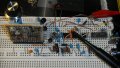
Here are a couple pictures of the solderless breadboard prototype.

The current source (I2I) PCB assembly is plugged into the SBB on the left of the picture. The frequency is set by the pot with the knob showing in the upper left of the photo.

The frequency can be adjusted over about a 100 to 1 range. It is quite noisy (jittery) at lower frequency settings. Some of this noise may be from the charge pump I am using for the -5V power supply. Another possibility is that it is coming from the step-up switcher on the I2I board. I have not had time to pursue this yet.

The triangle and square waveforms were done at a bandwidth of 200 MHz. The frequency is set for 5MHz in the photo. The triangle waveshape degrades quickly above that frequency. The triangle is about 2.5volts p-p and the square is about 900mv p-p.

As you can see, there are lots of ripples in the square wave. This is likely caused by poor termination and grounding on the breadboard. The ripples on the square wave cause ripples on the triangle wave. The ripples are , no doubt, aggravated by the long ground leads on the scope probes. These are a few inches long -- but not much can be done to shorten the ground connections on the SBB.

5MHz_tri_sqr.JPG
5MHz_tri_sqr_SBB.JPG
 

OBW0549

Joined Mar 2, 2015
3,565
The frequency can be adjusted over about a 100 to 1 range. It is quite noisy (jittery) at lower frequency settings. Some of this noise may be from the charge pump I am using for the -5V power supply. Another possibility is that it is coming from the step-up switcher on the I2I board.
At lower frequencies, where smaller currents are involved, don't discount the possibility that you may be picking up interference from stray EMFs in the room. Where I am, I get a lot of 60 Hz interference in anything involving high impedances, as well as 20 kHz to 50 kHz garbage spewed out by the CFLs I use for lighting. Something to consider, anyway...

As you can see, there are lots of ripples in the square wave. This is likely caused by poor termination and grounding on the breadboard. The ripples on the square wave cause ripples on the triangle wave. The ripples are , no doubt, aggravated by the long ground leads on the scope probes. These are a few inches long -- but not much can be done to shorten the ground connections on the SBB.
Yeah, that's what it looks like to me, too: a mix of SBB effects and the effects of probe ground leads. The annoying thing is, you can't really tell for sure without making a proper PCB.

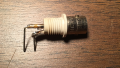
One thing I've done for situations like this is to make a "breadboard-friendly" BNC socket for use with my scope probe's probe-to-BNC adapter barrel. The first pic is the SBB-friendly-BNC, and the second is showing it assembled to the scope probe and plugged into a little pulse generator circuit I've been fooling with.

BB-friendly BNC.pngCircuit with BNC.png

It does a great job of cleaning up waveforms, but it does take up some room on the SBB and complicates layout.
 

Attachments

Thread Starter

RichardO

Joined May 4, 2013
2,270
At lower frequencies, where smaller currents are involved, don't discount the possibility that you may be picking up interference from stray EMFs in the room. Where I am, I get a lot of 60 Hz interference in anything involving high impedances, as well as 20 kHz to 50 kHz garbage spewed out by the CFLs I use for lighting. Something to consider, anyway...

Yeah, that's what it looks like to me, too: a mix of SBB effects and the effects of probe ground leads. The annoying thing is, you can't really tell for sure without making a proper PCB.

One thing I've done for situations like this is to make a "breadboard-friendly" BNC socket for use with my scope probe's probe-to-BNC adapter barrel. The first pic is the SBB-friendly-BNC, and the second is showing it assembled to the scope probe and plugged into a little pulse generator circuit I've been fooling with.View attachment 139422View attachment 139421

It does a great job of cleaning up waveforms, but it does take up some room on the SBB and complicates layout.
All good thoughts. :D

I keep dithering back and forth between cleaning up the SBB prototype or waiting for the faster parts to arrive and doing it right on a PCB. :rolleyes:
 
Status
Not open for further replies.
Top