Op amp hysteresis

crutschow

Joined Mar 14, 2008
38,507
That calculation is confusing since they don't show the power voltage to the op amp, and, since that voltage affects the op amp output voltage, it also affects the hysteresis value.
 

Thread Starter

Zeeus

Joined Apr 17, 2019
616
That calculation is confusing since they don't show the power voltage to the op amp, and, since that voltage affects the op amp output voltage, it also affects the hysteresis value.
my fault..did not say

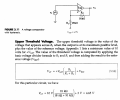
+-15 and finally assumed output voltage is 10V which is used in the calculation
 

crutschow

Joined Mar 14, 2008
38,507
What about the calculation do you not understand?
The hysteresis is the difference between the high and low output voltage reduced by the voltage divider action of R1 and Rf.
 

Thread Starter

Zeeus

Joined Apr 17, 2019
616
Vut (upper threshold) is the voltage at the + pin when output is 10V ?

so in the calculation shouldn't it be 7V* and not 10V*
 

Ylli

Joined Nov 13, 2015
1,092
Yes, you are correct Zeeus. The voltage across Ra will be the difference between the op amp saturated output and the reference voltage, divided by the resistor ratio. Then add the ref.

So in the figure you posted, the output of the op amp has to be assumed to be + 13 volts for the equations to be correct. Alternately, if the output of the op amp is +10, then the formula should be 7 * [18/(18+91)] + 3.
 

Thread Starter

Zeeus

Joined Apr 17, 2019
616
Yes, you are correct Zeeus. The voltage across Ra will be the difference between the op amp saturated output and the reference voltage, divided by the resistor ratio. Then add the ref.

So in the figure you posted, the output of the op amp has to be assumed to be + 13 volts for the equations to be correct. Alternately, if the output of the op amp is +10, then the formula should be 7 * [18/(18+91)] + 3.
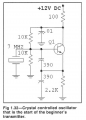
Please explain this circuit..."Start of a beginner's transmitter...." will learn it later but just want to understand a little

Thanks
 

Attachments

Thread Starter

Zeeus

Joined Apr 17, 2019
616
That's a Colpitts transistor crystal oscillator.
A Google search will turn up much info on that.
Yes it will turn up much info..Just need summary of that information now as will surely read on it later in book

Is the crystal itself not an oscillator? why then add the transistor and capacitor etc
 

crutschow

Joined Mar 14, 2008
38,507
Is the crystal itself not an oscillator?
No.
The crystal is just a mechanical resonator with a very accurate resonant frequency.
The crystal is piezoelectric so the mechanical resonance creates a small electrical signal, but it can't resonante by itself.
So an amplifier is needed to feed a signal back to it and keep it resonating.
This is provided by the transistor, with the capacitors to generate the proper phase for the feedback signal.
Such oscillators can be finicky, and if the circuit isn't turn just right to generate the proper feedback to the crystal, it can refuse to oscillate.
 
Top