I would like a one shot 7555, running on 3vdc, that gives a 1 second pulse , then locks out for 40 seconds. Is this possible?? (time does not need to be absolutely accurate in any way). Thanks guys
To be clear, a push switch activates the 1 second pulse then the circuit prevents further activation by the switch for 40 seconds?
Is your goal to do this using a single 7555 chip?
To be clear, a push switch activates the 1 second pulse then the circuit prevents further activation by the switch for 40 seconds?
Is your goal to do this using a single 7555 chip?
Edit: Had to modify the circuit to use two 7555's.
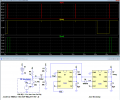
Below is the LTspice sim for a two 7555 design:
A PB trigger (red trace) triggers both 7555's.
The first generates a 1s pulse (green trace).
The second generates a 40s pulse (yellow trace) that inhibits further triggering until it times out.
R2C1 determines the 1s pulse time, and R7C3 determines the inhibit time.
Below is the LTspice sim of a circuit using one 7555:
When the 7555 is triggered by the PB (red trace) its output pulse (green trace) charges up the capacitor C2 (yellow trace) which inhibits further triggering until the capacitor has discharged to again allow triggering (here at around 40s).
R2C1 determine the pulse period, and C2 along with the parallel value of R1, R3 and R4 determine the lockout time.
I found a problem with that circuit due to my using an ideal model for the 7555 that precludes that simple single 7555 circuit so I modified it to use two 7555's.
Hope that's still acceptable.
ok, I, having a slight problem
I have a Green LED running from the positive supply rail from pin 3 of U2
I have a Red LED running from the negative supply rail from pin 3 of U2
When the circuit us triggered the red light is on for 7 minutes, and then extinguishes the red led, illuminating the green LED until the circuit is re-triggered
What is the "slight problem"?
You made no mention of LEDs in your original post.
What, exactly, do you want the LEDs to do?
Do you have a resistor in series with each of the LEDs?
What is the "slight problem"?
You made no mention of LEDs in your original post.
What, exactly, do you want the LEDs to do?
Do you have a resistor in series with each of the LEDs?
What is the "slight problem"?
You made no mention of LEDs in your original post.
What, exactly, do you want the LEDs to do?
Do you have a resistor in series with each of the LEDs?
I am using LEDS to test out if the circuit is working. I am not using dropping resistors as it seems that the voltage is low enough to drive them directly

 Facebook
 Google
 GitHub
 Linkedin