On/Off Indicator using a Current Transformer

Thread Starter

ruairihev

Joined Oct 28, 2008
9
Hi all,

I have a current transformer ASM-010 with the datasheet in this link:
http://www.micropik.com/PDF/asm_series.pdf

I want to use this CT on a heater element to give an indication of whether the element is on or off, I am not concerned about the measurement of the current, just if it is flowing or not.

The heater element draws about 1.5A @230VAC so using the 50R resistor in the datasheet I get about 5mV AC across it with one loop through the CT.

Can anyone advise on a simple circuit that will light an LED when current flows? A picture of a circuit would be helpful but words would also do.

Thanks for any help or advise.
 

wayneh

Joined Sep 9, 2010
18,105
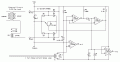
It may not be the most elegant solution, but you could put the 5mV output into a comparator and use the comparator's output to drive an LED directly. Only the positive pulses will turn the LED on, but the flashing won't be visible. I think the comparator will survive negative peaks since they are in the single mV range. You'll need a DC supply for the comparator.
 

inwo

Joined Nov 7, 2013
2,419
It's one of those things where it's hard to justify building, when there is an off the shelf solution.
If it's not self powered it doesn't make sense.

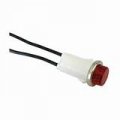
Similar function to the neon but current operated indicator leds are less than $10. Self powered.

Some use a ct.
 

Thread Starter

ruairihev

Joined Oct 28, 2008
9
Thanks for the replies.

I can't use the neon indicator in parallel because if the heater element fails then the neon indicator will still light up and will not indicate a failure of the heater element. I didn't mention that in my question but the purpose of the indicator is to let me know when an element has failed.

I could use the Honeywell CSDA1AC but they are far more expensive than the ASM-010. €28 v's €1.50. I also forgot to mention that cost was a factor as each heater has 10 elements and there are 3 heaters so the cost of the Honeywell CSDA1AC would start to add up for that many elements.

I had considered the Op-amp comparator route as the solution but don't know what way the opamp comparator shoud be arranged in the circuit. Would I need +Vdd and -Vss or +Vdd and Ground with a voltage offset to 2.5V.

Could someone suggest an opamp comparator circuit that would work; inverting, non-inverting, differential...etc? I can loop the wire through the CT a few times to get the mV reading up to 100mV before it starts to distort.

I considered the Microprocessor route aswell :)
 

mcgyvr

Joined Oct 15, 2009
5,394
We do have some people here that could get a microprocessor working on this.:rolleyes:
We could all go back to using discrete circuits for everything.. But if you want to learn about micros then use a micro..even if its something simple/overkill.. blink a LED, turn on a relay, etc...
 

#12

Joined Nov 30, 2010
18,224
Now you're talking! The actual needs for the job have arrived.
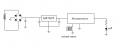
It's a good thing we have microprocessor people. They can use this drawing, add 29 more current sensors, 29 more LED indicators, fill in the part numbers and pin numbers, and write the code for you.
Of course, I'm assuming an MCU chip can just ADC a 5 millivolt AC signal, and I might be wrong. Would you like this multiplexed or do you want to build one, completely separate circuit for each of the 30 heaters?
 

Attachments

wayneh

Joined Sep 9, 2010
18,105
I had considered the Op-amp comparator route as the solution but don't know what way the opamp comparator shoud be arranged in the circuit. Would I need +Vdd and -Vss or +Vdd and Ground with a voltage offset to 2.5V.
If you can get 10mA or so out of your sensor, just drive an LED with that. You could get fancier and drive the LED of an optoisolator, and then use that signal to amplify and do whatever you want with it. But I really think you could make an LED flash directly off the sensor.

I can describe the comparator idea in more detail if you want, but I don't think you need it.
 

#12

Joined Nov 30, 2010
18,224
I just tried winding a hundred turns of #30 wire around an 8 gauge wire with 3 amps of 60 Hz. running through it. Couldn't detect any voltage at all on my scope set to the 2 mv range and loading the coil with 1 Meg of resistance. This convinces me that a commercially made current transformer is the only way.

One opinion is, if you're going to pay for current transformers, get some that will run an LED directly and forget all this complication with amplifiers, microprocessors, and etc. One coil, one resistor, and one LED per heater, or one of each for any group of 2 or 3 heaters, and adjust a second load resistor so that losing 1/2 or 1/3 of the load will make the LED drop out of conduction. Then you can go in with a clamp meter and find the sick heater.

Yeah, I know it bites the wallet, but there is no "off the shelf", three dollar solution to this problem. A custom made solution is going to cost you more than lunch money, regardless of whether you pay for the "right" current transformers or use cheap ones and amplify the results.
 

inwo

Joined Nov 7, 2013
2,419
If you could find some small transformers with separate windings. Cut one winding with a cut-off wheel. Put a few turns thru it for current side. I think wall wart is a good source.

See what you get using the line side going to led first. You may find the sweet spot with no other components or maybe just an inverse parallel diode.

Self powered is the way to go.
 

Thread Starter

ruairihev

Joined Oct 28, 2008
9
I won't be able to connect an LED directly to the CT that I already have as the most I could get from it was 200mV, probably to do with saturation of core and small turns ratio....etc.

I've found this CT, the AC1005. It will put out the higher voltage that I need to drive the LED directly. It has a 1000:1 turns ratio and rated at 50Hz

http://docs-europe.electrocomponents.com/webdocs/0775/0900766b80775c43.pdf

I'm mounting everything on a PCB that I will be getting made. I'll order in some and see what happens. Thanks for the ideas.
 
Top