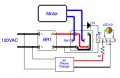
Old guy needs help for a simple project = LED to show motor run direction

dl324

Joined Mar 30, 2015
18,400
1. For R1, does it make any difference which value I install?
The LED brightness is 2.5mcd, which is pretty dim by today's standard. Using 33k gives a current of about 5mA. That might, or might not, be bright enough.

If you use a 10k resistor, current increases to about 15mA. Power dissipation in the resistor would be about V^2/R = 165V * 165V / 10k = 2.7W, so you'd need at least a 3W resistor. Voltage across the resistor is the rectified line voltage minus the diode drops in the rectifiers and LED.
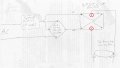
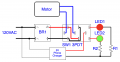
2. It looks like the two leads powering the LED bridge the switch, which is a DPDT. Of the 6 terminals on the back of my DPDT switch, which two should the circuit be connected to?
The center terminals on the switch that you've connected to the motor. I assumed that describing the terminals as "From Switch" would be understood as the two terminals from the switch that connected to the motor...
 

AnalogKid

Joined Aug 1, 2013
12,174
The schematics in post #4 and post #12 are correct.

Yes, the resistor value matters. It limits the current through the LEDs to a safe value, but generates heat in the process. So the "correct" value is a tradeoff between LED current (which sets its brightness) and heat removal.

At 120 V, the power in a 33 K R1 will be approx. 0.41 W. The equation is: P = E^2 / R. Power dissipation equals the square of the voltage across the resistor divided by the resistor value. Because of the diode bridge in the circuit, the voltage across the motor and LED will be about 2 V less than the input. Because of the forward voltage drop across the LEDs, the voltage across the R1 will be about 2 V less than that. Use 116 V for the power math.

P = E^2 / R
P = (Vin-rms - 2 V (diode bridge) - 2 Vled)^2 / R1
P = ((120 - 2 - 2) ^2) / 33000 = 0.4078 W

With a 10 K resistor, the power dissipation increases to 1.35 W

While the power dissipated is calculated using the RMS value of the input voltage, The LED brightness is more closely related to the input voltage peak value. In your case, this is around 168 V. For R1 = 33K, the peak LED current is approx. 5 mA. Let's assume that the forward voltages (Vf) of the two LED die are approx. 2.0 V, a common value for typical non-specialized LEDs)

I = E / R
I = (Vin-peak - 2 V (diode bridge) - 2 V (LED)) / R1
I = ((120 x sqrt2) - 2 - 2) / 33000 = 0.00502 A = 5 mA

For better long-term reliability (and fewer burned fingers), R1 should be rated for at least twice the expected continuous power dissipation. It still will get hot, but your fingerprints will thank you.

ak
 

dl324

Joined Mar 30, 2015
18,400
At 120 V, the power in a 33 K R1 will be approx. 0.41 W.
The input is 120VAC, so peak DC is 170V.
For better long-term reliability (and fewer burned fingers), R1 should be rated for at least twice the expected continuous power dissipation. It still will get hot, but your fingerprints will thank you.
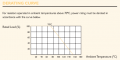
Resistors are specified to operate at 100% of their dissipation rating up to 70C ambient.

From Yaego for metal film resistors:
1768320956378.png

I don't know how long the OP operates the motor, but derating by 50% (or more) seems excessive.
 

Thread Starter

cazksboy

Joined Nov 9, 2009
60
The input is 120VAC, so peak DC is 170V.
Resistors are specified to operate at 100% of their dissipation rating up to 70C ambient.

From Yaego for metal film resistors:
View attachment 361979

I don't know how long the OP operates the motor, but derating by 50% (or more) seems excessive.
Dennis, I tend to operate the motor to drive my lathe in spurts - in other words, intermittently. I use a foot pedal to connect or disconnect power to the motor... so 95% of the time my motor is only ON for maybe 20 - 45 seconds.
 
I was taught to always derate resistor's power rating by 50% or more as good practice.
Also the LED dropping resistor is traditionally oversized (in power rating) because of the voltage spikes that can be there. The resistor's voltage rating also needs to be considered.

Mains is not a nice pretty 120VAC sine-wave, it's common to see high voltage transients for LED indicators.
Here, the lathe motor will have spikes due to the brushes arcing.

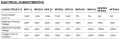
Example: Yageo MFR metal film max. overload voltage for the 1W (not mini version) is 1,000V.

I'd go with 33k 1W that Analog Kid suggests.

Yageo MFR voltage.PNG
 

Thread Starter

cazksboy

Joined Nov 9, 2009
60
I was taught to always derate resistor's power rating by 50% or more as good practice.
Also the LED dropping resistor is traditionally oversized (in power rating) because of the voltage spikes that can be there. The resistor's voltage rating also needs to be considered.

Mains is not a nice pretty 120VAC sine-wave, it's common to see high voltage transients for LED indicators.
Here, the lathe motor will have spikes due to the brushes arcing.

Example: Yageo MFR metal film max. overload voltage for the 1W (not mini version) is 1,000V.

I'd go with 33k 1W that Analog Kid suggests.

View attachment 361997
Thanks for that! Much appreciated...
 

AnalogKid

Joined Aug 1, 2013
12,174
At 120 V, the power in a 33 K R1 will be approx. 0.41 W.
The input is 120VAC, so peak DC is 170V.
The power dissipated in a resistor is a function of the RMS voltage across it because in this application there is no filter capacitor after the bridge. The actual resistor voltage is the input RMS value minus some constant voltage drops. Those drops distort the resistor's voltage waveform slightly, but that distortion affects the actual RMS value by less than 1%.

Resistors are specified to operate at 100% of their dissipation rating up to 70C ambient.
If you drill down into the MTBF (Mean Time Between Failures, a reliability indicator) data, you will see that the warrantied lifetime at that max temperature is not great. A good example of this is the common electrolytic capacitor. Low cost varieties are rated to operate at +70C, but only for 1000 hours. At 8 hours per day that is less then three months.

Separate from that, note that that full-power, 70C rating is for a resistor operating in free air with a specified lead length (because the leads act like heatsinks, increasing the effective surface area of the component). If the resistor is in a closed enclosure, such as in the TS photos, a half-watt resistor dissipating 0.4 W will rocket past 70C in minutes.

I don't know how long the OP operates the motor, but derating by 50% (or more) seems excessive.
50% derating is a mandatory, minimum requirement of many MIL, automotive, and industrial companies. Of course there are exceptions, such as power line filter X and Y capacitors, but this requirement is common in extreme and/or high-reliability environments. MIL-HDBK-217 goes into this in detail.

http://everyspec.com/MIL-HDBK/MIL-HDBK-0200-0299/MIL-HDBK-217F_14591/

ak
 
Last edited:

B-JoJo-S

Joined Jan 3, 2026
376
Are you opposed to using a 3PDT switch? You can use the third pole to switch from one LED to another AND you can use a low voltage for the diodes. Low voltage, low wattage, plenty of room for brightness without having to mess with all that high voltage DC.
 

Thread Starter

cazksboy

Joined Nov 9, 2009
60
Are you opposed to using a 3PDT switch? You can use the third pole to switch from one LED to another AND you can use a low voltage for the diodes. Low voltage, low wattage, plenty of room for brightness without having to mess with all that high voltage DC.
Hey! Nope, substituting a 3PDT switch for the DPDT one I put in would be possible, maybe even easy. But I'm only using a single LED...it's a "bicolor" (red & green) according to the Radio Shack packaging that it came in. Supposedly, the color change happens when the applied DC voltage changes polarity.

BUT....

Somebody here mentioned the 33k resistor will generate some heat, and the "project box" enclosure (pictured in post #12) is a bit crowded so I was thinking a pair of DC fans (intake & exhaust) would help control the heat. A little digging turned up some sub-micro-mini fans at Digikey - they run on 3VDC and the tiniest one measures only 15.4mm x 15.4mm x 3.4mm and the next size up from that measures 17mm x 17mm x 3mm. Good grief - and I thought CPU fans were small! I'd have to take another look inside my switching project box the way it is right now...I'm betting I could fit a couple of one or the other sizes. Cutting the phenolic would be the hardest part, and it's not really very hard.
Check this out... I don't know what the differentiation is between fans & blowers... they're the same thing, right? I guess not, but check this page out at Digikey... https://www.digikey.com/en/product-highlight/d/delta-electronics/miniature-fans

Anyway, I don't think I need a 3PDT switch in there to select LED's, but maybe they can turn on two tiny fans at the same time the DC voltage is applied to my lathe motor...??????
 

B-JoJo-S

Joined Jan 3, 2026
376
I'm only using a single LED...it's a "bicolor" (red & green) according to the Radio Shack packaging that it came in. Supposedly, the color change happens when the applied DC voltage changes polarity.
OK, well, that makes a difference. Will have to think on it. Maybe a DPDT relay connected to the motor voltage input or the low voltage input.
Dang, that's a great circuit diagram. How did you do that? You must have a program on your computer to do it.
TurboCAD15. Just got it based off of a recommendation from another member.
 

dl324

Joined Mar 30, 2015
18,400
Somebody here mentioned the 33k resistor will generate some heat, and the "project box" enclosure (pictured in post #12) is a bit crowded so I was thinking a pair of DC fans (intake & exhaust) would help control the heat.
For the amount of time you use the motor, dissipation in the resistor isn't much of a concern.

As @AnalogKid mentioned, the rectified voltage is unfiltered and will be essentially the same as the input AC voltage.

At 120VDC, dissipation in a 33k resistor would be V^2/R = 120V*120V/33k = 0.44W. So a 1W resistor would be derated by 50% which should be plenty for the amount of time you say you're using the motor. For simplicity, I ignored the voltage drops of the bridge rectifier and LEDs. That only represents a few percent error.

The issue will be if the LEDs will be bright enough.
 

B-JoJo-S

Joined Jan 3, 2026
376
OK, different arrangement:
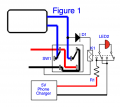
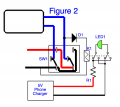
This is the change using a DPDT 120VAC (or VDC) relay coil. LED 1/2 is connected to the two Common points.
Screenshot 2026-01-16 at 8.07.58 AM.png
In Figure 1 the switch is shown in the UP position (K1 is de-energized). Only LED 2 will be lit when 120VAC is supplied to the phone charger.
Screenshot 2026-01-16 at 8.08.16 AM.png
In Figure 2 the switch is shown in the DOWN position (K1 is energized). Only LED 1 will be lit when 120VAC is supplied to the phone charger.
Screenshot 2026-01-16 at 8.08.23 AM.png
As for the value of R1, that will depend on how bright you want it and what the forward voltage is.
 
Top