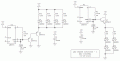
Old circuit alteration

Thread Starter

Icanmakeit67

Joined Sep 23, 2018
210
Ran across this circuit from 2010. Snapped a pic. Wondering if anyone can tell me what I can do to the circuit to handle 4 LEDs in parallel in using in a model. This circuit works very well when I breadboarded it. I appreciate the knowledge of the creator. Just want to tweak it a bit.
Thanks
 

Attachments

WBahn

Joined Mar 31, 2012
32,823
On possible issue you are going to have is that the base current of your transistor is going to be polluting the timing current used for the oscillator. This is why the circuit uses a Darlington transistor instead of just a simple PNP transistor (or are you planning to use two transistors in a Darlington configuration).

Also, the base voltage on the transistor is going to vary from about 1/3 Vcc to 2/3 Vcc and the voltage across the LED resistor is going to vary by that same amount, which means that it will not blink on and off sharply, but rather fade out significantly and then turn back on sharply. If that is either the behavior you want, or it is at least acceptable, then it's not a problem.

What's your Vcc?

What is the frequency you are targeting?

Even with the Darlington configuration, you may find that supporting 60 mA is going to have a discernable effect on your timing, given R1 being anything near 100 kΩ, but it is probably tolerable for a model.
 

Thread Starter

Icanmakeit67

Joined Sep 23, 2018
210
On possible issue you are going to have is that the base current of your transistor is going to be polluting the timing current used for the oscillator. This is why the circuit uses a Darlington transistor instead of just a simple PNP transistor (or are you planning to use two transistors in a Darlington configuration).

Also, the base voltage on the transistor is going to vary from about 1/3 Vcc to 2/3 Vcc and the voltage across the LED resistor is going to vary by that same amount, which means that it will not blink on and off sharply, but rather fade out significantly and then turn back on sharply. If that is either the behavior you want, or it is at least acceptable, then it's not a problem.

What's your Vcc?

What is the frequency you are targeting?

Even with the Darlington configuration, you may find that supporting 60 mA is going to have a discernable effect on your timing, given R1 being anything near 100 kΩ, but it is probably tolerable for a model.
Love the effect for a space vehicle navigation lights. On bright then fade out. I also like the adjustable speed of the on-fade cycle. I want 4 LEDs to run in sync. I alway use 9vdc for supply. How ever the configuration ends up, I need longevity after the model is glued shut on completion.
 

AnalogKid

Joined Aug 1, 2013
12,127
What is the operating voltage of your circuit? If 9 V or greater, you can put two LEDs in series (two parallel strings with two LEDs in each string), cutting the total current seen by the transistors in half. Transistor peak power dissipation would be less than 200 mW, which is less than 1/3 of the device rating.

This will not work with 6 V or less.

ak
 

Thread Starter

Icanmakeit67

Joined Sep 23, 2018
210
What is the operating voltage of your circuit? If 9 V or greater, you can put two LEDs in series (two parallel strings with two LEDs in each string), cutting the total current seen by the transistors in half. Transistor peak power dissipation would be less than 200 mW, which is less than 1/3 of the device rating.

This will not work with 6 V or less.

ak
9vdc. I want the bright then fade out cycle. I’ll breadboard it up and try various LED configurations. Two sets of two in series. It was suggested adding 3 more LED -resistor strings in parallel to get to the 4 LEDs I want.
 

AnalogKid

Joined Aug 1, 2013
12,127
I agree with the previous response that 4 parallel strings pushes the transistor close to its rated max collector current. It also wastes battery power. Of course, the resistor values are different in the 4-string and 2-string circuits.

ak
 

WBahn

Joined Mar 31, 2012
32,823
Love the effect for a space vehicle navigation lights. On bright then fade out. I also like the adjustable speed of the on-fade cycle. I want 4 LEDs to run in sync. I alway use 9vdc for supply. How ever the configuration ends up, I need longevity after the model is glued shut on completion.
How do you define longevity? If you have four LEDs, each pulling 20 mA, on for half the time, that will be an average current draw of about 40 mA. A typical alkaline 9 V battery has a capacity of about 500 mAh, so you can expect perhaps twelve hours of useful life. Is that long enough for you? If not, then you either need to make the battery accessible to replace it, or make it rechargeable in place and use a high-quality battery to get as many recharging cycles out of it as possible.
 

WBahn

Joined Mar 31, 2012
32,823
Depending on what your actual needs and constraints are, there are small, inexpensive modules constant current drivers that would let you put all of the LEDs in series, with no current limiting resistor, and have a small microcontroller program the current profile to be just what you want. This would not only give you a lot of flexibility and control, but would also maximize energy usage to provide for maximum battery life.
 

dl324

Joined Mar 30, 2015
18,326
I alway use 9vdc for supply. How ever the configuration ends up, I need longevity after the model is glued shut on completion.
You should use a rechargeable battery.

I don't like these batteries for a number of reasons, but they might be suitable for your application:
1710774416680.png

They're fakes, but delivered 300mAh in my tests. IIRC, they can be charged while they're being used.

They're unsuitable if you need long life at low current. They self-discharge in a month or two. Load regulation is poor, ...

Might be more info here.
 

AnalogKid

Joined Aug 1, 2013
12,127
Here are two variations of the original circuit, updated with four LEDs. The right circuit uses about half the power of the left circuit. The oscillator sections are identical, which is why they have identical reference designators. The two output sections show different LED connection options.

With the left circuit, the LEDs might not completely extinguish at the dimmest point in the cycle. They will in the right circuit.

Note that while many power darlington transistors do indeed have base-emitter resistors included internally, common small-signal darlington's do not. The right circuit shows this option.

The two LED-and-resistor blocks are interchangeable between the two circuits.

ak

Update: Looking at this again, probably better to decrease R1 to 10K to provide a more stiff voltage source driving Q1, and increase C1 to whatever.


LED-Fader-1-c.gif
 
Last edited:
Top