Off Topic: How to Float a Lighthouse?

Thread Starter

Wingsy

Joined Dec 18, 2016
86
Off topic I know, but since this place has a good concentration of brains I thought I'd see how this goes...

I bought a really neat miniature lighthouse. I was going to put it on the bank of one of my ponds but then had the idea of floating it somewhere out in the water. It's 3 feet tall and weighs 10 lbs. Keeping it vertical and immune to tipover is the problem. For starters this is what I've come up with. I'm wide open to suggestions.

Lighthouse glued on top of a blue 5-gal plastic bucket (bucket inverted). Lid of bucket riveted to bucket. 4-ft threaded rod attached to center of lid with nut & fender washer (bucket is inverted so lid of bucket is at bottom). A stack of ten 3.5lb bricks are held to the rod with fender washer & nut at bottom of rod. Rod goes through the center hole of the bricks. A small plastic hose positioned so one end of the hose is held near the top of the inside of the bucket, with the other end through a hole in the lid and dangling in the water under the bucket. The purpose of this hose is to let enough water into the bucket so that it floats with barely any of the bucket above water. Once I add/remove water from inside the bucket I think I can just let that free end of the hose dangle in the water below the bucket. And finally, 3 bricks on the bottom evenly spaced around the lighthouse, with fishing line attached to the bucket to hold it in one general area.

Each brick displaces 3 cups of water, or 1.5 lbs, so each brick would give me 2 lbs of pull when under water. Total of 20 lbs. 5 gallons of air in the bucket would give me 40 lbs of floatation, enough to support the 20 lbs of bricks and 10 lb of lighthouse. Letting some water into the bucket would let me adjust the height above water of the top of the bucket (which I want to keep to a minimum so it would be hard to see).

Suggest a simpler way please.

Picture is photoshopped lighthouse in water.

Lighthouse2.jpg
 

AlbertHall

Joined Jun 4, 2014
12,619
A strong wind will still make it lean over and will, because of the tethers, also cause it to be lower in the water.
Could you not make a solid, or at least heavy, connection to the bed of the pond so that it would not move at all. You could have an actual rock or a fibreglass make believe rock for the lighthouse to stand on so that as the water level changes it would still look OK.
 

Thread Starter

Wingsy

Joined Dec 18, 2016
86
A strong wind will still make it lean over and will, because of the tethers, also cause it to be lower in the water.
Could you not make a solid, or at least heavy, connection to the bed of the pond so that it would not move at all. You could have an actual rock or a fibreglass make believe rock for the lighthouse to stand on so that as the water level changes it would still look OK.
Yeah, the fake rock would look neat. Thinking about how to do that.

The area where I want to put the lighthouse is about 9 feet deep and the bottom is anything but firm. Don't think I can anchor it to the bottom with anything rigid.

And the tethers... lots of slack so they won't be pulling down on the lighthouse. I'll attach them to a wire wrapped around the bucket at the waterline, so any pull against the tethers due to the wind would be at the center of floatation. It shouldn't tip one way or the other if tension is applied at the waterline. (Correct?)
 

AlbertHall

Joined Jun 4, 2014
12,619
I think it will still tip. The wind will exert a sideways force on the part that is out of the water. As it tips the weight will also be tipped and and will exert a righting force. It will settle at the position where these two forces are balanced but that will be tipped to some extent.

You say the tethers will be slack, but at least one of them won't be when the wind blows. The lighthouse will move in the direction of the wind until a tether (or two) stops it moving. Now the continuing sideways push from the wind will result in the lighthouse floating lower than normal. I don't know big this effect will be.
 

Thread Starter

Wingsy

Joined Dec 18, 2016
86
Can you drive a vertical pile into the pond bed, or will that let the water out?
I'm sure it won't let the water out, but getting out there with a pile driver is a problem. All I've got is a small jon boat, and I don't have any friends coordinated enough to hold a steady position of the boat while I hammer in a 12-foot rod. Been there before. :) Also, the pond level can change as much as a foot or maybe more, and the batteries & electronics in the lighthouse is located in its base. I'd hate for that part to get under water.
 

Thread Starter

Wingsy

Joined Dec 18, 2016
86
I think it will still tip. The wind will exert a sideways force on the part that is out of the water. As it tips the weight will also be tipped and and will exert a righting force. It will settle at the position where these two forces are balanced but that will be tipped to some extent.

You say the tethers will be slack, but at least one of them won't be when the wind blows. The lighthouse will move in the direction of the wind until a tether (or two) stops it moving. Now the continuing sideways push from the wind will result in the lighthouse floating lower than normal. I don't know big this effect will be.
Yeah, I see your point and I think you're right. It will tip some... it seems it will have to, even if tethered at the waterline. But by how much? If it would only be an obvious tilt under extreme winds, I could live with that.
 

AlbertHall

Joined Jun 4, 2014
12,619
If the tethers are horizontal the effect will be less than if the tethers go downwards. How big the effect will be depends on the windage of the lighthouse and, obviously the wind strength. The effect will also be less the further down the balancing weight is.
 

Kjeldgaard

Joined Apr 7, 2016
476
I remembered the way we make adjustable kite control lines.

And to explain it, I had to draw the following sketch:

FloatingLightHouse_1.jpg
Each anchor line is attached at two points, one as high above the center of gravity as artistically possible and the other point completely underneath the float.
By moving the adjustable knot, you can customize the resulting drag point with respect to the center of gravity.

And as others have mentioned, then the anchor blocks are placed far away from the lighthouse.
 

AlbertHall

Joined Jun 4, 2014
12,619
This will work if the sideways force is applied between the two attachment points. However when the force is applied halfway up the lighthouse there is still a tipping moment. The lower attachment will be slack, the upper attachment and the tether to the anchor will be a straight line and there will be tension in that line and that tension is directed at an angle downwards and will result in the lighthouse floating lower in the water. As I say I don't know how big this effect will be. A trial would tell you.

Putting the weight as far below the water surface as possible on a rigid attachment will reduce the tip (as the weight will have a greater mechanical advantage), but won't alter the change in float height.
 

Thread Starter

Wingsy

Joined Dec 18, 2016
86
I remembered the way we make adjustable kite control lines.

And to explain it, I had to draw the following sketch:

View attachment 121693
Each anchor line is attached at two points, one as high above the center of gravity as artistically possible and the other point completely underneath the float.
By moving the adjustable knot, you can customize the resulting drag point with respect to the center of gravity.

And as others have mentioned, then the anchor blocks are placed far away from the lighthouse.
Couldn't I get away with just 1 attach point? My thinking is, that if the tether were attached at the waterline and a strong wind blows it will tip the lighthouse in the direction of the wind. If the tether were attached to the top of the lighthouse it would tilt towards the wind. Somewhere between those 2 points the tether would counteract the wind such that there would be zero tilt.

Come to think of it, if the tether were attached at the waterline, AND the tether makes, say, a 45 degree angle to the bottom, then any movement of the lighthouse away from the anchor would pull the upwind side of the lighthouse slightly downwards, counteracting the tilt to some unknown degree.
 

AlbertHall

Joined Jun 4, 2014
12,619
Come to think of it, if the tether were attached at the waterline, AND the tether makes, say, a 45 degree angle to the bottom, then any movement of the lighthouse away from the anchor would pull the upwind side of the lighthouse slightly downwards, counteracting the tilt to some unknown degree
That should work. You could adjust the effect by having a horizontal 'stick' just below the waterline (so you can't see it) and adjusting how far along that stick the tether is attached.
 

Thread Starter

Wingsy

Joined Dec 18, 2016
86
That should work. You could adjust the effect by having a horizontal 'stick' just below the waterline (so you can't see it) and adjusting how far along that stick the tether is attached.
Oh yeah. Much better than going up the side of the lighthouse to find the magic spot.

Or by adjusting the angle to the anchor?
 

Thread Starter

Wingsy

Joined Dec 18, 2016
86
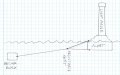
OK. I know this can be calculated, but it is beyond me. Haven't used my geometry and trig to this degree since before the flood.

What angle (shown as 45 degrees here) must the tether be in order to maintain the lighthouse upright with a wind that produces, say, 1 lb of force on the lighthouse?
 

Attachments

wayneh

Joined Sep 9, 2010
18,089
Maybe I missed it but one thing is not clear - does the water level change enough that the lighthouse really needs to float? Or could there be a solid connection to the ground below? Screw the rod into the ground (or a into a bucket full of concrete resting on the bottom) and set it to vertical with 3 wires.

Regarding the placement of the guy-wire: It needs to be at the aerodynamic center of force of the above-water portion. (Unfortunately that point might move with windspeed.) This is the only way to eliminate a rotational torque. Obviously, the torque from the wind can be swamped by the weights and floats to a large degree.
 

Alec_t

Joined Sep 17, 2013
15,103
Also, the pond level can change as much as a foot or maybe more, and the batteries & electronics in the lighthouse is located in its base. I'd hate for that part to get under water.
I had in mind the top of the pile being slightly below the lowest water level and the lighthouse being on a float but vertically constrained by a couple of vertically spaced loops sliding up/down the pile.
 

Thread Starter

Wingsy

Joined Dec 18, 2016
86
Maybe I missed it but one thing is not clear - does the water level change enough that the lighthouse really needs to float? Or could there be a solid connection to the ground below? Screw the rod into the ground (or a into a bucket full of concrete resting on the bottom) and set it to vertical with 3 wires.

Regarding the placement of the guy-wire: It needs to be at the aerodynamic center of force of the above-water portion. (Unfortunately that point might move with windspeed.) This is the only way to eliminate a rotational torque. Obviously, the torque from the wind can be swamped by the weights and floats to a large degree.
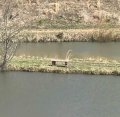
Right now the water level is even with the top of the spillway. I've seen it at least 8" below this. And 3 times in the past several years I've seen water even with the seat of that cement bench in the picture, creating one big pond out of 2. That's got to be at least a 2-foot variation, probably closer to 3. So yes, I think it has to float.
WaterLevel.jpg
 

wayneh

Joined Sep 9, 2010
18,089
So yes, I think it has to float.
OK, then I think your sketch is reasonable. I'd make the weights go as far below the float as possible, since that will increase their impact on torque for any given amount of weight. If you're relying on them to hold it vertical, the guy wires(s) can be at or just below the water line.

I'd be tempted to use an open bucket on the bottom so I could just add rocks to set the flotation level.
 
Top