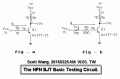
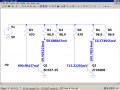
Please show your testing circuit, so everyone has the same target to discuss with.
Generally the voltage of c will be 0.06~0.2V, if the c of npn is a light current then the voltage of c could be lower than 0.05V, if there is no load then the c should be no voltage, but the multi-meter could be shows some values, it depends on the meter.
Please show your testing circuit, so everyone has the same target to discuss with.
Generally the voltage of c will be 0.06~0.2V, if the c of npn is a light current then the voltage of c could be lower than 0.05V, if there is no load then the c should be no voltage, but the multi-meter could be shows some values, it depends on the meter.
Thanks for your response to my thread. What you say is what I was seeing during my testing of a npn transistor from Fairchild. My confusion was that I THOUGHT that it had to be close to .2v but in my testing was NOT the case as I was seeing Vce from .037-.04v+ depending on my Ib. All in all I learned a lot from everyone's help and thank everyone for it.
There is no schematic as I was only questioning a npn transistor but I see what you mean and will do so in the future.
Thanks for your response to my thread. What you say is what I was seeing during my testing of a npn transistor from Fairchild. My confusion was that I THOUGHT that it had to be close to .2v but in my testing was NOT the case as I was seeing Vce from .037-.04v+ depending on my Ib. All in all I learned a lot from everyone's help and thank everyone for it.
There is no schematic as I was only questioning a npn transistor but I see what you mean and will do so in the future.
Since you have the Vce value and Ib then the circuit you should be tested, how come there is no circuit:
1. Vcc = ?V
2. a npn bjt (I can't find bu337-25, so it could be bc337-25? ).
3. Rb = ? Kb
4. Vin = ?V (Input to Rb and Ground)
5. Rc = ? Kb (a resistor from c of bjt to Vcc as a Load)
6. Vb = ? V
7. Ib range = ? mA
8. Vc = 0.037-.04V
Hello:
Since your new to transistor circuit design,
first my disclaimer:
I can share with you at a hobby level only how a hobbyist designs circuits, I'm not a professional so this is only a hobby point of view in this.
Ok,
A transistor circuit is designed so that the beta number given in the data sheet is not fully relied on, for optimal performance.
Because manufacturing of individual components have varying values.
Now thats when your designing circuits that require a transistor to work in its linear region, amplification ect..
When you are designing for switching modes, the beta of the transistor is not even considered, because beta values are no longer valid in cutoff and saturation regions.
Thats where you design for a specific collector current depending on your load to be driven.
Then you calculate the base current to be around 1/10 th of that collector current.
This ensures that your transistor should saturate, or at least VCE be low enough to drive a heavy load current.
Now saturation is given as the base emitter diode is forward biased, but also the base collector diode is forward biased as well. This can only happen when you have a substantial amount of resistance at the collector lead, with respect to the amount of base current drive your giving it.
For instance lets say you built a transistor switching circuit that required you to use a smallish value of collector bias resistance, to drive a low impedance load.
Then you decide arbitrarily how much current you want your transistor to supply.
Then you use the rule of thumb of base current being 1/10 th of collector current.
You test it out, and find your transistor is not switching as you expected, its in a linear amplifying region, the VCE is around 1.8 volts.
This happens often, if a design is not approached methodically and logically.
Here is how you approach this kind of a design, to make it work all the time.
First you want the transistor to saturate, to be used as a switch.
Ok so here is how you use the data sheet.
You look at the given sat. voltage and you use that value to do yur calculations with.
NOW, don't expect this value to show up in the testing, this value is only for design calculations, NOT for expected measureable results.
Now lets say it says VCE sat. 0.2v. Ok good now you know what to use in the design work.
So lets say you have a 1K ohm resitor in the collector lead. And you are using a supply of 10v.
You take that data value given and do this calculation, You ASSUME (data sheet) 0.2v to be dropped across VCE, under input conditions.
That would then require the rest of the voltage to be dropped across the collector resistor of 1K ohms.
So assuming your familiar with basic circuit analysis and theory, of voltage and current laws.
Then you design for (VCC - 0.2v - VRC) = 0v VRC = vdrop across collector resistor of 1K ohms this example.
Therefor (10v - 0.2v) = 9.8v dropped across RC (collector resistor)
Now you can solve for collector current (VRC / RC ) = IC
9.8v / 1K ohms = 9.8mA
AHH now we know what collector current we can use to make this work like a switch, working through a 1k ohms resistance.
NOW we apply our rule of thumb IC / 10 = IB for sat.
So we calculate that to be 980uA for IB.
OK now alls we need is a base bias resistancwe that will supply our value of 980uA OR grerater to ensure sat. or at least (switching mode)
So our (VCC - Vbe - VRB) = 0v VRB being Vdrop across base bias resistor.
NOW again we refer to the data sheet for calculations only.
We look up what Vbe is given in the data sheet for that transistor being used.
Assuming it shows any where from 0.6v to 0.8v, we can choose in between of 0.7v.
Will it actually measure out to be under test, probably not, but were not looking for that value in actual test we use that data sheet value so we can do our calculations only.
Ok now we solve for our base bias resistor by using (10v - 0.7v) = 9.3v dropped across RB.
aha, now we know what current we want to flow through this resistor, because we ASSUME 1/10 th of collector current to flow through this resistor, so now we can solve for the value of RB by using ohms law again (VRB / IB) = RB
(9.3v / 980uA) = 9489 ohms.
Alright we know that all our calculations were done on assumptions of data sheet values, so this value of base resistor, is just another approximation value. We do NOT need to have a specific value claculated, just something close to it, 9.1K ohms or 10k ohms could be chosen.
Now knowing we want to ensure a heavy base current we could choose the lower value resistor of 9.1K ohms.
The final REQUIREMENT in any design is to prototype it on a real breadboard, and take measurements, do NOT expect calculated values to the "T" however expect values close to the values calculated, in a range of tolerance.
Lastly when it all is satisfying the design requirements, then do a 5 or 10 transistor test, try at least 5 or more transistors in place of the originals, to make sure circuit performance is meeting circuit requirements, NOT exact measured values, but circuit performance.
Then if you take it further, check circuit performance under varrying amounts of voltage, using a variable power supply, do a range of voltage changes to record when the circuit meets its limits of maximum reliability, with lower and upper range of voltages.
And so on and so forth.
My confusion was that I THOUGHT that it had to be close to .2v but in my testing was NOT the case as I was seeing Vce from .037-.04v+ depending on my Ib.
I cant thank all of you enough for the wisdom that you have freely shared with someone who was confused on a few things w/ in this case npn transistors. Thank you so much.

 Facebook
 Google
 GitHub
 Linkedin