Hi,I found the following schematic out on the internet
(credit to George Persico, Jestine Yong)
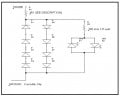
View attachment 320177
My question: what is the purpose of having 4 diodes in series?
Is the nearly 3 volt forward voltage drop significant?
Could there just as easily be any number?
Thank you for the detailed explanation.The voltage drop of those diode strings is to develop enough voltage to illuminate the LEDs The reason for adding those diodes is that with just the LED and a series resistor there would simply be a momentary bright light and then the LED would be failed. That is assuming the capacitor was charged to more than 5 volts. And only the title describes what the circuit is intended for.
I would not ever use such a circuit for any capacitor discharge application that was required for safety BECAUSE there is much to geat an opportunity for it to fail in an open condition and leave a capacitor charged.
And what is the current rating of those diodes?? If the capacitor stores enough energy to produce a visible spark when it is discharged then the instant current is a few amps. That will quickly cause the failure I described. Then a safe discharge does not happen.
Thanks, but that doesn't explain why there are four in series -- what is their function in this circuit?Hi,
It depends what you intend to discharge with it.
Four diodes could be too many or not enough.
To create a nearly constant voltage source for the LEDs when the capacitor discharges. Without them, the LEDs will experience a large voltage (and hence current) practically equal to the voltage on the capacitor. Which will cause their failure.Thanks, but that doesn't explain why there are four in series -- what is their function in this circuit?
Thank you!To create a nearly constant voltage source for the LEDs when the capacitor discharges. Without them, the LEDs will experience a large voltage (and hence current) practically equal to the voltage on the capacitor. Which will cause their failure.
That's just so the LED will light up as MrBill pointed out.Thanks, but that doesn't explain why there are four in series -- what is their function in this circuit?
Thank you.That's just so the LED will light up as MrBill pointed out.
The problem though is that this circuit may not work right for all discharging applications. The diodes have to be the right part number depending on what is being discharged, and probably a resistor added to limit the current for example. They show R1 but the value needs to be adjusted per application.
I did indeed take note of the explanation in your original response.I explained in detail what the four diodes in series were for, back in post #3. And the voltage rating of the diodes does not matter much because the will be FORWARD BIASED, and so almost one volt across each diode, UNLESS the diodes fail because of excess current.
With a 400 volt capacitor and a 2000 ohm resistor , since I= V/R = 400/2000=4/20, the current would be 1/5 amp, 200mA, not going to do any damage.
What he meant is that you cannot both short something out and at the same time get voltage to drive LEDs with. You need to KEEP some of the voltage around so you can drive the LEDs until the cap is completely discharged, then the LED goes out.I did indeed take note of the explanation in your original response.
I hope you will indulge another beginner q or two.
With reference to your first post, I don't really understand this:
"The voltage drop of those diode strings is to develop enough voltage to illuminate the LEDs "
Is there not more than sufficient voltage in the cap to illuminate the LEDs?
Are they not really there to reduce the voltage seen by the LEDs?
| Thread starter | Similar threads | Forum | Replies | Date |
|---|---|---|---|---|
|
|
Automotive Relay Clarification for Novice | General Electronics Chat | 15 | |
| R | Mains AC to DC, naive novice | Power Electronics | 38 | |
| S | Advice about experimenting for a novice | Power Electronics | 17 | |
| D | electronic novice | Power Electronics | 3 | |
|
|
Obsolete circuit board, novice trying to fix it | General Electronics Chat | 8 |