Advice about experimenting for a novice

Thread Starter

short_circuited

Joined Sep 30, 2024
7
Hi :)
I'm kinda new in this area, and I'm experimenting at home with wiring things such as small motors people got rid of.
During this, I use the apartment outlets to power things, but this means that the apartment's circuit breakers & safety switches break quite often while I'm experimenting.

Does anyone have a suggestion for a substitute for using the apartment's outlet? I thought about purchasing a designated car battery, but I don't know if it has a replaceable fuse in case it's short circuited (and I don't want to constantly replace fuses). Perhaps a UPS of some sort could work? What do people usually do?

BTW - in order to power up motors I use two circuit breakers (10 Amperes each) on the plug coming from the wall so that they will break before the apartment circuit breaks, but this doesn't help since both my circuit breaker and the apartment's circuit breaker break :(

Thanks :)
 

BobTPH

Joined Jun 5, 2013
11,463
What you need is not more equipment but more knowledge.

If the motors have markings on them (manufacturer, model number, etc) then look them up online rather than guessing how to wire them. Some even tell you how to wire them right on the nameplate.

Or take pictures of them and post them here before trying anything.
 

Thread Starter

short_circuited

Joined Sep 30, 2024
7
Thanks BobTPH :)
I probably should have been more clear: I used "motors" just as an umbrella term. I get short circuits even when playing around with very simple things.
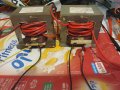
For example - I'm now trying to wire a series of two microwave transformers. All I did was soldering the cable/plug coming from the wall to the transformers, and still - it's causing a circuit break. I need to isolate the culprit, but at some point trying to connect them to the outlet and seeing what happens will be inevitable...
So basically the question is: is there anything I can use for experimentation without using the wall outlet itself?
 

Alec_t

Joined Sep 17, 2013
15,101
I'm now trying to wire a series of two microwave transformers.
Those can be LETHAL if not treated properly.
Unless you are aiming for a Darwin Award, or have unlimited cash to replace damaged items, you really need to do (more) research to learn about the hazards of electrical systems and the properties of the gadgets you experiment with, before connecting things willy-nilly to mains outlets or other supplies.
 

dl324

Joined Mar 30, 2015
18,216
I'm kinda new in this area, and I'm experimenting at home with wiring things such as small motors people got rid of.
During this, I use the apartment outlets to power things, but this means that the apartment's circuit breakers & safety switches break quite often while I'm experimenting.
You need to be more careful. I wouldn't be working with line voltage (lethal voltages) unless I knew what I was doing. In all of my decades of working on things, I have never tripped a circuit breaker.
 

DickCappels

Joined Aug 21, 2008
10,661
These days you can make circuits that do amazing things with very little power. This includes motors.

I suggest keeping away from the AC power lines - they kill people. Battery packs, less often :)

Pick up some light emitting diodes, some 1k (1,000 ohm) resistors, and if you like a small motor.

You should be able to do plenty with one of those 5V 1 A cell phone chargers as a safe power supply.
 

MrChips

Joined Oct 2, 2009
34,626
You don’t play around with power coming from wall outlets. You could burn the house down. You could be electrocuted.

What you need is a proper power supply that delivers the appropriate voltage and current required for your experiments. The power supply could be wall adapters or batteries.
 

MisterBill2

Joined Jan 23, 2018
27,159
You don’t play around with power coming from wall outlets. You could burn the house down. You could be electrocuted.

What you need is a proper power supply that delivers the appropriate voltage and current required for your experiments. The power supply could be wall adapters or batteries.
It is not the problem of the voltage, IT IS THE PROBLEM OF A LACK OF UNDERSTANDING!!! I was building circuits using retired industrial control relays when I was ten years old. Very seldom popped a fuse, our house had fuses back in 1956.
I see two reworked transformers that no longer produce high voltages. I see what looks like a meter lead with a test probe.
So it is understanding that is missing. So the solution is studying, not experimenting. I suggest actual books, because they are much more likely to be correct than what is shown on the cartoon channel, where every clown is allowed to talk.
 

geekoftheweek

Joined Oct 6, 2013
1,429
I suggest actual books, because they are much more likely to be correct than what is shown on the cartoon channel, where every clown is allowed to talk.
I second this and will add there are good sites (not videos) out there if you dig. Some people go pretty in depth with the needed calculations and theory. If you don't at least see some formulas and math shown on the page move on to the next.
 

MisterBill2

Joined Jan 23, 2018
27,159
The other reason I suggest actual books is because reading would be done at the pace the reader uses to understand the material, while a video goes at the speed the actor can talk (Speedy Gonzollas on "SPEED"). And that is faster than I can understand new stuff.
 

wayneh

Joined Sep 9, 2010
18,085
Your first post is one of the more frightening things I've read in quite a while.

The other replies have reflected this but I want to emphasize to you that you should be learning and experimenting with things that involve voltages below 12V and currents less than 1A. That's an arbitrary max of 12W and knocking that down 10-fold is perfectly reasonable. You can learn virtually everything there is to know about electronics in the realm below 5W. You can learn a lot at 5V and max 100mA, just 0.5W.

Graduating to higher power levels is a specialized subset of the overall world of electronics. Since higher voltages and currents introduce real risks, even fatal ones, no one should go there without the first mastering the low power basics and a deep understanding of what's going on. Even then, you need the guidance of experts to alert you to dangers you may not have thought of.
 

sparky 1

Joined Nov 3, 2018
1,218
There are smaller motors called 775 and 555 that won't blow the circuit breakers. These motors are sometimes found in electric drills.
I mention these because there are all kinds of hardware; mounting brackets, pulleys, belts, controls that makes them popular
for experimenters in Asian countries. Mechanical drawing and understanding parts is very helpful, If you work with same motor
you can become familiar with what size metric threads. Companies need to automate as Ai is coming and installers will be needed.
Some industrial equipment needs power factor correction, it can save money and is now available at reasonable price.
https://www.allaboutcircuits.com/te...pfc-converter-circuit-improves-power-quality/

Safety is very serious, sometimes you don't get a second chance never start fires or get shocked.
Use an ammeter or clamp ammeter, it tells you if a circuit is drawing too much current.

 
Last edited:

MisterBill2

Joined Jan 23, 2018
27,159
One More Time: WHAT IS MISSING IS UNDERSTANDING!! And understanding comes from study, not experimenting.
Experiments are done to verify theories, and so the theory must come first. The good news is that in the electrical realm the valid theories have been verified and the incorrect theories have been disproved. That means that reality is available through study and learning. Rebuilt transformers have already been proven and they can work very well! But understanding HOW they work comes from study much better than experiments to see what happens.
Rather than scream at you in panic as has been done, Learning and understanding the power involved with mains voltages and currents is the way to stay safe. Of course, that certainly includes understanding what is required to control all of that power. That requires reading and learning before any experimenting to verify.
 

MrChips

Joined Oct 2, 2009
34,626
Understand why fuses blow and breakers trip.

If the breaker is rated for 10A, then it will trip when the load tries to draw more than 10A.

At 230 VAC, that represents 2300 W which is a lot of power.
To put that into perspective, an LED house lamp takes about 4-8 W, an incandescent bulb is typically 40-60 W, soldering iron 25-60 W, hair drier 1500 W.
 
Top