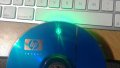
I just took an HP CD-R disk and shown an LED through it without having to remove the coating. Removing the coating would make it as worthless as a piece of glass. In fact, you can even see the clothes pin I used to clip the LED to a 2032 coin battery.
This is what I'm aiming for. Space is tight though. I'm hoping enough light will bleed through the edge to illuminate the clock face.
The holes to the left of 6 o'clock are where the wires from the battery will come through. What is the best way to have the resistors and wires fit into this space keeping as flat as possible? Any overlaps of wires and the disc platter won't fit over the top everything has to be flat.
EDIT
I've got four resistors but only put three in the image above.
Hmm, I only just realised 3v from two AA batteries is only enough to power 1 LED. I just tried to light up 4 white LED's (w/o resistor) and none of them light up unless I connect just one bulb. That kinda' scuppers my plans. Back to the drawing board.
The LEDs in that orientation won't cast much light upwards through the disc. Most of the light is projected from the ends of the LEDs.
For thinness, use a PCB with SMD LEDs and resistors. You could also mount those components on a prototype board (like veroboard) and wire with wirewrap wire.
The LEDs in that orientation won't cast much light upwards through the disc. Most of the light is projected from the ends of the LEDs.
For thinness, use a PCB with SMD LEDs and resistors. You could also mount those components on a prototype board (like veroboard) and wire with wirewrap wire.
You will have to wire the LEDs, with their series resistors, in parallel across the battery.
As the diagram you put in your previous post. I understand, but it's trying to adapt this into a circular pattern that's causing me some grief. I've opted to use white LED's instead as they are brighter - I assume I still need to drive them with resistors so they don't burn out (though 3 volts seems to be fine - unlike the red ones that burn out in seconds).
Even with veroboard there isn't enough space behind the disc platter (finding using laptop HDD's a mistake here), though I might get away with using SMD LED's I still need a circular veroboard though. But even with SMD LED's I'm not sure the disc platter would still fit afterwards. Basically the thickness of a 3.3Oh resistor just about fits between the HDD and the disc platter on top. I've got to heat shrink the whole lot because it will all be touching the metal disc platter.
My intention was to hot glue the LED's and resistors to a circle of thin plastic (behind the disc platter) but it's making your "driving four LED's in parallel" into a circular pattern and having it all fit into such a tiny space that is the issue here.
Maybe I should just abandon this idea and just have one white LED in the top left corner with a switch on the back. That'll work - I can do that!
The resistors don't need to be behind the disc. You can bring out the wires from the LEDs and connect the resistors and battery to those wires. Use wirewrap wire or similar. Something like this.
The resistors don't need to be behind the disc. You can bring out the wires from the LEDs and connect the resistors and battery to those wires. Use wirewrap wire or similar. Something like this.
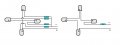
Here are two alternatives for wiring the LED's within the cavity. And if there's room for LED's to lay sideways there's also room for resistors to lay inside there as well. But if you want, you can have the resistor(s) outside. You can run a single positive and a single negative into the cavity OR you can run five wires into the cavity.
Actually, you can also wire up two LED's in series and the other two in series and have the two series LED's in parallel with each other if you feel the need to reduce the amount of hardware in or around the back side. Personally, I'd opt for the 4 in series as shown on the right. I used resistors calculated for 10 mA at 12 V.
Here are two alternatives for wiring the LED's within the cavity. And if there's room for LED's to lay sideways there's also room for resistors to lay inside there as well. But if you want, you can have the resistor(s) outside. You can run a single positive and a single negative into the cavity OR you can run five wires into the cavity.
Actually, you can also wire up two LED's in series and the other two in series and have the two series LED's in parallel with each other if you feel the need to reduce the amount of hardware in or around the back side. Personally, I'd opt for the 4 in series as shown on the right. I used resistors calculated for 10 mA at 12 V.View attachment 118305
Thanks Tonyr1084. I'm using 5v LED's and I've got 3.3Ohm resistors. If I were to use 8 (or even 12) LED's would a single 300Ohm resistor (in the example on the right) suffice?
@AlbertHall The diameter is 0.1mm, barely large enough to poke the battery pack wires through.
I've had to stop using Photobucket, I can't be doing with its ad heavy pop-up bullshit any more.
EDIT
I just tried a quick rough arrangement of that example, using one resistor and nothing lights up. Two AA batteries is enough to light up four LED's right? Because I can't even light up two of them. Thinking the resistors I'm using are no good, it says 3.3Ohm on the label but I assume that just means 330Ohm? Anyway I would have thought I could like up two LED's joined together without a resistor but none of them light up.
Maybe I need a 9 volt battery then? I'd like to arrange 12 white LED's (the more the better) as in Tonyr1084's example using just ONE resistor. I can make that all fit under the disc platter I think using the only available 0.1mm holes for the two wires from the battery mounted on the back of the HDD and heat shrink it all.

 Facebook
 Google
 GitHub
 Linkedin