noob and oscilloscope

Ya’akov

Joined Jan 27, 2019
10,241
Thank you again for your guidance Yaakov. Please tell me what advantages that the Siglent has over the Rigol.
(I am not questioning you advice; just hoping to learn.)

I now take it as gospel that a newer scope is the better choice. (Even though microscopes, etc are the opposite.) :)
The Siglent has a better reputation than the Rigol among users, so far as I can tell. Also, if I am going to advise you, I need to make it based on my experience, and I know the Siglent is a good scope.

If you had the Rigol, I am sure you'd find it good, but I do believe, among entry level scopes, the Siglent seems to win on performance and features overall.
 

atferrari

Joined Jan 6, 2004
5,012
Thinking of my own experience as a long time self trained idiot, try to buy a DSO.
In my case, having the possibility to capture frames at will allowed to progress incredibly fast when exploring digital protocols (PS/2 and others).
 

MrChips

Joined Oct 2, 2009
34,829
If you are willing to wait, I would suggest shopping around. They do occasionally go on sale.
Don't forget to include the cost of shipping.
 

Ya’akov

Joined Jan 27, 2019
10,241
OOPs, NM

I thought the Tektronix 2465 DMS quad-trace Oscilloscope was digital. :(
It's a nice scope but as long as it has a CRT it's too old to be in the class you are looking for. I have a nice HP digital scope that has a CRT and it would be marginal for neophyte use because it came before the readily available computer power that makes the new DSOs so capable and user friendly.
 

MisterBill2

Joined Jan 23, 2018
27,584
Ithink that is the same model of Kenwood amplifier that I was given many years ago because it quit working and the quote to repair it was excessive. No service information was available so I was on my own. No parts looked failed, either. So I examined the bottom of the circuit board and saw many failed connections. re-soldering every connection took about 15 minutes and it worked perfectly after that. A small hot iron and patience at gaining access to the underside of the PCB were the technical requirements, and a foot of good solder. There were no failed parts. , many failed connections in the power supply section.

This might not apply in your instance but it is easy to spot and simple to repair.
 

Thread Starter

v1x2w3

Joined Jan 20, 2007
54
This might not apply in your instance but it is easy to spot and simple to repair.
Looking at the circuit boards and simple layout is what prompted me to jump into audio repair with zero experience.
I've done simple soldering only but with the multiple youtube videos doing even the relatively limited production KR-7400 and, of course, awesome support from folks here at AAC, I'm ready to jump into stereo repair! (OLD, no surface mount foolishness!)
 

MrChips

Joined Oct 2, 2009
34,829
@Yaakov makes some valid points about a modern DSO for future work.

If you want to get wet doing audio repairs then I would not be in such a rush to lay out $350 for a DSO.
I would focus on the following:

1) DMM
2) signal generator (e.g. sine wave generator) or signal source (e.g. mp3 player)
3) signal tracer (inexpensive audio amplifier, e.g. computer powered speakers)
4) capacitance meter and/or ESR meter
5) finally, an inexpensive oscilloscope, analog 20MHz scope will do fine

For general hobby experimenting, a variable bench power supply comes in handy.
 

MisterBill2

Joined Jan 23, 2018
27,584
Most of my service work is done with the digital meter. Good probes with useful points are valuable, poor probes cause grief. Beyond that, a schematic diagram is valuable, which I was not able to locate for the Kenwood Amp. In fact, they did not even admit to having produced it. Fortunately the many poor solder joints were very easy to repair. But a clean well tinned tip is mandatory, otherwise good soldering is very difficult.
 

MaxHeadRoom

Joined Jul 18, 2013
30,679
I picked up one of the small hand held DSO 'scopes for general use to save lugging a heavy Tektronix around.
Does the job for the simple work/circuits I am playing around with now.
 

Ya’akov

Joined Jan 27, 2019
10,241
@Yaakov makes some valid points about a modern DSO for future work.

If you want to get wet doing audio repairs then I would not be in such a rush to lay out $350 for a DSO.
I would focus on the following:

1) DMM
2) signal generator (e.g. sine wave generator) or signal source (e.g. mp3 player)
3) signal tracer (inexpensive audio amplifier, e.g. computer powered speakers)
4) capacitance meter and/or ESR meter
5) finally, an inexpensive oscilloscope, analog 20MHz scope will do fine

For general hobby experimenting, a variable bench power supply comes in handy.
i agree with @MrChips but to be clear, were I recommending a "cheap 20MHz oscilloscope" I would still not recommend a cheap, 20MHz CRO. For audio work, you want to be able to check the waveform at various stages for distortion and that is a very minimal job for a scope

But the CRO can still be a confusing mass of knobs and switches and even a small mistake (turning down the intensity, or moving the trace out of view) can, to the neophyte make the scope look broken and take considerable time to work out.

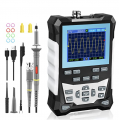
So, I would be inclined to recommend one fo the cheap and cheerful handheld scopes, like this one:

1643877574465.png
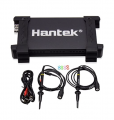
or, if it fit the circumstances, s USB scope like this one:
1643877803433.png
Each has its advantages. The handheld scope is a toolbox item and could be used for a lot of things, like car repair and small spaces that the UBS scope would be a pain for. The USB scope has two channels and the computer based features are very useful.

In any case, if you don't already have a good DMM, an LCR meter of some sort, and some to inject and detect signals (this lat one, the generator and tracer are going to be more important than a scope in audio repair work) and buying them would mean not buying the better scope, buy them, @MrChips is right.


Thread Starter

v1x2w3

Joined Jan 20, 2007
54
I would focus on the following:

1) DMM
2) signal generator (e.g. sine wave generator) or signal source (e.g. mp3 player)
3) signal tracer (inexpensive audio amplifier, e.g. computer powered speakers)
4) capacitance meter and/or ESR meter
5) finally, an inexpensive oscilloscope, analog 20MHz scope will do fine

For general hobby experimenting, a variable bench power supply comes in handy.

While I don't welcome spending more, I do see that your point is valid. 1: I have a Klein MM400 that does have capacitance capabilities but in-circuit testing would be awesome.. The rest I will look into. Thank you
 

MisterBill2

Joined Jan 23, 2018
27,584
If you are servicing any portable audio devices that are battery powered you will also need an adequate DC power supply. One with the ability to monitor current and voltage will be the most useful, and an adjustable current limit function can prevent causing damage if there are problems. A lack of adequate power makes any diagnostic efforts much harder.
 

Thread Starter

v1x2w3

Joined Jan 20, 2007
54

Attachments

Ya’akov

Joined Jan 27, 2019
10,241
It suddenly occurred to me that a warning for the future is appropriate:

Before attaching your oscilloscope’s probe (tip or ground) to any powered circuit be sure you know what you are connecting to.

The scope probe ground will be tied to your electrical systems earth ground througet the oulet’s third pin. In some power circuits this means there will be a high potential between your scope at what you are probing. This can be very bad.

It isn’t something you have to worry about with just a little forethought and study.

Here is a good video that explains the whole thing, worth watching:

 
Top