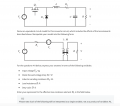
Nonideal Buck Converter

Thread Starter

Box-O-Rocks

Joined Jul 14, 2022
13
Hello, I am having trouble with getting the proper expressions. I have an nonideal buck converter (attached) Based on the model and expressions provided, I came up with Re = D^2*RL or RL (neither is correct), Ve = D*VF or VF (neither is correct), M = D (correct), V= D*(Vg-VF)*(R/(R+D^2*(RL))) (not correct), and without getting the other answers correct i really can't solve for the efficiency in #8.

Could someone explain where I am going wrong?
 

Attachments

MrAl

Joined Jun 17, 2014
13,667
Hello, I am having trouble with getting the proper expressions. I have an nonideal buck converter (attached) Based on the model and expressions provided, I came up with Re = D^2*RL or RL (neither is correct), Ve = D*VF or VF (neither is correct), M = D (correct), V= D*(Vg-VF)*(R/(R+D^2*(RL))) (not correct), and without getting the other answers correct i really can't solve for the efficiency in #8.

Could someone explain where I am going wrong?
Hi,

There is a good pdf on the web somewhere if you do a search, but to get you started you can try this first.

Ve is not really VF because VF is only in effect for part of the entire switching cycle. That means it cannot be constant because if it was it would always be subtracting the same value from Vg, which can't be right because it's not always in effect, and the time period it is in effect changes as the duty cycle changes. You may have figured this out already.
What you could do is, for now, assume a 50 percent duty cycle, then see if you can figure out the value of Ve based on the diode and the switching duty cycle. Then, bump it up to maybe 60 percent and see how it changes. You could probably figure out the right expression then.
At 50 percent for example, the full voltage will get though half the time while the diode drop will reduce the effective input for the other half of the time.
Here is something else interesting about that diode voltage VF and Ve:
At 100 percent duty cycle the diode is never in the circuit but
at 0 percent duty cycle the diode is always in the circuit (in the purely theoretical sense that is) and the circuit never gets any input from the input voltage Vg.
So in one case you have the diode out of the circuit and the input source Vg in the circuit, and in the other case you have the diode in the circuit and Vg not part of the circuit anymore. This is similar to what happens when the duty cycle is less than 100 but greater than 0 percent, except the 'on' and 'off' times for the diode will be of different periods.
 
Last edited:
Top