Noise Gen. with changed on-hand transistors

Thread Starter

PeteHL

Joined Dec 17, 2014
574
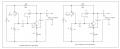
My revisions of a published design of a pink noise generator are as follows:

1. Vcc reduced from 18V to 15V
2. transistors Q1 and Q2, PN2222A substituted for 2N2712
3. Bias resistor R3 increased from 1 Meg-Ohm to 10 Meg-Ohm

The substituted transistors are what I have on hand. Resistance of R3 was increased to increase measured collector voltage of Q2 with respect to ground (after making the first two revisions) from about 1.5V to 7.5V.

Is the revised circuit still a legitimate pink noise generator, or are my revisions in error? Measuring with a DMM that reads AC voltage accurately to 1 kHz, the audio output level reads 48 mV which I would think is too low. Is this about the voltage output level that the circuit should produce?

Thanks in advance for your comments,
Pete
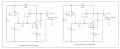
PN-GEN.png
 

Attachments

MrChips

Joined Oct 2, 2009
34,714
2N2712 is chosen for its reversed biased breakdown voltage.
Try different transistors for Q1, even among the same part number, until you get the desired results.
 

Thread Starter

PeteHL

Joined Dec 17, 2014
574
2N2712 is chosen for its reversed biased breakdown voltage.
Try different transistors for Q1, even among the same part number, until you get the desired results.
Connecting a crystal earphone to the output of the revised noise generator I can hear noise. Is that the desired result, or does the desired result need to be something more specific?

Thanks for the reply,
Pete
 

Thread Starter

PeteHL

Joined Dec 17, 2014
574
Pink noise is very specific.
https://en.wikipedia.org/wiki/Pink_noise

Are you very specific about your needs?
No, a signal that approaches what pink noise strictly is will be fine for the experimenting that I want to do. The description of the published circuit (in the Encyclopedia of Electronic Circuits, Vol. 1 by Graf) points to including C2 so that the noise is similar to pink noise. This has to do with modifying stereo, so I need a signal something like one channel of a stereo music recording, but more constant.

Pink noise can be considered to be analogous to music, so it is said.
 
Last edited:

Thread Starter

PeteHL

Joined Dec 17, 2014
574
Bordodyno,

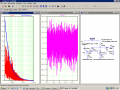
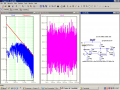
Thank you for the simulation. In your simulation where you have R4 = 10 meg-Ohm, this results in DC voltage of the collector (bias voltage) relative to ground equal to 500 mV. That I believe would make the transistor amp Q2 non-linear.

There is no reference that I have seen saying how pink noise should look in a bode plot. On a RTA, pink noise is displayed as a flat (horizontal) line according to one of my texts. I certainly don't own a RTA! nor am I likely to ever.

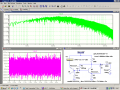
In a simulation of the generator published in Pop Electronics, the bode plot is a hill with a peak at about 500 Hz. Sorry, I can't export the graph from the program.

Edit: Rod Elliott strikes again! According to what he says in the linked article, the low-pass function of a pink noise generator should roll-off at 3 dB per octave.http://sound.whsites.net/project11.htm
 
Last edited:

#12

Joined Nov 30, 2010
18,224
That I believe would make the transistor amp Q2 non-linear.
An yet, you're looking at a perfectly symmetrical output voltage!
Here's the trick: The R2 R4 network is a biasing method where, if the transistor has enough gain to saturate, the base current diminishes to stop that from happening as the collector voltage diminishes. It's kind of self regulating and it works nicely for low AC voltages. In this case, the output voltage is only 4% of Vcc.

ps, you notify a person with an @ symbol like this: @Bordodynov
pss, Check the labeling on the axis of those graphs you saw. The only way to make a log function look like a straight line is to use a logarithmic graph.
 

Thread Starter

PeteHL

Joined Dec 17, 2014
574
@#12

Thanks for cluing me in to what the "@(member)" is all about, I noticed that, and wondered what it meant.

The green trace in Bordodynov's post #9 is basically what I had seen in my simulation of the generator published in Pop Electronics. Compare that to the graph of Fig. 2 of Elliott's article. The pink noise of the Pop Electronics circuit is only very, very approximate.

My plan is make the first stage of the generator that I'm building the circuit in Bordodynov's post #9, except R2 revised equals 1 Meg-Ohm, R4 revised equals 10k and eliminate C2. Then the second stage is the further amplification and filtering according to Rod Elliott's Fig. 1 in his article linked to in my post #7.
 
Last edited:

davideather

Joined Dec 12, 2016
33
My revisions of a published design of a pink noise generator are as follows:

1. Vcc reduced from 18V to 15V
2. transistors Q1 and Q2, PN2222A substituted for 2N2712
3. Bias resistor R3 increased from 1 Meg-Ohm to 10 Meg-Ohm

The substituted transistors are what I have on hand. Resistance of R3 was increased to increase measured collector voltage of Q2 with respect to ground (after making the first two revisions) from about 1.5V to 7.5V.

Is the revised circuit still a legitimate pink noise generator, or are my revisions in error? Measuring with a DMM that reads AC voltage accurately to 1 kHz, the audio output level reads 48 mV which I would think is too low. Is this about the voltage output level that the circuit should produce?

Thanks in advance for your comments,
Pete
View attachment 130652
My revisions of a published design of a pink noise generator are as follows:

1. Vcc reduced from 18V to 15V
2. transistors Q1 and Q2, PN2222A substituted for 2N2712
3. Bias resistor R3 increased from 1 Meg-Ohm to 10 Meg-Ohm

The substituted transistors are what I have on hand. Resistance of R3 was increased to increase measured collector voltage of Q2 with respect to ground (after making the first two revisions) from about 1.5V to 7.5V.

Is the revised circuit still a legitimate pink noise generator, or are my revisions in error? Measuring with a DMM that reads AC voltage accurately to 1 kHz, the audio output level reads 48 mV which I would think is too low. Is this about the voltage output level that the circuit should produce?

Thanks in advance for your comments,
Pete
View attachment 130652

Other than R3 being too high (ideally Hfe X R2 i.e 3.3M) it looks that everything is find. 48mV output is OK. Don't keep trying new transistors!. They will all start of with higher output which will then drop at a rate of approximately log time but once they have had their e-b junction break down then they are stuffed for anything else - measure the Hfe before you use one and then after you have used it for a minute.
 

Thread Starter

PeteHL

Joined Dec 17, 2014
574
@davideather,

Unfortunately Bordodyno in his post #12 assigned different numbers to the resistors of the circuit than I did in my first post. So unless you say which schematic diagram you are referring to, then I have difficulty understanding.
 

davideather

Joined Dec 12, 2016
33
in your first post r3 is a 1meg resistor which you replaced with a 10meg resistor, which is too high, but not super critical because of the feedback. You would normally want to bias the output to half of the supply voltage i.e 7.5v in your case. So 7.5v/100k = 75 uA through the collector of q2. or DC bias and at 75uA we can simply ignore the effect of r4 - it will only produce 0.1% error which is nothing compared to 5% or 10% components. From the data sheet the pn2222 will have a minimum gain of 35 @ 100 uA. which will be about right considering the trade offs of using lower current but probably having something closer to a typical gain figure. So r3 = (7.5v -0.67v)/(75uA / 35) which equals 3.19M or 3.3M as the closest e12 value. The easy way to get approximately the same answer is get the collector resistor r2 and multiply it by the transistor gain. *round down by 10% because you didn't account for Vbe of Q2
 

Thread Starter

PeteHL

Joined Dec 17, 2014
574
@davideather,
Thanks for walking me through that configuring of the resistors. As in my post #11, I ultimately chose rev.R2 = 10k and rev.R3 = 1M. I lowered resistance of R2 by a factor of 10 because I was measuring a very high voltage drop across R2 and I do know that it should be about half of the supply voltage.

Working from R2 = 10k and wanting about a 7.5V drop across it, that makes collector current = 0.75 mA. With that higher current than what you did, and looking at the specs for hFE, I chose hFE= 100. Then

Ib = Ic / hFE = 0.75mA / 100 = 7.5 microA

Making R3 = 1M yields about 7.5 microA base current, given a voltage drop across R2 = 7.5V.

Off and on over the years I have made some effort to understand configuring a single transistor as an amplifier, but never really got very far because of op amps. Still, if I'm not drawn away too much to other things, I would enjoy designing some circuit completely with discrete transistors.

Thank you,
Pete
 

davideather

Joined Dec 12, 2016
33
Your welcome. (normally r2 should drop about 1/2 the supply voltage - but for your case with a 50mV signal you do have a lot of wiggle room) I myself prefer op-amps for all the jelly-bean jobs and normally only go to discrete transistors only if there is a special reason - and normally the op amp turns out cheaper.
 
Top