Nixie clocks

Thread Starter

Jonlate

Joined Dec 21, 2017
121
so I know I haven’t even started my useless box yet, but while researching I came across Nixie Clocks.
They look great, however the tubes are way expensive, and some are supposedly not meant to be that great.
The IN-1 and IN-4 are meant to burn out quite quick.
The IN-8 isn’t meant to be that reliable.
And the IN 12, 14, 16 are okay, but don’t like the backwards 5 for a 2 in the IN-14
The IN -18 I would love as a 6 digit clock, but are way way way over my head.

This leave me the ZM series, as cheaper alternatives, but know nothing about how they are in a clock.

So does anyone have any recent experience with nixies? Where to buy the tubes? Where to get a PCB from? If you can get the board and components in one kit?

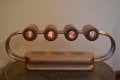
Eventually I would like it to look like this.

Any help or direction gratefully received
 

Attachments

gramps

Joined Dec 8, 2014
86
I'm not really up on Nixie tubes, but I just searched "nixie" on Thingiverse.com and got a zillion hits. Perhaps you can glean some info there. Have a look at instructables.com also.
 

jpanhalt

Joined Jan 18, 2008
11,087
Experience: decades ago. Consider something very similar, namely "vacuum fluorescent displays". They give the same brightness, are readable under all conditions, and are available at reasonable prices on eBay. For example: https://www.ebay.com/itm/10-Bit-Vac...458064?hash=item2caeeef990:g:ELwAAOSwbYZXeduo The characters will likely be smaller and won't have that nixie glow. Like nixie's, they use more power than LCD and you will need a driver.

I picked up an NOS Futaba display recently that way.

John
 

Thread Starter

Jonlate

Joined Dec 21, 2017
121
So I have purchased my board kit, and tubes, but I have another question.

What is the thinnest size wire I can use to wire it up?

My design is to feed the wires down a small diameter peice if copper tubing, but it’s lot of wires to get down the hole.

Should I use multi strand wire or solid wire? What size?

Thanks hopefully for your answers.
 

ebp

Joined Feb 8, 2018
2,332
The whole idea behind using Nixie tubes is the "steam punk" look. VFDs just won't do - yet. Maybe in another 50 years.

You can use very fine wire for Nixies. 30 AWG would be more than sufficient and it makes no difference if it is solid or stranded. The issue is insulation. A good quality magnet wire handled carefully should be OK. Fluoropolymer-insulated (e.g. Kynar) wire-wrap wire is a better alternative. For true steam punky look you probably should use double-cotton-covered magnet wire, but don't count on being able to find it.

edit - 30 AWG is 10 mils or 0.25 mm in diameter
 

Thread Starter

Jonlate

Joined Dec 21, 2017
121
Could I use cat 5 or 6 cabling?
It’s in a nice tidy package and will be ideal for pushing down the inside of copper tube.
Thanks for the idea of the magnet wire, I will look into that. I am worried that the coating may rub off when pushing it down tubing and around bends. I would hate for that to happen and spend ages trouble shooting a worn off coating!
Maybe I can bundle it and cover each section in electrical tape.

Will google wire types now I know a thickness I need.
 

ebp

Joined Feb 8, 2018
2,332
Cat 5 cable should be OK. The individual conductors are insulated with polypropylene which has excellent dielectric strength and is thick enough for an actual breakdown voltage of several thousand volts - but wire insulation ratings are always vastly more conservative because of concerns for imperfections and minor mechanical damage. Cat 5 conductors are normally 24 AWG.

Magnet wire, particularly the sort used for motor winding, has pretty tough insulation, but care is still required. You would certainly want to be careful with deburring your copper tubes.

Kynar and similar materials are tough to strip, and the sort of tool Bernard mentioned can certainly be helpful. The low-cost types I've used have a sort of slot stripper that works quite well but it needs to be matched to the conductor gauge. There are some very nice strippers that you use by inserting the wire in a hole in the end, squeezing the stripper closed and pulling. The ST-450 from Jonard is adjustable - but several tens of dollars.
 

Thread Starter

Jonlate

Joined Dec 21, 2017
121
I do have a fairly good wire stripper, with different holes for different wire thicknesses.

When googling Kynar wire, I saw a lot of wire wrappers, so instead of soldering you wrap the wire around a post.
Does anyone think you could use this system on the wires that come out the bottom of a Nixie tube, instead of soldering the wires onto a socket?

Thanks
 

ebp

Joined Feb 8, 2018
2,332
Good wire wrap wire that has been recently stripped is extremely easy to solder because it is silver plated. Kynar has a high melting point, so the insulation does not shrink back when soldered if moderate care is used. Polyvinyl chloride (PVC) insulation can shrink back dramatically. "Irradiated" PVC is much better in this regard and probably would be quite suitable for Nixie wiring. Polypropylene also melts at a low temperature and will shrink back, sometimes badly, sometimes tolerably.

Reliable wire wrap generally involves pins with square or rectangular cross-section. The sharp corners result in multiple gas-tight contacts between the wire and the pin, which is highly reliable. If you attempt to wrap a round pin the connection will always be dubious.

Kynar is a brand name for a specific fluoropolymer, polyvinylidene fluoride (PVDF), though it is often used as if it were a generic term. It was/is quite popular for wire wrap wire because of a good combination of properties. Tefzel, ethylene-tetrafluoroethylene (ETFE), is another brand name for a polymer also used on wire wrap wire.
 

Bernard

Joined Aug 7, 2008
5,784
I use a mixture of wire wrap methods; with square posts it's 10 turns, on round or other 5 turns & solder, small holes like tube sockets insert, bend over & solder.
WW posts are available to insert in circuit board with post top & bottom or post & slot.
 
Last edited:
Top